
Task Automation: How to Cut Repetitive Work
Task automation saves time, gets work done faster, and reduces errors. Learn how to automate repetitive tasks step-by-step and how to decide what to automate.
Updated May 26, 2026

According to a Clutch survey of 250 full-time employees, 74% of professionals use AI regularly at work. But only 32% have received formal AI training from their employers.
That gap? It's costing you money and lost potential.
When employees figure out AI on their own, you get inconsistent results and security risks. On the other hand, companies investing in structured education transform their teams into AI power users who know exactly when, how, and why to leverage these tools.
Looking for a Artificial Intelligence agency?
Compare our list of top Artificial Intelligence companies near you
AI is already prevalent across industries. It's no longer a good-to-have, but a necessity to remain competitive.
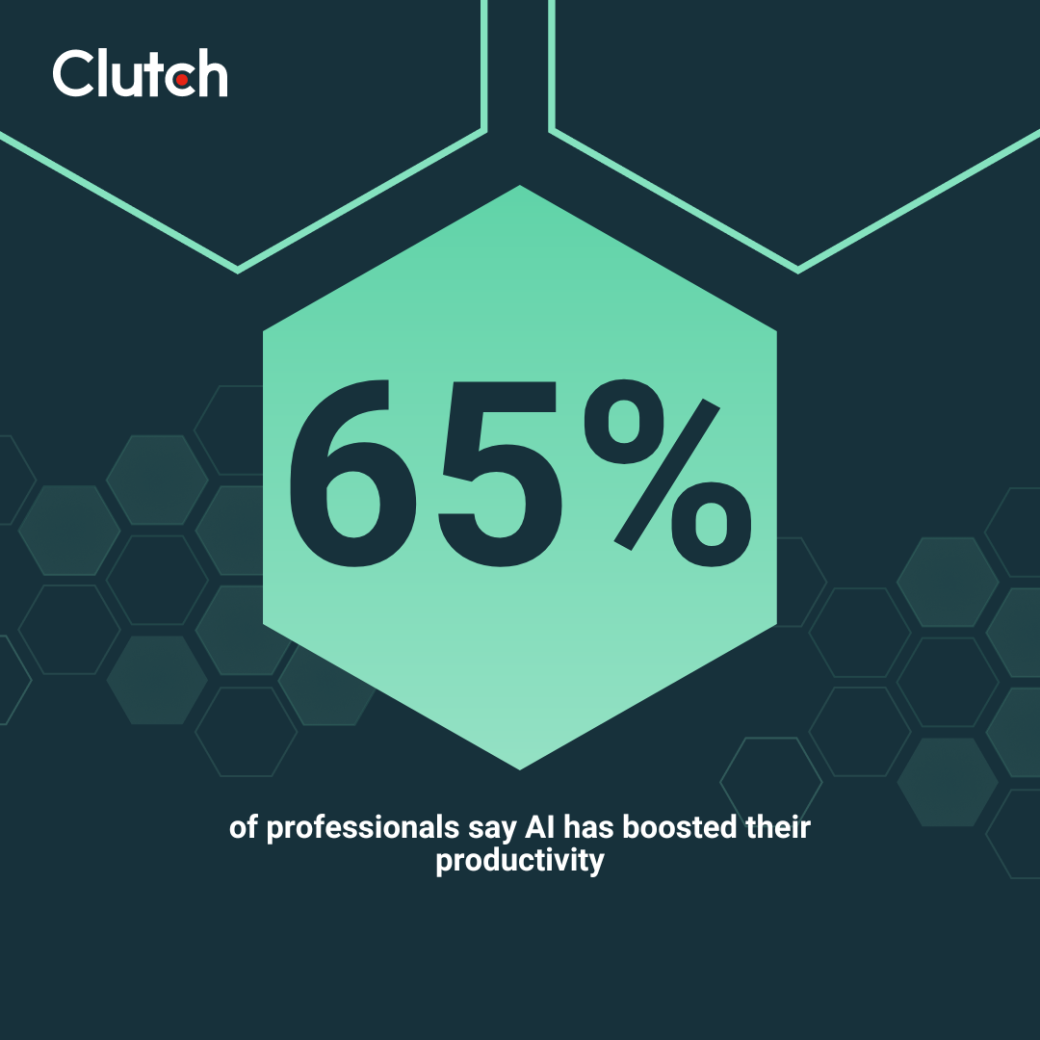
About 65% of professionals say AI has boosted their productivity. But raw statistics miss the real story happening inside organizations that get training right versus those that don't.
Companies with formal AI education programs see something remarkable happen. Their teams stop treating AI like magic or a threat. Instead, they develop what you actually want: healthy skepticism paired with strategic deployment. They question outputs. They verify results. They know when to lean on AI and when to trust their expertise.
Without training? You get chaos. Sales teams might share sensitive client data with public models, and engineers might trust AI-generated code without proper testing. Each department creates its own informal "best practices" that may not align with your business goals.
When your team understands how AI works, they make smarter decisions about when to use it. Employees who receive AI training are 33% more likely to trust and adopt its tools effectively.
The alternative? Fear-based resistance or blind acceptance. Neither serves your business. Training creates the middle ground where innovation meets judgment, where your team leverages AI without losing the critical thinking that makes them valuable in the first place.
Skepticism about AI often stems from legitimate concerns that training needs to address head-on.
Black box algorithms make executives nervous, and they should. When AI recommends cutting a product line or reallocating budget, your team needs to understand the reasoning. Without understanding the process, employees worry about trusting recommendations they can't verify.
Training demystifies this process and builds employee trust. It shows what data influences outputs, and where human judgment needs to override algorithmic suggestions. Your employees learn to demand explainability from AI tools, not just accept mysterious recommendations.
AI hallucinations are real problems. Models confidently present false information as fact and cite non-existent sources. They mix up critical details that could tank a client's presentation or strategic decision.
Your teams need to recognize these failure modes. Training teaches fact-checking workflows and the art of prompt engineering that reduces errors.
Nobody wants to become obsolete. Many employees worry about AI gradually taking over their decision-making authority until they're just button-pushers executing algorithmic commands.
But reality is different. "I see AI as a strong helper, not the final decision-maker," says Harish Kumar, VP of Growth & Product at DianApps Technologies Pvt. Ltd. "AI can also carry forward biases from its training data and sometimes produce confident but wrong logic."
Kumar's perspective captures what effective training teaches: AI amplifies human capability rather than replacing it. Your workforce learns to maintain control, set boundaries, and know when their expertise trumps algorithmic suggestions.
AI that works brilliantly for customer service might fail spectacularly at financial forecasting. Without training, employees assume one success means universal applicability.
AI education sets realistic expectations. Teams learn which tasks suit AI's current capabilities and which require traditional approaches. They understand why a model optimized for marketing copy can't suddenly analyze supply chain data.
Your company values matter. But AI doesn't inherently understand them.
Training addresses this disconnect directly. Employees learn to spot potential ethical issues and escalate concerns when AI outputs conflict with your standards.
AI education can't be a one-size-fits-all module. You need a strategic approach that's relevant and applicable to daily work.
Forget vendor demos disguised as training. Your first workshops need substance, not sales pitches.
Your CFO doesn't need the same AI skills as your CMO. So, map AI applications to actual job functions.
Sales leaders, for example, need to understand conversation intelligence platforms and predictive lead scoring. Operations executives should focus on process automation and predictive maintenance, and HR needs bias detection in recruitment algorithms and employee sentiment analysis.
Develop competency levels for each role. Not everyone needs to write Python or understand neural networks. Define what "AI literate," "AI capable," and "AI expert" mean for different positions. Set clear expectations about who needs which level.
Partner with department heads to identify real projects for practice. Each learning path should culminate in an actual AI implementation relevant to that role.
Also, use modular learning to maintain engagement. It could be a mix of videos, interactive simulations, and short courses.
Theory without practice is useless. Set up sandbox environments where teams can experiment without consequences. Give them access to AI tools with training data, not production systems. Let them break things and push boundaries safely.
Create "AI Champions" within each department. These are not IT people, but actual users who become internal resources. Often, seasoned professionals who understand business context make the best champions. They translate AI capabilities into departmental value better than any external trainer.
Run monthly challenges with real business problems. For example, "Use AI to reduce our RFP (Request for Proposal) response time by 30%" or "Find patterns in our customer churn data." Public recognition for creative AI applications motivates continued learning better than mandates.
Document and share wins broadly. When procurement uses AI to identify contract risks 70% faster, everyone should know. When marketing personalizes campaigns at scale, broadcast that success. Real examples from colleagues carry more weight than case studies from other companies.
You don't need to build everything from scratch. Smart partnerships often accelerate capability development.
Quality online AI training resources already exist; use them strategically. For instance, platforms like Coursera and LinkedIn Learning offer specialized AI courses for business professionals. But evaluate learning platforms based on business relevance, not course catalogs.
Bring in consultants for specialized training, but set clear deliverables.
Ensure knowledge transfer is part of the engagement. Consultants should leave your team more capable, not more dependent.
Stay connected to the broader AI community through industry conferences and webinars. Collaborative learning through trade associations or professional networks accelerates everyone's progress.
Send different people to different events, then require knowledge sharing. For instance, the person who attends the AI in Supply Chain summit presents key insights to operations teams. Marketing's representative at the Customer Intelligence conference shares applicable tactics. This way, you maximize learning per dollar spent.
AI training can't be a project with an end date. It's an ongoing organizational capability you need to nurture.
To build a culture of continuous learning, link AI competency to career progression explicitly. Include AI skills in performance reviews and promote people who successfully integrate AI into their workflows. Make it clear that AI fluency is a leadership requirement, not an optional skill.
Another great idea is to create internal certification programs that mean something. Not participation trophies, but rigorous assessments that demonstrate real capability.
Develop internal mentorship programs pairing AI champions with learners. This creates sustainable knowledge transfer and builds a network of AI advocates throughout your organization.
Lastly, establish AI education as part of regular L&D programs. Traditional IT procurement cycles can't keep pace with AI innovation. Give teams flexibility to test solutions quickly, fail fast, and scale what works.
Companies are splitting into two camps right now: those with AI-capable workforces and those hoping their employees figure it out alone.
The gap widens daily. While untrained teams waste hours on trial-and-error, educated workforces deploy AI strategically. They automate the mundane and accelerate everything in between. More importantly, they do it safely as per your business objectives.
AI training isn't about turning every employee into an AI expert. It's about creating informed users who leverage these tools intelligently. Your investment in education determines whether AI becomes your competitive advantage or your competitors' opportunity.
Start now. Start small if necessary, but start. Because your employees are already using AI. The only question is whether they're using it well.