
Task Automation: How to Cut Repetitive Work
Task automation saves time, gets work done faster, and reduces errors. Learn how to automate repetitive tasks step-by-step and how to decide what to automate.
Updated October 20, 2026

The next wave of customer support is here: AI scheduling assistants. They offer a convenient way for customers to book appointments at any time, but how do you effectively implement one for your service business?
One glance in the mirror tells you it's time for a haircut. But instead of making a call, you visit your stylist's website, and an AI scheduling assistant steps in to help. It notes your availability, instantly scans their available appointments, and recommends a Monday appointment. Within seconds, you're taken care of—without ever picking up the phone.
Sound like science fiction? It's not. AI scheduling agents are the next frontier in customer support. They're helping clients explore services, book appointments, and confirm pricing. These tools eliminate the need for long phone calls, providing immediate support without any wait time.
Looking for a Artificial Intelligence agency?
Compare our list of top Artificial Intelligence companies near you
In a recent Clutch survey on agentic commerce, 37% of consumers said they would likely use AI to schedule services. An additional 27% are open to the idea, depending on the service type.
According to Kieran Gilmurray, Expert AI Speaker of Champions Speakers Agency, "Booking is becoming the clearest near-term win for agents because it is a structured problem with high friction in the human journey." Consumers don't want to search for company phone numbers or sit on hold. They want to schedule an appointment and get back to daily life.
For service-based businesses eager to please their customers, integrating AI scheduling assistants makes sense. This guide provides actionable advice to get started with agentic scheduling without sacrificing customer trust or control.
An AI scheduling assistant engages visitors in conversational language while relying on the training data you provide. This data can include your website, calendar, support manual, and similar materials.
Using multistep decision and execution, AI scheduling tools can:
Every time an AI agent executes a task, it updates you in real time. Gilmurray explains, “A customer could ask an assistant to book a home service appointment next week after 6 PM, confirm the total price in advance, apply the correct cancellation policy, and add the appointment to their calendar. The booking is completed in one exchange rather than a series of emails, forms, and follow-ups.”
As you can imagine, this is a tremendous time-saver for businesses and customers.
Clutch data shows that 70% of consumers already use AI to shop online. AI chatbots help them research products, compare features, and find the best deals. The next step is service-based support, with scheduling being a natural fit.
Nearly two-thirds of Clutch survey participants indicated an interest in AI service agents. Of those surveyed, 37% would likely use AI for service scheduling, and 27% were open to it. This data supports demand for early adoption and the potential for increased usage.
Why are people receptive to AI scheduling agents? A few reasons include:
Consumers use AI to support daily tasks. They know that AI can save time, reduce their cognitive load, and help them compare options. Scheduling is another function that AI performs well while still keeping consumers in the driver's seat.
You can visualize customers interacting with your AI agent, booking appointments, and asking questions. But with AI still relatively new, should you take the plunge now to add it? Yes — and here's why.
Many service-based businesses haven't yet jumped on the AI agent booking train. Being among the first can give you better visibility among public chatbots. "If an [AI] assistant repeatedly selects your products, you gain a durable distribution advantage similar to early search engine optimization (SEO), but with fewer visible levers and stronger 'winners take most' dynamics," says Gilmurray.
Think of it like this: It's 2001, and you decide to list a few products on Amazon for sale. As an early adopter, you're quick to surface in results without a substantial investment in online ads.
Optimizing your website with AI booking tools sends a positive search signal to public chatbots such as ChatGPT or Claude. It tells them that your site is well-adapted for service support, which can enhance visibility in AI results.
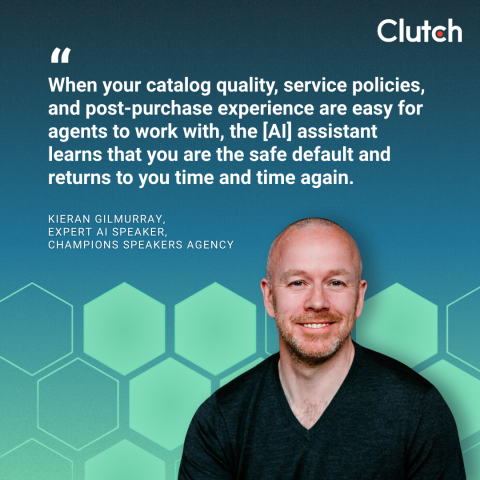
Gilmurray explains, "When your catalog quality, service policies, and post-purchase experience are easy for agents to work with, the [AI] assistant learns that you are the safe default and returns to you time and time again."
Translation: Users expect AI tools to provide them with a reliable experience. If your site hits all the marks, AI will continually surface it.
Reeling in new customers can be challenging, especially in a competitive service environment. Any business that's developed marketing journeys complete with email, social media, SEO, and online ads can tell you that. But with AI tools, some of that work drops to the wayside.
"When agents handle comparison, configuration, and checkout, friction drops and intent is captured at the moment it forms, particularly for replenishment and routine purchases," says Gilmurray. Customers cut through the noise to get what they want, with less frustration.
AI scheduling is ideal for repeatable, low-risk services whose outcomes are reversible. However, consumer adoption drops with more complex and personal jobs. It won't stay like that forever, though — as the technology improves and more people interact with AI tools, the willingness to interact with AI agents will likely increase.
What service areas are ripe for AI-based automatic scheduling? Here's what Clutch data shows.
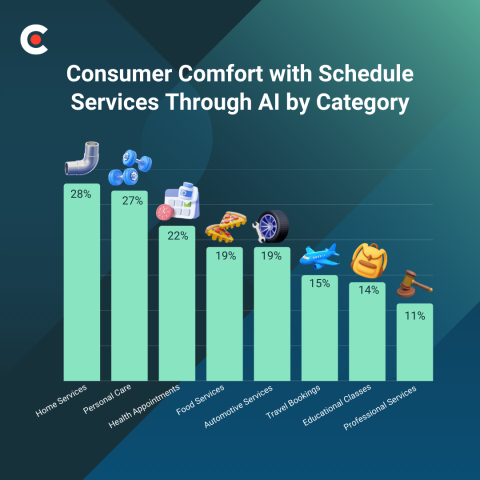
Top service categories where consumers are open to scheduling agents include home services and repairs (28% readiness) and personal care and fitness (27%).
Home services such as plumbing, cleaning, and HVAC checkups are transactional, time-bound, and easy to verify. And in the personal care and fitness category, consumers value the convenience of scheduling haircuts, spa appointments, and gym classes.
Clutch data shows lower consumer willingness to use AI support tools in these categories:
As AI agents become more ubiquitous, however, opinions and expectations in all areas may change.
What deters people from using AI for scheduling? Data privacy leads the list of reasons, with 63% of Clutch survey respondents citing concerns about buying through AI assistants. They may fear mistakes or feel a loss of agency in the purchase process.
Arranging services can feel riskier than buying products. For one, a service involves a time commitment. When a customer books an appointment, they're promising to be available at a specific time. But if the AI tool fails to coordinate the schedule, the provider may not be available to fulfill the service.
Another concern clients have is the company's policies. They may be hesitant to book appointments with companies that charge a fee for rescheduling or cancellation.
Gilmurray advises companies to prioritize AI tools that support customers, rather than make decisions for them. Gaining consumer trust is most important and is achievable through proper tool design.
Agentic scheduling is a solid fit for your business, and you'd like to try it. So where do you start?
AI tools examine websites differently from traditional search engines. They look for sites that are machine-readable and well-structured. To increase your chances of landing in chatbot results, create scannable content that's consistent across your entire website.
"A brand might be tempted to launch an AI assistant before its pricing rules, policies, or service availability are consistent across channels. But when an assistant gives different answers depending on where it looks, trust is lost immediately," cautions Gilmurray.
The lesson? Give your website a thorough review before introducing an AI agent. Check for accuracy, consistent pricing, and structured service attributes.
Website analytics may already be an essential part of your digital marketing stack. But with AI chatbots on the rise, it's critical to ensure your analytics package supports them.
"Add instrumentation that tells you when assistants are sending traffic, what they are recommending, and where customers drop," encourages Gilmurray. Insights can show you where website optimization is paying off and alert you to disruptions in the booking process.
Above all, verify that customers benefit from a solid user experience. This is accomplished by thoroughly integrating the AI agent into your existing support tools, which is why it's worth comparing the best appointment scheduling software on integration depth before you layer an agent on top. "The strongest experiences connect calendars, staffing, deposits, cancellation rules, and identity checks, so the agent can complete the booking end to end," advises Gilmurray. When the systems work together, customers don't need to take any further action.
Design your scheduling agent as an informative support tool that leaves final decisions to customers. Gilmurray refers to this as a "human control" model. "Give clear confirmations, an ability to edit constraints, and require a customer's explicit permission for purchasing or booking," he says. "This is how you earn trust while still capturing the efficiency upside."
Offering customers an easy way to make changes or cancellations is also important. No client wants to jump through hoops if there's a conflict, and they need to make an adjustment.
There may be times when a customer requires human assistance. "When exceptions arise, such as complex services or policy disputes, the experience is defined by how smoothly context is handed to a human. If the system blocks the user, customers will leave and often not return," explains Gilmurray. Providing clients with a simple way to connect with a live agent through the AI assistant can minimize frustration.
Customize agents to provide customers with clear explanations of pricing, service policies, and booking times. This promotes transparency and provides clients with the details they'd expect from a human customer support agent.
For instance, say a customer requests multiple services and a weekend appointment. The AI scheduling assistant could:
In this case, the customer receives clear information they can use to make a final booking decision.
AI tools can do more than book appointments. They can recommend services, support customer research, and facilitate purchases. With so much to offer, it's tempting to add all the bells and whistles to tool implementation. However, focus on getting the logistics organized first. See how customers react to the new tool and how it affects traffic driven by public chatbots. Trying to do too much may turn away clients and make it hard to identify what's working.
Companies see the benefits of AI scheduling assistants, and customers do, too. But implementing a scheduling agent isn't a guaranteed path to success. It requires careful thought and planning, with a focus on the tool's transparency, control, and value proposition.
Service businesses that adopt early are poised to gain an advantage. To start, website optimization is a must. AI assistants work best when they can read and interpret your site correctly.
To prepare your organization for agentic scheduling, hire a web design agency. Professional developers can refine your site with structured data and build trust-first AI experiences that please customers. With their assistance, you can feel comfortable knowing that your business is AI-ready.