
What Are AI Influencers? A Guide to Virtual Creators
AI influencers abound on social media. Clutch explains what they are, why brands partner with them, and whether people can tell them apart from human...
Updated August 24, 2026

Competition in the tech job market is fierce. The growth of AI means that the kinds of roles available are changing, and so are the skills employers are looking for. AI tools, when used correctly, can give applicants an edge.
In tech, the job market is quickly changing. AI is creating new opportunities, but it is also reshaping traditional career paths and reducing demand for some entry-level roles.
At the same time, job seekers are facing more competition than ever. While tech companies are hiring, applicant pools continue to grow, making it challenging for job seekers to stand out when applying.
Looking for a Artificial Intelligence agency?
Compare our list of top Artificial Intelligence companies near you
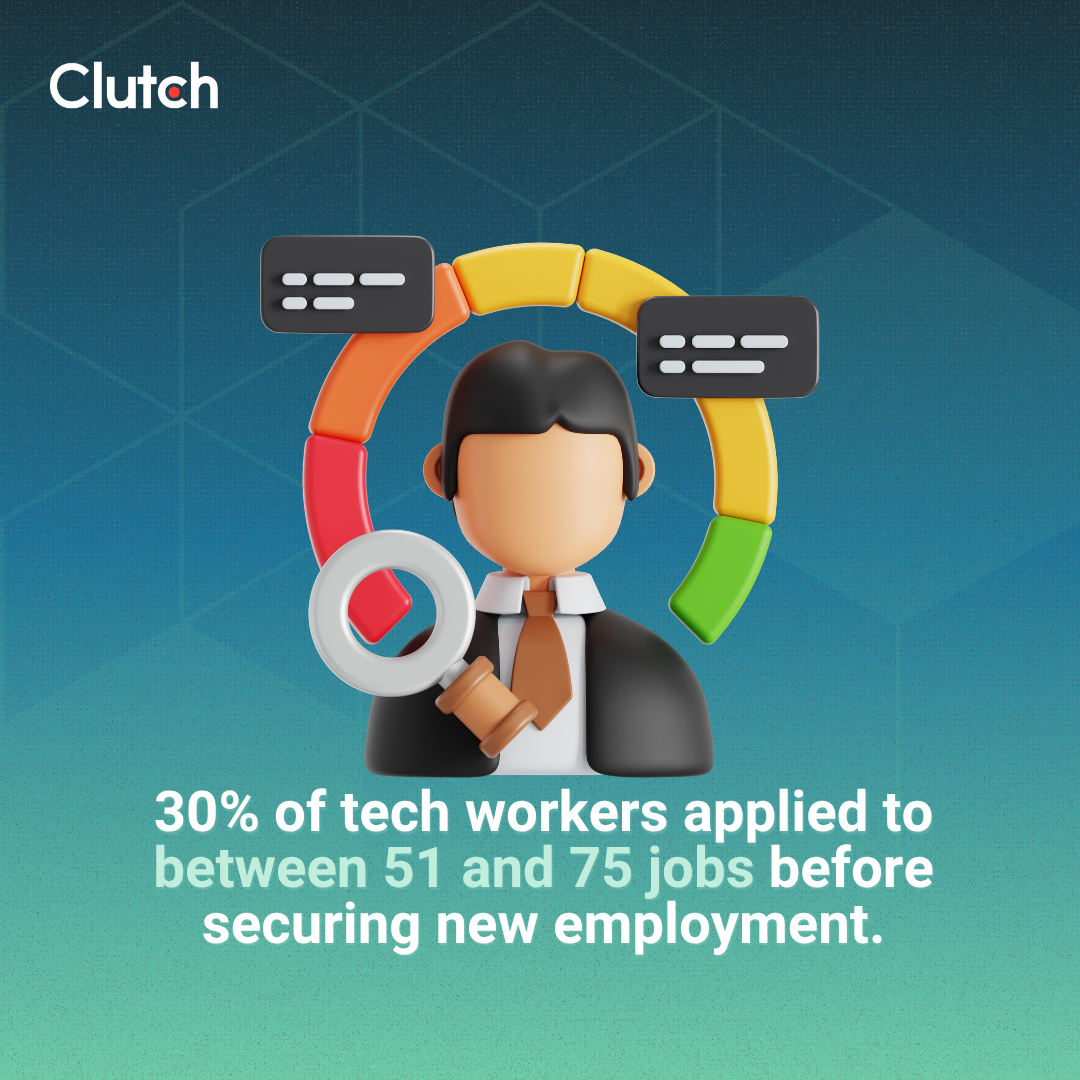
A Clutch study found that nearly 30% of tech workers applied to between 51 and 75 jobs before securing new employment, the highest rate among all industries.
Part of the reason may be because of how AI is transforming how companies hire. While job seekers shouldn’t fear these changes, they do need to understand how to adapt. Having the right skills is only the first step. Candidates also need to know how to stand out in AI-powered screening processes and make a strong impression on hiring teams.
Building a strong network, optimizing your resume for both AI tools and recruiters, and understanding what employers are looking for can help you find your next position.
Contrary to what some think, AI isn't destroying tech jobs. In fact, job postings in June 2026 are up 27% year-over-year, according to Dice's 2026 Tech Jobs Report. Yet plenty of skilled tech workers are struggling to find new employment or even to get to the interview phase.
AI may be creating new job opportunities, but it's also redefining what employers expect from candidates. According to Dice, 75% of tech job postings now include AI-related skill requirements. As AI becomes a standard part of the workplace, familiarity with these tools is quickly shifting from a competitive advantage to a baseline expectation, leaving those who haven't developed these skills at a growing disadvantage.
Employers value AI skills because they can significantly boost productivity. At the same time, those productivity gains are shrinking demand for many traditional roles, especially junior positions, as companies shift toward AI-focused and AI-assisted work. One mid-level engineer can now do the work of three junior developers using AI. For those just starting out in tech, it's getting harder to get a foot in the door.
In addition, job seekers are also using AI to easily apply to many jobs at a time. When companies might receive thousands of applications for one junior role, standing out from the crowd is harder than ever.
More than three-quarters (77%) of workers believe the companies they've applied to use AI to screen applications — and most of them are correct. For most job seekers, an applicant tracking system (ATS) is the first step in the hiring process.
After collecting your resume, the ATS scans for keywords and qualifications, and those that don't meet the requirements are screened out. Many ATS also produce a candidate ranking, so recruiters can focus on the top choices.
With this in mind, 80% of applicants have adjusted their resumes to optimize for AI.
Getting your resume past ATS isn't complicated, but you have to focus on giving the system what it's looking for:
AI has made it easy for candidates to tailor their resumes and bulk-apply to many jobs. With 30% of tech workers submitting 51-75 applications before finding a new job, hiring managers are overwhelmed.
ATS platforms help recruiters sort through overwhelming numbers of applications by identifying candidates who best fit the role. But when recruiters begin reviewing applications themselves, a personalized resume can make a stronger impression and set you apart.
Ninety-four percent (94%) of workers tailor their resume for each application. How well you tailor your resume matters. Adjust your employment, education, and projects sections to focus on the skills the specific employer is looking for.
If you are submitting a cover letter, make sure it has a personal touch. AI can assist with the initial structure, but take care that your voice comes through. Match your tone to the employer. A casual tone wouldn't be right for a large, conservative firm, but it might be perfect for a start-up.
As AI becomes a bigger part of hunting for a job, it's the human touch that can help you secure an interview. Tech is a fast-paced industry, and networking has always been an important skill. As firms drown in applications, connections are more important than ever for job hunters.
The people you know can help you gather information about a company and its culture, as well as the best way to apply. Companies take referrals seriously, too, and earning one may fast-track your application.
Networking is a marathon, not a sprint. Even if you aren't searching for a tech job in 2026, tending to your network now may pay off when you do want a new role.
Your existing network is likely broader than you think. Former colleagues, classmates, and cohorts from tech boot camps can all be resources for finding the right job opportunities and making it to the interview stage.
LinkedIn can be a valuable tool, but you need to use it strategically. When you look to connect with someone, try to personalize it by mentioning a common interest, mutual contact, or shared interest. Offer your help to contacts when you can instead of reaching out only when you need something.
When so much networking takes place over social media, face-to-face meetings can be especially powerful. Take advantage of any chances you get to catch up with someone in person, and push yourself to go to actual networking events once in a while.
A great way to build your network, especially if you're trying to break into a new niche, is to contribute to a technical community.
For instance, participating in niche Discord servers or Slack groups can help you grow your network and strengthen your skill set. By joining in a discussion or answering a question, you make an impression on those you're talking with as well as others reading your post. You don't need to join dozens of groups, either. Posting regularly over the course of a year in one group can be better than posting inconsistently across several.
Attending hackathons or contributing to open-source projects shows off your skills, as well as your ability to collaborate. Building in public, or documenting the process of what you're building and sharing projects, is a great way to get your work in front of others. Though it might be scary to share your missteps, building in public can also demonstrate your problem-solving skills.
Engineers in particular can benefit from maintaining a GitHub profile with active, well-documented projects. For many roles, established, consistent project success is more attractive than a polished resume might be. Your project list may even inspire hiring managers to contact you about opportunities, saving you the trouble of getting past the ATS.
If you're sending out plenty of personalized applications but having trouble getting any further, you may want to target smaller companies and startups. They don't receive as many applications as larger organizations and generally have fewer layers of leadership, making it more likely that an actual person will read your resume right away.
Start-ups move fast, so hiring managers often leverage their own personal networks to find candidates. What's more, hiring decisions may only come down to one or several people. Leaning on your own network can help you learn what opportunities are out there, and being proactive in your search can differentiate you from other candidates.
The skills tech workers need for success are changing. Companies are adjusting roles to focus less on basic tasks that AI can automate and more on high-level decisions.
Thankfully for applicants, these roles are also paying more. Postings that mention AI or machine learning have salaries $30,000 to $50,000 higher than those that don't.
Some of the skills with the highest demand growth are:
Because AI can help with lower-level tasks, employers are looking for niche skills over general proficiencies. Modern tech roles are less about implementation and more about strategy and architecture.
The most in-demand roles include:
Employers remain focused on the bottom line, especially as costs increase. Many of the hottest roles now have a direct impact on profits or cost efficiency.
Dice's report found that of the top seven skills referenced in tech job postings, five — including communication, troubleshooting, management, leadership, and problem-solving — are soft skills.
While employers are often looking for specific knowledge, they also want resilient applicants who learn quickly and work well with a team. That's why job seekers should highlight soft skills on their resume and other application materials.
When used strategically, AI can help you improve your chances of landing an interview. However, using AI to mass-produce generic applications can backfire, as recruiters often filter out resumes that contain obvious AI-generated content without meaningful human input.
"AI makes it easier to apply for more jobs, but sending more applications doesn't always improve your chances. When everyone uses AI to create applications quickly, it becomes harder for employers to see who is genuinely a good fit. AI should help people find the right jobs and present their real experience clearly, rather than simply helping them apply faster," says Deven Patel, Founder of Role.
Instead, job seekers can use AI as a tool to identify relevant opportunities, tailor their resumes, and strengthen their applications. In fact, 67% of workers who used AI to improve their job applications received an interview invitation, showing that AI can be most effective when it enhances rather than replaces the applicant’s own efforts.
For instance, you should be using AI to support:
Some tech companies set specific guidelines for AI use in applications. Make sure you stick within the boundaries of approved use.
Hiring managers for any tech role want applicants familiar with AI technology. No matter what level of job you're applying for, you should expect AI-specific questions.
Research the answers as if you already work there. AI programs can help you anticipate potential questions, as well as sharpen your answers, and AI mock interview programs can evaluate your performance.
You should also prepare for AI-led screening rounds. These are designed to augment or replace a traditional first interview round. Instead of hopping on a 20-minute phone call, you might complete a detailed interview that includes recording one or more brief videos.
As impersonal as an AI screening might feel, remember that there is a human at the other end of the process. Recruiters receive raw transcripts, as well as analytics and ranked lists of candidates.
While AI can help you prepare for an interview, it shouldn't replace your skills and effort. Companies want to know more about you, not your computer. Most companies are able to detect if you're using an AI copilot to help you answer questions or assist you in technical whiteboarding exercises.
The current tech job market is brutal, but it's not a contraction as much as a huge shift in what employers need. AI is changing the skills employers are looking for, but it also offers new tools to help your 2026 job search. By understanding this technology and leveraging it appropriately, you can better your chances of landing the tech job you're looking for.