
Task Automation: How to Cut Repetitive Work
Task automation saves time, gets work done faster, and reduces errors. Learn how to automate repetitive tasks step-by-step and how to decide what to automate.
Updated May 28, 2026

AI is now being used to complete tasks that once defined junior-level development roles. Without these responsibilities, many wonder how developers new to the workforce will learn and gain the skills they need for the rest of their careers.
The rapid rise of AI tools, like ChatGPT, GitHub Copilot, and Tabnine, has sparked a growing debate in the software industry: will AI eventually replace software engineers?
As these tools become more powerful and widely adopted, opinions are sharply divided. Some see AI as an opportunity to accelerate development, improve productivity, and open doors for new talent. Others worry it could make developers—especially those just starting out—obsolete.
Looking for a Artificial Intelligence agency?
Compare our list of top Artificial Intelligence companies near you
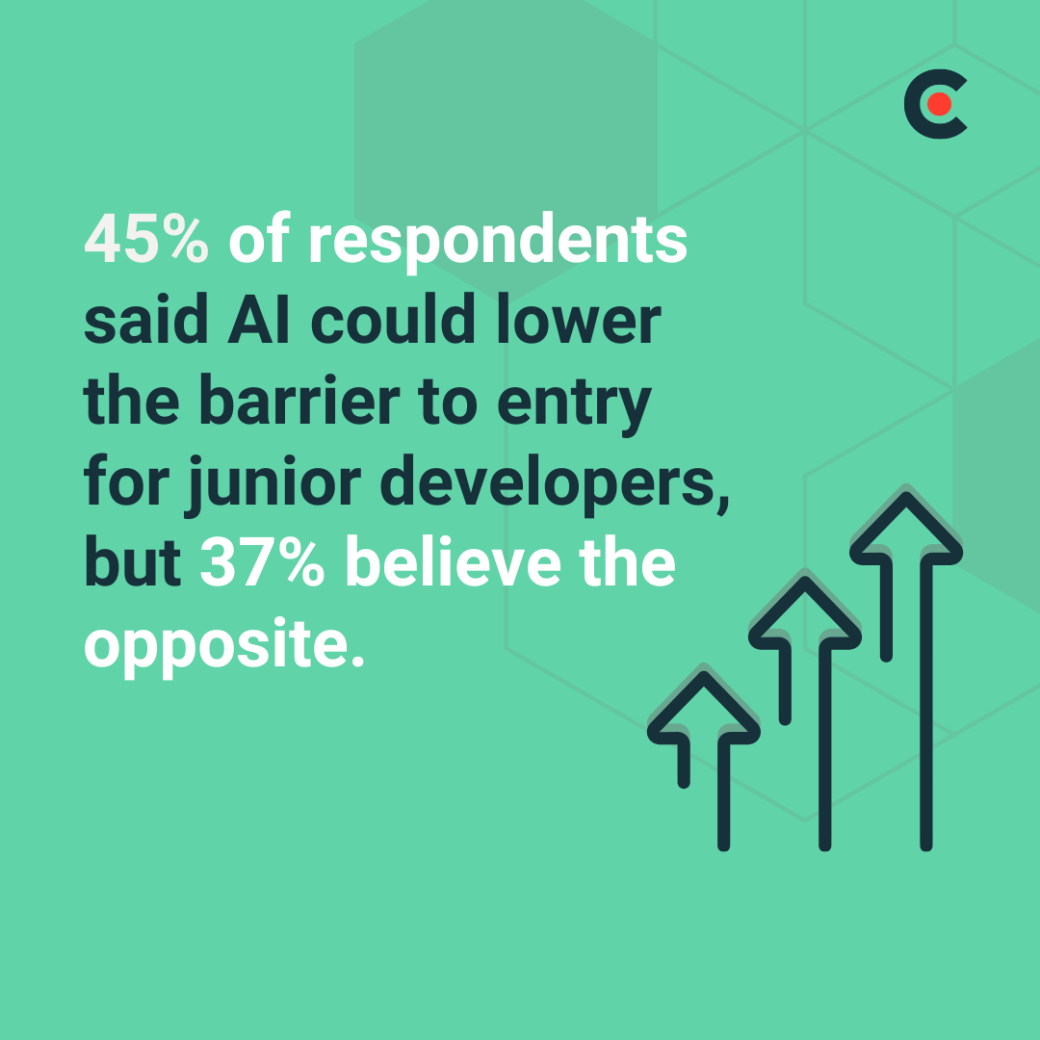
New data reflects this divide. In a recent survey of 800 software professionals, 45% of respondents said AI could lower the barrier to entry for junior developers, offering faster ways to learn, better tools, and built-in guidance. But 37% believe the opposite—that AI might make it harder for newcomers to compete, gain experience, or even find a job as automation fills entry-level jobs.
Remember when you had to spend hours debugging a simple syntax error? Or when you'd get stuck on basic concepts because Stack Overflow answers were too complex? Those days are fading fast.
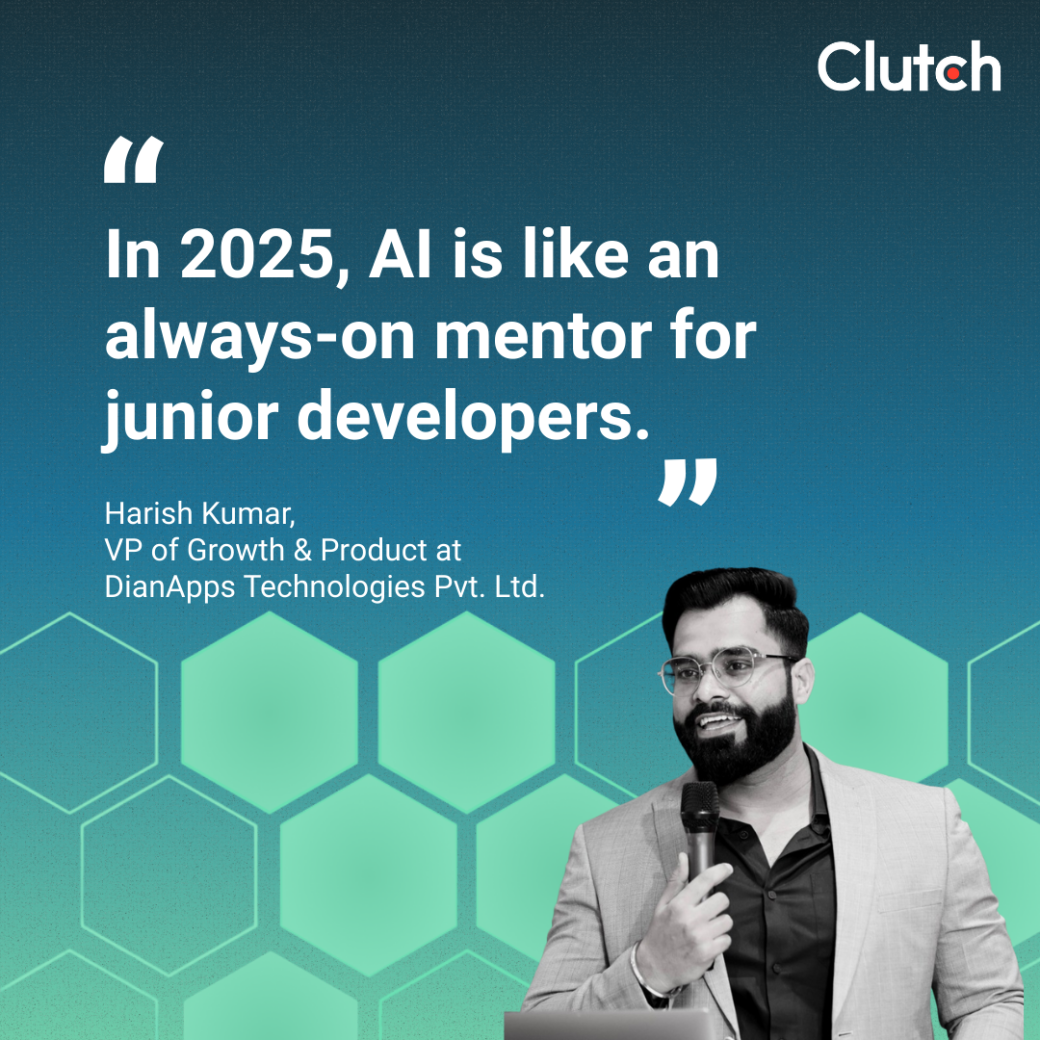
“In 2025, AI is like an always-on mentor for junior developers,” says Harish Kumar, VP of Growth & Product at DianApps Technologies Pvt. Ltd. “It explains tough ideas, suggests good practices, and helps debug with the patience busy seniors may not have time for. It shines when learning new tech—juniors can try unfamiliar frameworks with real-time guidance. AI also helps them understand code patterns and design choices by giving context and options, speeding up the jump from writing code to thinking in systems.”
GitHub Copilot now suggests entire functions as you type. You can write a comment describing what you want, and working code appears instantly. It's like having a senior developer sitting next to you, 24/7. At the same time, ChatGPT breaks down complex programming concepts into bite-sized explanations. You can ask it to explain recursion like you're five years old, or to contextualize concepts using real-world examples.
As a result, AI is changing how young developers learn and grow by providing instant suggestions, completing code, and can offer instant feedback, helping young developers quickly understand new concepts and code.
These tools give you capabilities that senior developers could only dream of when they started:
AI is making high-quality learning resources and expert-level guidance accessible to anyone willing to learn. With these benefits, it's no surprise that nearly half (45%) of developers believe AI can lower the barrier to entry for junior developers and help them ramp up faster than ever before.
On the other hand, many developers are concerned that the very tasks that traditionally helped junior engineers gain experience are now being automated.
In fact, 37% of respondents believe AI is actively taking over entry-level work. They're seeing AI handle responsibilities that once defined junior roles, such as:
These tasks—the bread and butter of junior positions—are becoming automated. And for those trying to break into the industry, the concern is real.
Why would a company hire three junior developers when one mid-level engineer using AI can produce the same output? The math is simple—and brutal. Fewer openings mean fiercer competition for the roles that remain. And when AI handles the "grunt work," newcomers worry they'll have fewer opportunities to build hands-on experience, sharpen their skills, and prove themselves on real projects.
Companies are no longer just looking for people who can write code—they're looking for developers who can think critically, solve complex problems, and adapt to a fast-evolving, AI-driven landscape. Young developers who are looking to break into the industry need to also focus on what was once considered "soft skills."
As AI takes over more of the actual code-writing process, the most valuable developers are those who understand what problems need solving in the first place.
5Developers have to understand its purpose, its impact, and whether it’s even necessary. AI can generate a flawless sorting algorithm, but it can’t decide if sorting is the right solution. It won’t recognize when a simple filter would better serve users or when a feature adds unnecessary complexity without delivering meaningful value.
The ability to identify user pain points, navigate business constraints, and turn vague ideas into concrete solutions remain deeply human skills. This shift means developers are now expected to engage in deeper product thinking. That includes talking to users, understanding business metrics, questioning assumptions, and considering the long-term implications of their technical decisions.
AI can dramatically boost productivity, but it's only as effective as the developer using it. Knowing how to harness these tools responsibly and strategically is now a critical part of the job. Those who use AT tools need to understand AI's limitations and be able to verify outputs. Those who don't, risk the performance of their product, security issues, and more.
As AI takes on more of the routine coding tasks, collaboration is becoming one of the most essential skills in modern software development. It's no longer just about writing clean code—it's about how well you work with others to build the right solutions.
Meaningful collaboration means translating technical concepts for non-technical stakeholders, working side-by-side with designers to turn ideas into feasible features, and supporting teammates when they hit complex bugs. It also means contributing to architectural discussions—even as a junior developer—and understanding how your decisions impact the broader system.
These interactions require more than technical knowledge. They demand empathy, clear communication, adaptability, and shared ownership—traits AI simply can’t replicate. In a world where tools like Copilot or ChatGPT can generate boilerplate in seconds, the ability to collaborate effectively across teams is what sets high-performing developers apart.
While some worry that AI may take their development jobs, knowing how and when to utilize these tools is essential to remaining competitive in the industry. 3 in 4 developers say AI proficiency already impacts hiring decisions, and that number will only grow.
New to the workforce, young workers need to invest in learning how to implement AI in their jobs and adapt to provide more value. Here are some tips for entry-level developers:
Becoming completely dependent on AI leaves you helpless when it fails. AI should amplify your capabilities, not replace them. Here's how to use AI effectively:
For instance, when Copilot suggests a solution, don't just accept it. Understand it. Break it apart. Ask yourself why it works. What edge cases might break it? How would you improve it? This curiosity transforms AI from a shortcut into a teacher.
Additionally, set boundaries for yourself. Try writing the core logic manually and use AI for tests. Or prototype with AI but refactor by hand.
Code reviews offer another opportunity. When reviewing AI-generated code, approach it critically:
These questions develop your engineering judgment.
Random codes won't cut it anymore. Employers want to see you implement complete, deployed applications that solve real problems.
Therefore, building end-to-end means sharpening various aspects of your software development skills, such as:
Take this approach by following these steps:
This cycle teaches lessons no AI can provide, like why users always break your app in ways you never imagined.
Eventually, you'll build a strong GitHub profile. Each project demonstrates different skills — one may show your frontend creativity while another proves you can handle complex backend logic. Maybe another demonstrates your ability to work with external APIs and data pipelines.
Employers are increasingly looking for developers who also bring human qualities to their work.
For example, empathy means understanding user frustration when your app crashes. Or knowing why accessibility matters even when it's not in the requirements.
Creativity shows in elegant solutions to complex problems. While AI generates predictable code, you find novel approaches. You combine technologies in unexpected ways and see connections others miss.
Product insight develops through curiosity about business and user behavior, such as:
These questions lead to better software than any AI can produce.
You can develop these skills by:
Each skill sharpens your understanding of the human side of software.
AI isn't replacing developers, but it is redefining the role. Entry-level development jobs look nothing like they did a few years ago, because it’s not just writing code anymore.
While it's unclear how AI will continue to shape the role of junior developers, those who are able to learn how to utilize AI themselves will be best positioned for success. This means understanding how AI tools can assist in various stages of the development lifecycle, from automating repetitive coding tasks to generating initial code structures, identifying bugs, and even assisting with design patterns.
The ability to prompt AI effectively, evaluate its output, and integrate AI-generated components into larger systems will become indispensable.