
Why Searching for a Specialized Dev Agency Takes Longer Than It Should — And What to Do About It
Looking for a niche software development agency? Learn how to define your requirements, find specialized providers, and vet their experience.
Updated May 26, 2026

The entire software development process is extremely complex, tedious, and time consuming but innovations in the realm of artificial intelligence can help ease that work. It’s crucial to understand how to maximize AI to ensure optimal productivity without compromising quality. In this article, we’ll go through the aspects impacted by AI and how new advancements can affect the future of software development.
While AI boosts productivity, it complements human creativity and collaboration, paving the way for innovative solutions and optimized development cycles.
Looking for a Software Development agency?
Compare our list of top Software Development companies near you
This year, the adoption of Artificial Intelligence (AI) has accelerated across various industries, including software development. By nature, software development is logical and complex and requires technical knowledge, problem-solving skills, and a creative mindset. As we know, developers spend much time on small and simple but repetitive tasks, such as writing code, running tests, debugging, or even managing version control systems.
However, AI integration has changed the landscape by adding the possibility of automating tasks, allowing developers to focus on strategic and creative tasks of the development process.
AI has revolutionized app development, design, testing, and maintenance. New AI-driven tools can assist in writing code, identifying bugs, suggesting optimizations, and even providing real-time code improvements. They reduce the time required to complete small tasks and enhance code quality through smart suggestions and error predictions. As a result, the software development cycle has been faster and more efficient.
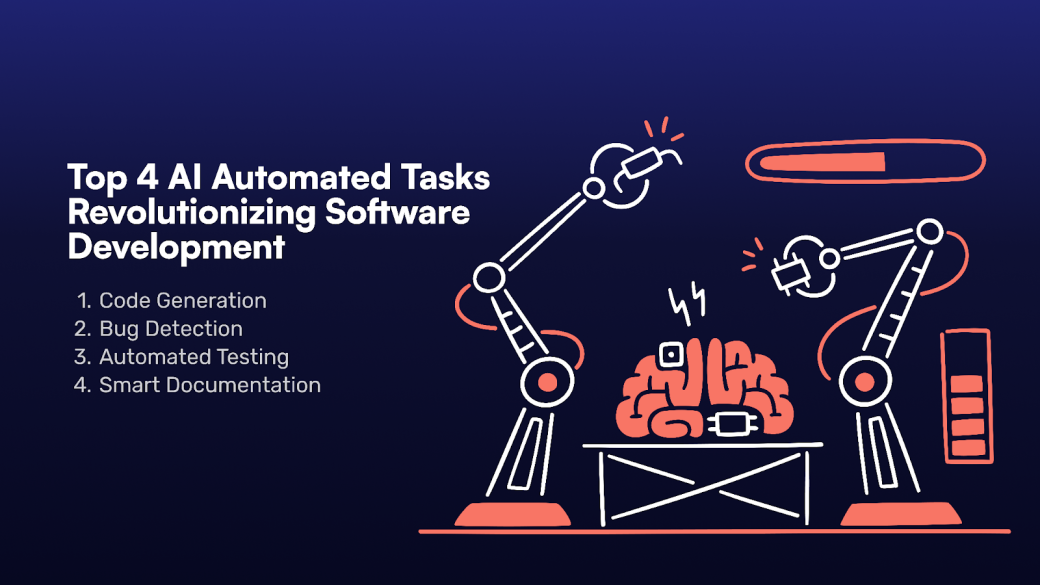
AI-powered tools such as GitHub, Copilot, and OpenAI's Codex are intended to assist developers by creating simple snippets based on brief descriptions of what the code should accomplish. These tools improve coding efficiency and prevent errors by recommending manual code-writing techniques to developers.
AI can assist in detecting bugs and suggesting fixes before the code goes live, helping save time during the debugging phase. Using historical data, machine learning models can predict common coding errors, ensuring mistakes are caught early in development. It is much more cost-effective than finding them later.
Testing is an important but frequently repetitive aspect of software development. AI-powered testing solutions may automate the generation of test cases, their execution, and even test result analysis, resulting in higher software quality and shorter release cycles.
Another often overlooked aspect of software development is Documentation. AI-powered technologies can assist in creating and improving quality documentation by evaluating code and describing how it can be used. These tools are helpful not just for onboarding new technical collaborators but also for making sure that all changes to the codebase are well documented.
AI is revolutionizing software development by automating key tasks. Tools like GitHub and Copilot aid in code generation, enhancing efficiency and reducing errors. AI detects bugs, predicts common coding mistakes, automates testing for faster release cycles, and improves documentation quality, streamlining onboarding and ensuring thorough codebase updates for better software outcomes.
Despite AI's impressive contributions to software development, it's unlikely to replace human programmers fully. Here's why:
Creativity and Problem-Solving Mindset
AI excels in pattern recognition and technical automation, but creativity and creative problem-solving remain distinct human talents. Some areas of software development, such as architecture design, high-level strategic decision-making, and constructing or adapting unique solutions to difficult circumstances, require human intuition, user experience knowledge, and creativity, which AI cannot replicate.
Understanding the Context
Programming is more than writing snippets and coding. Good developers should comprehend the big picture and the context in which the code will be used, considering business requirements and user needs. Now, AI can suggest code or even write simple programs but cannot fully comprehend the full context in which the solution must function. Human developers can understand the nuances of a project and adjust their solutions to fit specific needs and challenges.
Collaboration and Communication
Software development is a collaborative process that requires alignment across various stakeholders and business needs. In their daily work, programmers work closely with multidisciplinary teams, such as designers, product managers, and business analysts, to ensure the software meets user and business requirements. While AI can help automate tasks, it cannot fully communicate or negotiate trade-offs essential in team environments.
AI enhances software development by automating tasks but cannot replace human programmers. Creativity, problem-solving, contextual understanding, and collaboration remain uniquely human strengths. Developers excel in designing complex solutions, adapting to specific needs, and aligning with business goals—skills AI cannot replicate. Human intuition and teamwork are essential in creating effective software.
AI will be a primary priority in software development in the future, with improvements likely to increase its influence in the process. Here are three significant areas where we might anticipate a big impact:
AI-powered tools will become more sophisticated, providing developers with options beyond code generation. These tools will provide insights into optimizing software architecture, finding security vulnerabilities, and fixing performance concerns, hence improving the development process efficiency.
Here we have 3 examples of this:
AI will significantly impact the DevOps pipeline, automating continuous integration and deployment (CI/CD) operations. AI models will monitor system performance, identify potential faults, and offer real-time changes, ensuring that applications continue to scale.
Here we have 2 examples of this:
AI isn’t meant to replace programmers but to work alongside them, helping streamline daily workflows and tackle time-consuming tasks. By handling repetitive and routine duties, AI gives developers more time to focus on creative, strategic, and problem-solving work. This collaboration leads to faster development, better software, and innovative results.
Here we have 3 examples of this:
AI will continue transforming software development by automating simple activities and increasing productivity, making coding faster and more reliable. While it will not replace human developers, it will be a great tool for supporting and boosting their creativity and problem-solving talents. The future of AI in this industry appears bright, with additional developments likely to expedite and optimize software development cycles, benefiting both developers and end users.
Software developer companies must act as partners rather than service providers by deeply understanding the customer’s business challenges and opportunities through collaborative discovery sessions.
rom there, they can recommend the right AI tools and functionalities, ensuring they are purposeful and aligned with specific objectives. For instance, a retail client might benefit from AI-powered recommendation engines or chatbots to enhance customer engagement. At the same time, a healthcare provider could use AI for predictive analytics to improve patient care.
The consultation team's role is to advise when to integrate AI (during the initial product development phase or as part of iterative updates to existing systems). This ensures seamless implementation and minimizes disruption.
Moreover, they can help identify where AI makes the most impact, such as automating repetitive processes, improving user experience through personalization, or enabling smarter decision-making through data insights. This team’s expertise ensures that the type of AI solution, machine learning models, natural language processing tools, or computer vision system matches the customer’s technical capacity and market demands.
AI is revolutionizing the software development cycle by automating repetitive tasks, enhancing productivity, and empowering developers to focus on strategic, creative work.
Tools like GitHub Copilot and machine learning models assist with code generation, bug detection, and error handling, streamlining the coding and debugging processes. Automated testing and smart documentation further reduce time-consuming activities while improving software quality.
As AI tools become more advanced, they will integrate deeply with the DevOps pipeline, optimizing CI/CD processes, detecting real-time faults, and enhancing application scalability.
Despite these advancements, AI remains a complement rather than a replacement for human developers. Critical aspects such as creativity, problem-solving, and understanding project context require human intuition and collaboration. Developers and consultation teams must work alongside AI to ensure its effective adoption, tailoring solutions to specific business needs while prioritizing user experience and seamless integration. AI and human expertise drive faster, more efficient, and more innovative software development.
Partner with top-notch software development companies on Clutch. Read through insightful company profiles, client reviews, and portfolios to match with the right team.