Software Development Metrics That Matter to Business Leaders (With Examples)
Tracking and reporting key metrics is paramount to ensuring the success of your software development project. Understand these benchmarks to improve...
Updated January 2, 2025

Discover why companies in the automotive industry are moving to an agile approach to software development and what benefits this approach offers.
Updated May 13, 2022
The automotive sector is one of the world’s fastest evolving industries, spending around €54 billion (or more than $61 billion) on research and development (R&D) each year.
Looking for a Software Development agency?
Compare our list of top Software Development companies near you
This amount is justified as established engineering-centered auto companies such as BMW and VW feel pressure both from the intensifying competition in Silicon Valley and consumers’ growing demand for smart, connected, and autonomous vehicles.
Companies such as Google and Apple tend to outpace traditional automakers in the software development sphere.
Do traditional automakers have any chance to compete?
Car manufacturers need to realize they’re in the midst of a transformation: They have to shift the way they build vehicles and rely on software as much as mechanics; vehicles run more on code than horsepower, and automakers can’t afford to ignore that.
Three drivers for agile implementation include efficiency, effectiveness, and steering.
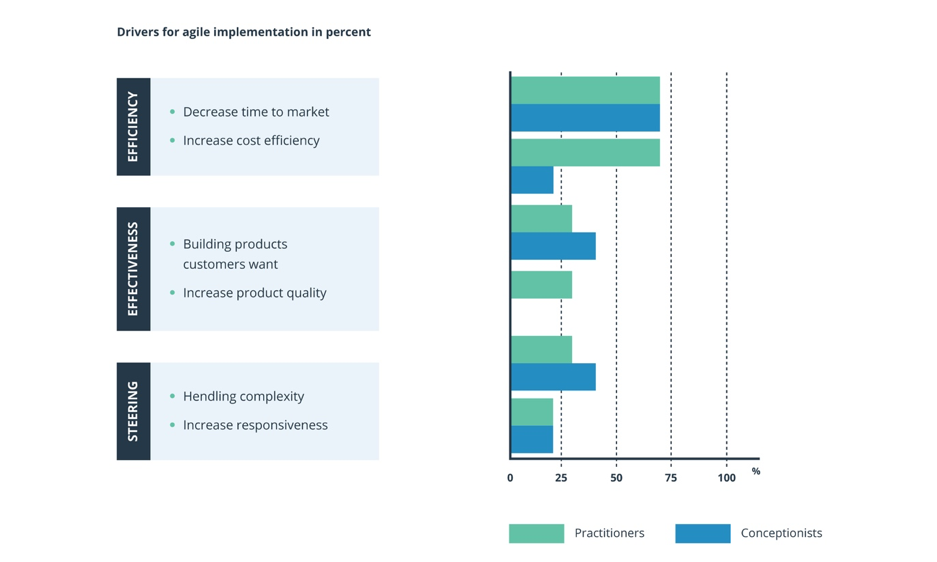
With an agile approach, automotive manufacturers can:
Agility is a key characteristic that automakers must embrace in the digital and connected age, and both original equipment manufacturers (OEMs) and Tier 1s, companies that supply software and hardware to OEMs, should pay more attention to agile development in automotive R&D
Agile development consists of:
These processes can benefit not only the automotive industry but other industries as well.
Looking for a software development company? Check out Clutch’s directory of top software development firms. Then filter by budget, location, and more to find the perfect partner for your project.
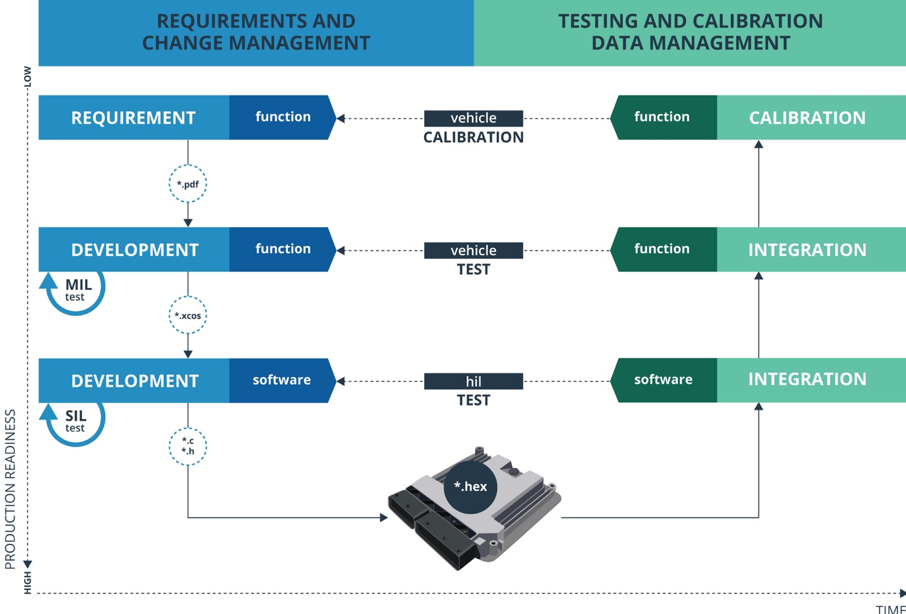
The classic V-model is the de-facto standard in automotive software development and splits the software development process into two main phases or verticals:
The left side of a V-model focuses on requirements analysis, architecture, and software design and development, while the right side focuses on verification and validation of the product at every stage of the development process.
The V-model is the default approach because it is simple, easy to use, and supports design, planning, development, integration, and verification.
This model makes it possible for manufacturers to simultaneously develop vehicle parts through different suppliers by means of frozen standards and specifications at the very beginning of development.
Although this approach offers an easy user experience, it is not perfect. One of its main drawbacks is its lack of efficiency: It can take a long time to get from the requirements research stage to getting real product usage feedback.
Agile methodologies can help reduce this waiting period and improve the operational efficiency of automotive development.
Being agile means being flexible and responding to daily changes effectively. An agile approach helps companies succeed in an uncertain and ever-changing environment.
Agile methodologies include:
These frameworks base their values on those described in the Agile Manifesto.
These values include:
The focus on cooperation among teams makes agile software development different from other approaches.
Solutions evolve through effective communication between cross-functional teams assigned to projects. And this evolution is demanded by the dynamic environment.
Additional reading, ‘What is Agile Development?’
The main challenge in the automotive domain is to integrate and deploy new functionality without compromising quality and safety – both of which are critically important to consumers.
One of the main benefits of agile for automotive is continuous integration and continuous deployment (CI/CD). While manual integration of software components is an expensive and error-prone process, CI/CD automates the integration process.
This helps reduce a product’s time to market and improves the product's quality with each iteration.
Agile software developers are flexible, adaptable, and productive.
Agile methodologies combined with iterative development allow teams to get early feedback on how new functionality will change the product.
With this feedback, car manufacturers get valuable insights into what needs to be advanced or changed so they can deploy features incrementally while the product is still in development.
With the help of a project manager required by each agile team, it’s easier to make decisions and prioritize actual requests to produce collaborative results.
It’s vital to make changes as a natural part of development; instead of avoiding changes, an agile team values them as improvements to the overall product.
Change management keeps track of a project’s scope and changes, ensuring conformity with customer expectations and keeping the balance between the stream of new requests and intermediate development progress results.
Agile change request management aims to boost project responsiveness and increase the speed of change implementation — minimizing the time between receiving feedback from customers and making decisions based on that feedback.
With agile development, feedback cycles become short, with frequent face-to-face communication between customer and vendor teams.
Additional Reading, ‘When Cost is King: Mastering Automotive Software Excellence.’
OEMs have started using over-the-air (OTA) updates to deploy firmware and bring operating systems up-to-date.
Since connected vehicles can receive OTA software updates and send operational data from onboard systems, car manufacturers are able to fix bugs and upgrade software faster.
Plus, the predictive capabilities of OTA updates can point out issues before a product launch, shortening the software development lifecycle and saving both time and money for OEMs.
This kind of connectivity also allows carmakers to increase product quality and performance. This approach is exactly what agile software development is about — being flexible and changing fast.
At its core, this iterative software development methodology is transforming the automotive domain. There are already automakers that can boast of using agile in their development lifecycle.
Tesla is an example of successful implementation of agile in automotive and refused to follow the long development cycles that have long been considered standard in automotive.
Instead of acting like any other automaker, Tesla acts more like a software company. It rolls out improvements as they come, taking regular feedback, cultivating new ideas, solving problems at the development stage, and striving for continuous improvement.
Both extreme programming and Scrum principles helped Tesla build its infrastructure around accepting changes as they appear, thus constantly bringing innovations to market.
Such an iterative approach should become an example for car manufacturers and encourage them to change their traditional, V-shaped software development mindset.
In a dynamically changing world, the faster a company validates and brings new ideas to the market, the closer it is to the success.
Automotive such as autonomous driving, V2X communications, vehicle-in-cloud solutions, fleet management, and increased mobility demand rapid responses from OEMs.
Automakers may have difficulties developing new features or integrating them into existing vehicle architectures, but agile software development can simplify this process, making it faster and more efficient.
Expect to see wider use of agile methodologies in automotive production in the coming years.
Looking for a software development company? Check out Clutch’s directory of top software development firms. Then filter by budget, location, and more to find the perfect partner for your project.
Additional reading:
Oleksandr Vasylkov, Delivery Director in Automotive at Intellias with a genuine interest in global IT trends and passion to people relations and motivation. With more than 20 years of commercial software development experience in mass production and enterprise, automotive NDS map production, and in-car infotainment systems, Oleksandr has a strong application-level technical background. Since 2005, he has been managing SW projects with distributed multicultural teams up to 300 engineers, being responsible for people management, projects initiation, execution, and monitoring processes as well as production and financial planning, cross locations collaboration, and system testing with a focus on change management and process improvement. You can connect with Oleksandr on LinkedIn.
See full profile