
How App Companies Can Build Trust with Customers
Learn how app companies can build customer trust through better privacy practices, transparent communication, and stronger security to improve retention and...
Updated March 26, 2026

Agile tools allow teams to collaborate and share updates through various stages to create a flexible work process that adapts to changing events, even in a non-IT sector.
Updated July 6th, 2023
Agile tools allow team members to collaborate and share updates through various stages to create a flexible work process that adapts to changing events, even in a non-IT sector or with a non-IT project.
Looking for a Mobile App Development agency?
Compare our list of top Mobile App Development companies near you
Using Agile tools and agile processes in a non-IT sector is common practice now.
Agile methodology increases performance and delivers valuable products by adapting to changing events in the workplace. Agile tools ensure a quick response to changes in every production stage with work items, including team communication, task & project management, issue tracking, and knowledge sharing.
Many industries benefit from this management method, including sectors such as marketing, education, car manufacturing, publishing, transportation, and recruiting.
Still, deciding what management tools you want to implement for your company can be difficult.
This article discusses why a non-IT company needs a management solution, and how Agile technologies can solve many of your project problems.
Explore pricing for development teams for software projects or agile development work.
Agile tools can improve your business, especially when your company deals with large projects. Learn the perfect time to implement agile tools depending on your situation:
Most companies use the Agile approach as a response to evolving projects or issues like backlogs. Many businesses struggle with creating a flexible project system that encourages collaboration in a large community. Agile helps foster adaptability within large companies with cross-functional teams.
For example, many small companies depend on email as their main form of communication. Still, as the company grows with more projects and deals, the effectiveness of email decreases.
Businesses need a tool that makes it easy for employees to prioritize tasks and guide teams throughout project stages.
Agile tools like Jira Software, Kanban boards, or Trello can help businesses overcome these problems. These project management tools allow businesses to divide projects into smaller tasks and self-organizing these work items or tasks into groups by sprints.
Each small task has only one person responsible for its completion. The manager can monitor these tasks depending on overall project progress or by sprints. This Agile method allows businesses to change the initial plan at any time.
Communication is a crucial part of a business community. The agile approach promotes employee interaction and collaboration, especially while working on the same project.
Atlassian products celebrate the main agile values of team collaboration and result-oriented work. Atlassian products ensure that companies may gather and combine tools depending on the activities they want to focus on. These tools integrate with each other and optimize workflows to build a management system tailored to company needs. Some Atlassian products are:
Successful agile processes thrive on open communication and collaboration.
Agile project management tools can help businesses respond to unpredictable situations and deliver a real product. Your company can split a project into tasks and assign a person to each one. It can also create sub-tasks to involve more employees.
Jira supports different workflows, especially nonlinear work items and processes. Your company can start a task, review it, redo the task, and repeat these activities as many times as required to complete a project effectively.
Below is a scheme representing the content creation workflow at Rozdoum, a software development house providing outsourcing services. The processes were rigid and straightforward when Rozdoum started its content marketing strategy. The tools were not adaptable.
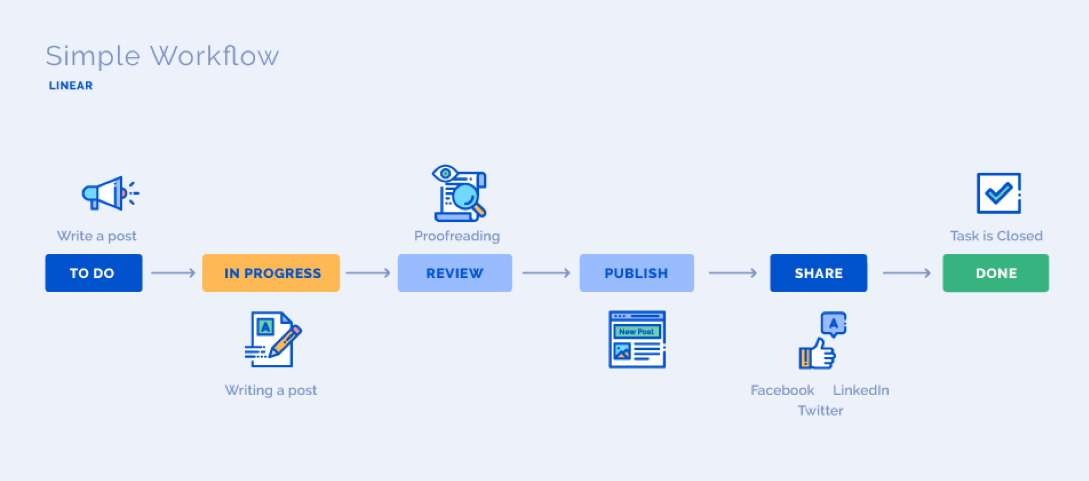
With the growth of the marketing team, Rozdoum added operations to improve content creation. The initial workflow developed into a more complicated but flexible plan.
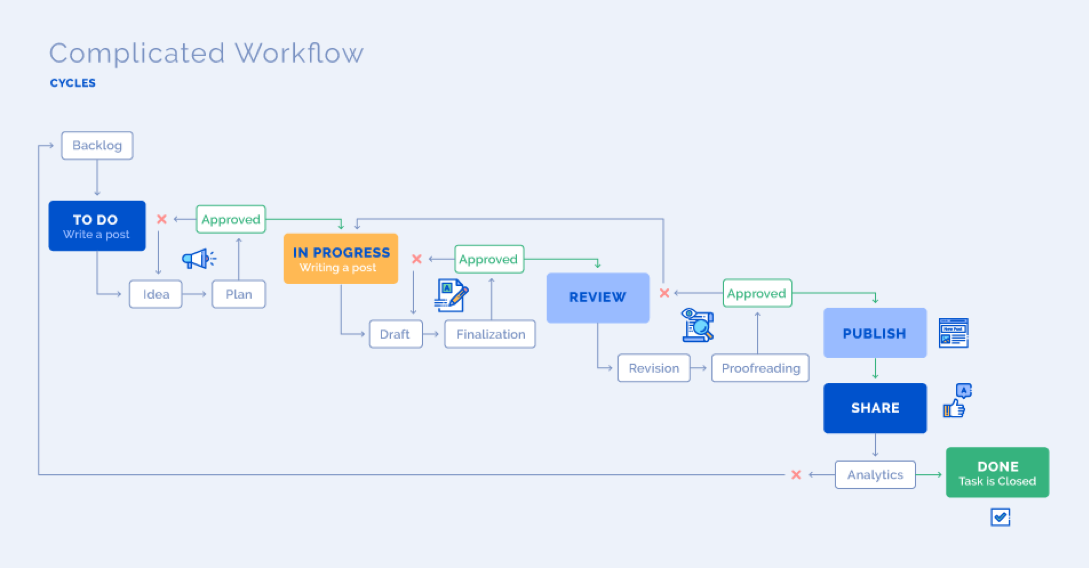
Although more complex, this new plan allowed Rozdoum to create a more effective and flexible workflow. All with the use of an Agile approach.
Businesses suffer from miscommunications and wasted time when management tools stop being helpful. Common problems that can be solved by Agile principles are:
Businesses that face these common problems could benefit from Agile.
Many industries recognize the value of implementing agile tools. Besides software development, the following industries find agile products to be an effective management platform:
As Agile tools become more common, businesses have the opportunity to streamline communication across industries.
The Agile approach is a practical solution for large projects with changing requirements and workflows. Atlassian products help businesses automate processes, evaluate performance, and monitor progress. Collaboration and communication are the core mantras of an Agile framework.
Benefits of using agile tools include:
The benefits of using Agile practices all help streamline business processes for end users, no matter the industry.
Your business knows how it wants to execute a project but needs the tools to implement an effective management process. If your business is unsure how to use Agile tools properly, then consult with an experienced software development firm for help.
The Agile approach allows businesses to respond quickly to any unexpected demands. The implementation of the Agile approach and the incorporation of Atlassian tools should improve the success of a product in any sector.
--
Additional Reading:
 Alex T is a mobile team leader and a certified Scrum Master at Rozdoum LLC, a software development contractor and a services provider founded in 2004. Rozdoum is a certified Atlassian Solution Partner and Vendor delivering apps simplifying project management.
Alex T is a mobile team leader and a certified Scrum Master at Rozdoum LLC, a software development contractor and a services provider founded in 2004. Rozdoum is a certified Atlassian Solution Partner and Vendor delivering apps simplifying project management.
See full profile