Mobile Apps vs. Web Apps vs. Websites: What Does Your Business Need?
Should you build a mobile app, web app, or website? Learn the key differences, costs, and use cases to choose the right platform for your product and users.
Updated December 22, 2025

As the workplace evolves, having the right tools in place can help make payroll, benefits management, and performance management easier. Learn more about the most popular mobile apps for HR.
The workplace is changing, and so is workplace management. Even small businesses can find themselves managing employees in different time zones, countries, and diverse working arrangements, including work-from-home and hybrid positions. Payroll now routinely includes tracking freelance and flextime arrangements, as well as standard full-time and part-time contracts.
The modern human resources professional needs to be on top of all of this and provide employees with a high standard of transparency and accessibility for HR resources, like benefits information, training documents, and compensation details.
Looking for a Mobile App Development agency?
Compare our list of top Mobile App Development companies near you
HR apps simplify processes, streamline communications, and enable greater access to HR materials than previously possible. They can help HR teams with recruitment processes from candidate screening and selection through to onboarding, as well as performance management, time tracking, and running analytics.
A recent Clutch survey found these apps are gaining popularity, with 21% of workers reporting they use at least one HR mobile app at work.
As the speed and capacity of mobile devices improve, so too does the functionality of workplace tech. Upgrade your business with this guide to the popular HR management apps available now.
Mobile apps help HR teams and employees in multiple ways, including:
In an age of remote work, flexible hours, and always-on devices, HR apps provide greater access to critical information for employees likely to be working outside conventional 9 to 5 in-office setups. Apps facilitate easy access to pay stubs, benefits, work schedules, and HR documents with the tap of a button on a mobile device or laptop.
Apps streamline HR communication by functioning as a single, centralized source for company information. They can send out timely alerts and notifications and instantly deliver updates, approvals, and announcements directly to mobile devices, putting the information workers need at their fingertips.
Instant messaging functions can enable employees and HR teams to exchange quick messages, and personalization features allow for targeted communications that minimize the likelihood of employees getting spammed by irrelevant announcements.
Apps can boost the efficiency of HR teams by digitizing and automating many processes and reducing paperwork for tasks such as approving time-off requests and updating onboarding protocols. Automating repetitive administrative tasks helps to free up HR personnel for more substantive projects, such as forecasting recruitment needs, analyzing performance data, or developing policy initiatives.
Increased automation can also cut down on manual record-keeping errors, routinizing the filling out of forms and using prompts and limited-field menus to minimize input errors.
More broadly, HR apps contribute to a better overall employee experience. They provide self-service tools that empower workers to manage their HR needs independently. Further, they connect remote employees to HR data and departments, as well as providing always-on, 24/7 access to documents and resources, such as contracts, leave balances, and benefits information.
In a recent Clutch survey, these HR management apps emerged as the most popular in today's workplaces:
By reviewing the features that make these apps useful, you can pick the best choice for your business model.
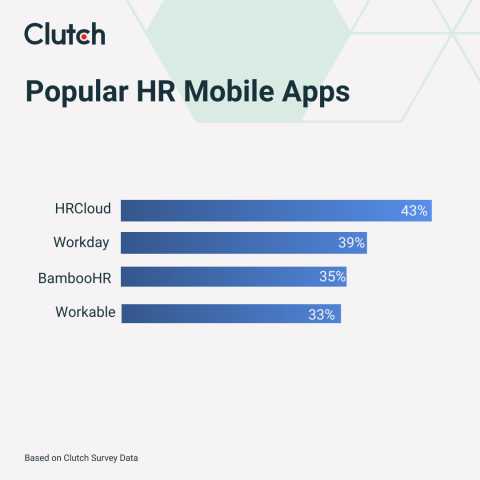
Billed as an "all-in-one solution to engage and empower your workforce," HRCloud promises tangible efficiency benefits — like seven hours saved weekly per HR team member on onboarding, or a 65% HR efficiency improvement. The app boasts a large, high-profile client list, ranging from Amazon to Toyota to KFC.
Workday's AI-driven platform integrates companies' HR, finance, operations, IT, and legal functions into a single, unified platform. This potentially streamlines a large swathe of corporate functions, making collaboration and knowledge-sharing easier across the company for all departments, including HR.
At the employee level, Workday's AI agents help to cut through noise and clutter, helping employees zero in on what they need. Pondering an internal transfer? The Workday agent can match your employees' skillsets to those required by the new role, identify potential weaknesses, and recommend courses and training to address those weaknesses. Employees can sign up for and complete online learning development courses from any device, at any time.
Workday's HR solution has been a leader in Gartner's Magic Quadrant (a proprietary market research methodology) for Human Capital Management Suites — a leading ranking of the apps on the market — for the last 10 consecutive years.
"A fully-connected HR ecosystem," BambooHR is easy to use and is marketed as "not just doable — it's bambooable."
The platform is highly customizable, with more than 150 pre-built integrations with other apps and software, and a full suite of HR functions. Features like "Employer of Record" help companies manage compliance and payroll worldwide, simplifying the complex task of managing HR requirements in multiple countries at the same time.
Workable offers a unified HR platform for management of critical employee information and communications, but it's best known for its recruiting platform. From a massive candidate database to automated distribution of job postings and integrations with LinkedIn, the Workable app streamlines everything from candidate sourcing to applicant tracking, hiring, and onboarding.
Zoho is a comprehensive software suite for businesses, covering everything from CRM to accounting and email. A modular approach allows businesses to scale up as needed, investing in the Zoho modules that they need, or that offer force-multiplier benefits when teamed with other Zoho tools.
On a unified Zoho system, for example, HR teams might manage internal projects using the Zoho project management app, with integrated tie-ins to Zoho email and collaboration tools.
Zoho People is the HR module within the Zoho suite. The module includes online expense reporting, a scheduling and time tracking function, and a digital signature app for streamlining approvals.
If you're already using Zoho in other parts of your business or want an HR platform that comes as part of a larger suite of business tools, this is the app for you.
Choosing the right HR management app for your company can be daunting, but the challenge is easier with a structured decision-making framework.
When evaluating your needs and identifying the right app for your HR team, consider the following selection criteria.
Not all HR needs are equal. You might not need a full-suite HR management platform but are hoping to automate a particular aspect of your company's HR practice.
Get specific about what you're really looking for: Is it full HR management, or a refined set of recruiting tools? Or is your priority employee engagement or managing payroll across multiple countries?
These apps are often a part of a larger HR platform. Be sure to thoroughly evaluate mobile functionality so you understand which features and resources employees can access directly in the app and which they'll need to access on a desktop or in the office.
Investing in an HR management app isn't usually the first thing a company does. It's likely you already have several software packages in place for payroll, time-tracking, analyzing performance data, or facilitating communications.
Many HR apps anticipate this, offering integrations with other software platforms so you don't have to start all your processes from scratch. Consider your company's integration requirements and look into each app's compatibility with the digital tools you currently rely on.
Whatever your needs are today, they'll likely evolve or grow over time. Consider the scalability of the platforms you're evaluating: Will this app scale with your team? Can it support basic HR tasks today and advanced workflows next year?
Cost is, of course, critical to evaluating return on investment. If it isn't explicitly stated, calculate the per-employee cost of the app.
Also consider the cost of scalability. Look at the pricing of add-on modules and anticipated long-term costs as your business grows.
UI can have a considerable impact on the individual user and your staff's overall experience of adapting to a new platform or technology. Look for an app that offers an intuitive design, one that is easy for both HR teams and employees to use. The more intuitive the user experience, the smoother the process of adapting your company to a new platform.
The number of HR apps on the market reflects the wide variety of needs and preferences in modern businesses. With so many options, you can find the right solution for your specific priorities. Establish clear evaluation criteria to judge each app against.
Whether you're looking for a mobile-first, all-in-one platform like HRCloud, a recruitment-focused package like Workable, or a module that connects to a larger software ecosystem like Zoho People, there's an HR management app for every requirement and budget.