
Updated September 21, 2026
Learning how to hire software developers is critical to the success and growth of any technology-backed enterprise. To develop high-quality software, you must assemble an A-team with complementary technical, interpersonal, and soft skills.
With 80% of modern business innovation driven by software enablement, custom solutions are no longer optional. They allow businesses to modernize legacy systems, scale operations efficiently, streamline operations, automate repetitive tasks, and improve overall efficiency. By addressing specific needs and challenges, companies can enhance productivity and reduce operational costs. Moreover, developing tailored software applications enables businesses to offer unique products and services, setting them apart in a competitive market.
Software development firms have the expertise and resources necessary to build robust, scalable software solutions tailored to their unique needs. Additionally, partnering with these companies ensures timely delivery and maintenance of high-quality applications, enabling businesses to stay competitive in an ever-evolving technological landscape.
This hiring guide will provide an overview of software development services, helping you to find the perfect partner for your upcoming project.
Browse Related Software Development Focus Areas
What Is Software Development?
Software development: the systematic process of creating, developing, and maintaining software programs.
Software development is the process software engineers use to build applications. The standard software development lifecycle (SDLC) consists of seven phases: requirement analysis, planning, architectural design, implementation (coding), testing, deployment, and maintenance. Following this structured approach ensures that the final product aligns with business goals and maintains high quality.
The software development team is involved in all stages of the software development life cycle, from conceptualization and design to testing, implementation, and maintenance. The main tasks associated with software development include:
- Design and analysis: A developer should understand the requirements of every project and design a program or application that serves the project's purpose.
- Coding: According to product specifications, a developer should write the software’s code using programming languages such as Java, HTML, SQL, C++, PHP, or Ruby.
- Testing: Software developers and QA testers utilize unit testing, integration testing, and automated Continuous Integration and Continuous Delivery (CI/CD) pipelines to identify and fix errors. They also perform Software composition analysis (SCA) to detect vulnerabilities in third-party libraries.
- Documentation: Software developers write documentation detailing the software’s functionality and architecture. They may also write instructions for end-users and other developers.
- Updates and maintenance: A software developer’s job involves monitoring application performance, managing containerized deployments (like Docker containers or Kubernetes clusters), and utilizing Infrastructure as Code (IaC) tools like Terraform to streamline updates.
- Deployment: Modern teams utilize advanced release strategies, such as blue-green releases and canary deployments, to ensure zero-downtime updates and seamless user experiences.
Through software development services, businesses can leverage emerging technologies such as the Internet of Things (IoT), machine learning, and artificial intelligence to create innovative programs that meet the needs and expectations of their customers. Software development helps businesses disrupt their industries and gain a competitive advantage while streamlining operations.
Software Development Services by Country
-
 United States
Software Developers Services
9,216 Providers
-
 Canada
Software Developers Services
1,584 Providers
-
 Australia
Software Developers Services
745 Providers
-
 United Kingdom
Software Developers Services
2,130 Providers
-
 India
India
Software Developers Services
8,339 Providers
-
 Pakistan
Software Developers Services
1,455 Providers
-
 Germany
Software Developers Services
908 Providers
-
 Philippines
Software Developers Services
162 Providers
Software Development Services by City
-
 New York City
Software Developers Services
996 Providers
-
 Los Angeles
Software Developers Services
505 Providers
-
 Houston
Software Developers Services
294 Providers
-
 Chicago
Software Developers Services
381 Providers
-
 Ontario
Software Developers Services
744 Providers
-
 London
Software Developers Services
1,178 Providers
-
 Sydney
Software Developers Services
294 Providers
-
 Dubai
Dubai
Software Developers Services
662 Providers
5 Benefits of Software Development Services
There are many reasons why businesses, regardless of size, leverage software development solutions. Here’s a breakdown of some of the benefits of hiring a software development provider:
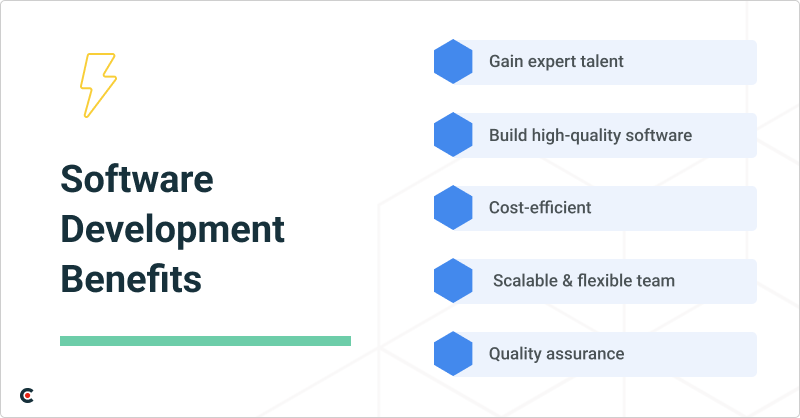
- Gain expert talent: Hiring a competent software development provider allows your business to take advantage of creative and innovative solutions. Expert talent that stays up-to-date in the fast-paced world of software development can bring the most efficient approaches and tools.
- Build high-quality software: Talented developers with extensive knowledge of software development best practices can write efficient code to develop high-quality programs. Expert developers can also implement robust solutions and introduce innovative features, giving a business a competitive edge.
- Cost-efficient compared to hiring an internal team: Outsourced software development services can come in handy on an as-needed basis, such as during product development, fixing bugs, or updating software, rather than having an in-house team that can be potentially expensive in the long run.
- Scalable and flexible team: Software development services can be personalized to specific business needs, guaranteeing that the software meets set requirements. Software development can offer scalability and flexibility since products are developed as per requirements. Still, the outsourced team can be modified based on needs.
- Quality assurance: Expert software developers can use cutting-edge technologies to improve product quality, detect and fix bugs early in the development lifecycle, improve user experience, identify vulnerabilities to protect the software from cyber attacks, and ensure products satisfy regulatory requirements.
Different Types of Programming & Scripting Languages
While some business leaders may not care about the programming languages and platforms used to build their product, those who have existing software products or an internal development team with specific expertise may search for a software company based on the tech options developers provide.
Deployment: Modern teams utilize advanced release strategies, such as blue-green releases and canary deployments, to ensure zero-downtime updates and seamless user experiences.
Most popular software programming and scripting languages on Clutch include:
.NET: .NET is an open-source developer platform that offers a variety of programming languages, editors, and libraries, providing a versatile environment for building different types of applications. Designed to optimize productivity and performance, .NET supports languages like C#, F#, and Visual Basic, allowing developers to write applications for web, mobile, desktop, and cloud environments.
Java: Java is extensively utilized for developing web, mobile, and desktop applications, making it one of the most popular programming languages. Its widespread use has resulted in an extensive collection of existing code libraries that developers can leverage for their projects.
Flutter: Laravel is a popular open-source PHP framework designed for building web applications following the model-view-controller (MVC) architectural pattern.
ASP.NET: ASP.NET is a server-side web application framework that allows developers to build websites, applications, and other software systems.
Unity: Unity is a game development framework that allows users to import and assemble assets, write cost, and import animation. This eliminates the need for programmers to switch between platforms.
What Types of Software Can Developers Provide?
After the completion of a successful software development hiring round, a business can take advantage of a range of services tailored to match its needs, including:
- ERP Systems
- Supply Chain Management
- SaaS
- CMS
- CRM
- Artificial Intelligence
- Internet of Things (IoT)
ERP Systems
An ERP system, which stands for enterprise resource planning system, is a program that integrates all essential business processes, including HR and finance, within a single database. Enlisting superior software development services allows large, mid-sized, or small businesses to streamline operations, improve efficiency, and provide valuable insights for data-driven decision-making by designing, developing, testing, and maintaining complex ERP systems.
Supply Chain Management
Supply chain management software is a tool that enables businesses to track fleets and inventory in real time, making warehousing operations more efficient. This software can identify faults in your supply chain process and prevent delays and other logistical issues. An expert software development team can develop the product’s UI/UX design, build the software, test it, and offer support and maintenance.
SaaS
Software as a service, commonly known as SaaS, is a service that hosts software in the cloud, allowing users access through the internet. Common examples include Netflix, Slack, Zoom, and Dropbox. A SaaS developer can create web-based technologies that can be remotely accessed to automate work and reduce business costs.
CMS
A content management system (CMS) is software that helps users create, manage, and modify digital content without having to code from scratch or code at all. With a CMS, you can publish content with a user-friendly interface. A skilled CMS developer can create, modify, or enhance the core functionalities of CMS platforms, such as WordPress, Joomla, or Drupal, to meet client requirements.
CRM
Customer relationship management (CRM) is a set of strategies, practices, and technologies that organizations use to manage interactions with current and potential clients. CRM software can gather, link, and analyze customer data, including purchases, interactions with company representatives, contact information, quotes, and service requests.
Artificial intelligence (AI) and Big Data
AI mimics human intelligence and uses machine learning and advanced algorithms to analyze big data, help with decision-making, and enable real-time conversations with bots. Big data is used in predictive modeling, machine learning, and other advanced analytics to make informed decisions and solve business problems. An experienced developer can leverage AI and big data to automate processes, predict future issues, spot trends, and offer solutions to fix software problems.
Internet of Things (IoT)
The Internet of Things, or IoT, describes connected devices that exchange data with other IoT devices and the cloud without human intervention. Examples include connected cars, connected homes, and smart buildings. With exceptional software development services, organizations can design, develop, and deploy intelligent systems, shaping the capabilities and functionality of IoT systems and devices.
How To Assess Software Development Services
There’s no denying that the development of quality software is imperative for project success. Measuring your developers’ performance using software metrics is a crucial step toward goal-setting and meeting the objectives you set out for your business.
By tracking software development metrics, businesses can make data-driven decisions and set themselves up for success in the long run. Some of the key metrics organizations use to assess the impact of software development services include:
- Cycle time: Cycle time is a key performance indicator that measures how much time is spent working on a single task — from start to completion. This metric paints a clear picture of efficiency since it measures the speed of delivery. Cycle time can help estimate how quickly the team can finish future tasks and identify areas of improvement.
- Change failure rate (CFR): This is a software development metric for measuring the quality of one’s source code. CFR is the percentage of deployments that lead to a failure in production, necessitating some remediation such as fixing, patching, or rolling back. A low CFR means high-quality code with fewer bugs, while a high CFR signifies more bugs and more time and resources to revamp the code.
- Defect detection ratio (DDR): The DDR ratio compares the ratio of software defects found pre- and post-release. DDR assesses the defects missed by developers and QA testers and encountered by end users, which negatively impacted their experience. This ratio helps you gauge the effectiveness of your testing team. Generally, a high DDR indicates an effective testing process, and vice versa.
- Bug rate: This refers to the number of bugs discovered during testing. Typically, bugs are measured in two aspects: the frequency of bugs and the severity of the bugs. A high bug rate could mean the developers rushed through the coding process or lacked the necessary experience or skills.
- Mean time to recovery (MTTR): MTTR is the average time it takes for a development team to restore service after system or product failure. This software development metric begins tracking time as soon as the product fails and ends once service is restored. MTTR is essential for SaaS organizations since optimizing MTTR can minimize downtime.
What Is a Software Development Team?
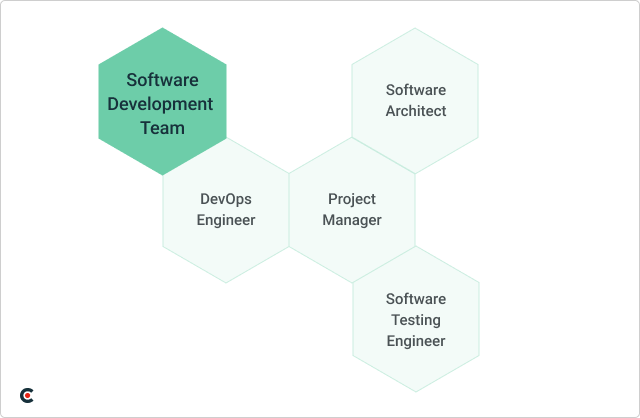
When working with a software development team, get ready to collaborate with teams with diverse talents and expertise that handle different roles, such as designing, building, and maintaining software applications. Members of a software development team work in unison to achieve common goals and include:
- Project manager: Oversees the entire development process, determining who will handle which tasks and when things will get done. They make sure the product is delivered on time and within budget.
- UX/UI designer: Transforms the product vision into an engaging and user-friendly design, creating a journey for the best user experience. They create prototypes, wireframes, and mockups.
- Software architect: Designs the overall structure of a software system, ensuring it meets functional and technical requirements. They work with developers to create secure, scalable, and maintainable systems.
- Software developer: Writes, tests, and maintains the system’s code based on the project’s specifications. They also debug and fix defects during the development cycle.
- Software testing engineer: Tests software to guarantee it works according to requirements and is bug-free.
- DevOps engineer: Serves as a link between development and operations teams, building continuous integration and delivery pipelines for faster product conception.
What to Look for When Hiring a Software Development Provider
Choosing the right software development provider is crucial to the success of your software project. If you are wondering how to hire software developers, it's important to evaluate your options and find a provider with outstanding software development services who can meet your needs and expectations.
Criteria for Hiring a Software Development Provider
Here’s what to consider before hiring a software development provider:
- Software development expertise and experience that align with your vision
- Cost and budget considerations
- Geographic location
- Transparency and communication
- Timelines and delivery
- Security and compliance
- Scalability and flexibility with their operations
- Post-development support and maintenance
By considering these criteria when seeking software development services and evaluating your choices, you can make an informed decision about hiring a team that meets your business needs.
Client reviews and testimonials also come in handy when hiring a software development provider. Clutch offers valuable insights into the performance of software development providers and how they handle projects for clients. By reviewing testimonials, you can get a rough idea about a provider’s profile and how they deliver the final product.
10 Questions to Ask When Hiring a Software Development Company
- What’s the first step you take on a project?
- How do you estimate project timelines?
- How many developers do you have?
- Is the software development team exclusively dedicated to my project?
- Will there be a specific contact person?
- Can you share examples of previous successful projects?
- Who will own intellectual property rights?
- What tools and development methodology do you use?
- What’s your payment structure?
- Why is your company right for my project?
During the interview, actively listen to their responses and inquire if they have relevant certifications and accreditations. Asking the right questions is essential to landing a partner who can meet your needs and expectations.
Shortlist Software Developers with Expertise in Your Industry
Having industry-specific knowledge allows developers to understand the unique challenges and requirements of your business, enabling them to create tailored solutions that address your specific needs. This contextual understanding ensures that your software is not only functional but also aligns with your business objectives and operational processes. For this reason, many business leaders look to hire software developers with experience in their specific industry.
Search for Software Developers With Experience in Your Industry
Information Technology
Custom software allows businesses to create tailored solutions that fit seamlessly within their existing workflows and infrastructure. This can help IT companies improve operational efficiency, increase productivity, and improve scalability.
Even more importantly, having modern and up-to-date software enhances security and compliance. Potential vulnerabilities can be identified and mitigated during the development phase, offering a higher level of security.
E-Commerce
Software development companies can build several solutions that can help e-commerce companies streamline operations and increase sales. Customer relationship management software (CRMs) businesses to collect, analyze, and leverage customer data to foster loyalty and drive sales.
Often, e-commerce companies hire developers to build inventory management systems, which can integrate seamlessly with sales platforms, provide real-time updates, automate reordering, and detail analytics, thereby improving decision-making and operational efficiency.
Business Services
The business services industry relies on a diverse range of software to enhance productivity, streamline operations, and maintain competitiveness. For instance, ERP systems integrate various business processes, such as finance, human resources, supply chain management, and customer relationship management, into a single unified system. Other types of software that are common in the business services industry include HR software, project management software, accounting and financial management software, and business intelligence tools.
How Much Should Software Development Cost?
One of the biggest factors of hiring a software development company is the price. Most software development projects on Clutch cost between $10,000–$49,999, but the total price depends on a variety of factors, including how complex the software is.
Most software development companies charge an hourly rate of $25-$49, but as the scope of your project expands, the more resources, time, and experience is required to bring your vision to life. As a result, the overall cost of your project will increase as well.
In addition to the scope of the project, how much a software development team charges relies on their company size, experience, and location. Larger development teams may be composed of people with varying amounts of experience and skill, allowing them to put newer developers on easy parts of your project while more experienced developers work on the more advanced aspects of the development process. This, of course, will keep costs down as those with more experience charge higher hourly rates.
Budgeting is a major challenge, as research shows that 47% of software development projects experience cost overruns. These overruns are frequently caused by miscommunication, scope creep, or a lack of a detailed Software Requirements Specification (SRS) early in the planning phase.
It's essential to discuss and understand the different pricing models in the context of your project's scope and potential for changes. Ensure that there are clear terms regarding scope creep and any additional costs that might arise. Balancing cost with quality and expertise will help in selecting a software firm that delivers optimal value for your investment.
Search for Software Development Services Based on Project Requirements
Ultimately, there are many software development providers out there to choose from. You can take advantage of Clutch to search for software development service providers who meet your project requirements and unique needs based on programming/scripting languages, application platforms, frameworks, and low-code vs. no-code development.
Evaluating High-Quality Software Developers
As you begin to shortlist prospective developers, you will want to review their portfolio and assess the outcomes of their work. These key performance indicators reflect both the quality of the software and the performance of the development team:
Code quality: Code quality refers to the overall state of code in terms of readability, maintainability, efficiency, and reliability. High-quality code is easy to understand, test, and modify, which makes it more maintainable over time. Key attributes of code quality include clear and consistent naming conventions, well-documented code, and adherence to industry standards and best practices.
Bug rate: Bug rate is a metric used to measure the frequency of defects or "bugs" found in software over a specified period or per a given amount of code. This provides insight into the quality and stability of the software, reflecting how often issues arise that need to be addressed by the development team.
Customer/user satisfaction: Probably the most important KPI is whether or not users are actually happy with the product — whether that’s your internal team or a customer. When software tools are designed with user experience in mind, they can improve productivity, reduce errors, and enhance overall workflow efficiency.
Ability to deliver on time: Sticking to a timeline can be challenging as hurdles can pop up throughout the development process. However, if you have a launch date, a great development team should be able to predict hurdles, plan the development process to meet your needs, and ultimately deliver on time.
One of the best ways to determine whether or not a software developer is a good fit for your project is by reading through client reviews. Each profile on Clutch includes an in-depth overview, client reviews, case studies, and a portfolio, enabling potential clients to make informed decisions based on real user experiences and tangible results. By reading through verified reviews, buyers like you can feel confident when choosing a software development partner.
Need a Budget for Software Development Services?
Download Your Software Development Budget TemplateHow Software Development Services Can Help Your Business Grow
Evaluating a provider requires looking beyond basic fit; you must assess their technical portfolio, review their software architecture choices (e.g., microservices vs. monolithic), and verify their security certifications (such as SOC 2). It’s best to partner with a provider who will get the job done, understands your business, and is ready to prioritize your interests at every stage.
Also, don't forget to ask important questions, such as whether they’ve handled roles similar to yours before and if previous clients can vouch for them. That’s how you get closer to having the best chance of hiring a competent software development provider.