
How to Define Brand Values That Guide Every Business Decision
Brand values are the principles that guide company decisions, define what a brand stands for, and shape how it treats customers, employees, and partners.
Updated February 17, 2026

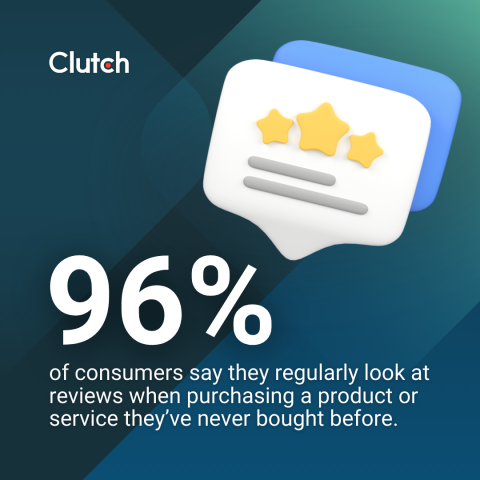
In 2026, online customer reviews remain one of the strongest forms of social proof in e-commerce, with 96% of consumers regularly looking at reviews when purchasing a product or service they’ve never bought before. However, the way consumers read, interpret, and trust them is changing.
Today’s shoppers are more informed, more skeptical, and more selective than ever before. While online customer reviews are still a default step in the buying process, especially for first-time purchases, consumers are no longer taking star ratings at face value.
Instead, they’re digging deeper into written experiences, scanning for visual proof, and actively questioning whether what they’re seeing is authentic or generated by AI.
Looking for a Public Relations agency?
Compare our list of top Public Relations companies near you
This report explores how consumers use online reviews in 2026, which review formats they trust most, and how skepticism around AI-generated content is reshaping e-commerce buying decisions.
Using original survey data, learn where reviews matter most in the customer journey, what makes them feel credible, and how businesses can adapt their review strategies to build trust in a more discerning marketplace.
For first-time purchases, checking customer reviews is a built-in step of the buying process. Across industries and price points, consumers consistently rely on customer reviews to reduce uncertainty and validate their decisions before committing.
According to Clutch data, an overwhelming 96% of consumers say they regularly look at reviews when purchasing a product or service they’ve never bought before, with nearly half (47%) saying they always check customer reviews in these situations.
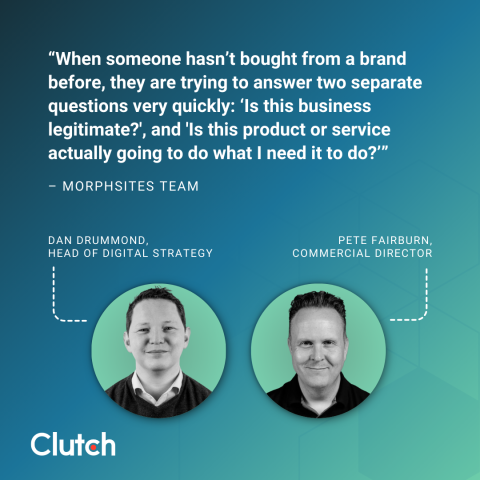
“Online reviews matter most on a first-time purchase because they step in where familiarity is missing,” explains morphsites' Commercial Director Pete Fairburn. Dan Drummond, Head of Digital Strategy, continues, “When someone hasn’t bought from a brand before, they are trying to answer two separate questions very quickly: ‘Is this business legitimate?', and 'Is this product or service actually going to do what I need it to do?’”
Notably, reviews influence buying decisions at multiple points throughout the purchasing journey. Consumers report turning to customer reviews during two key stages:
Ultimately, online reviews function as a default trust signal that helps bridge the gap between interest and action.
For e-commerce brands, this reinforces a critical reality: customer reviews influence which products are considered, which options survive comparison, and which earn a purchase.
Customer reviews influence purchasing decisions across virtually every product and service and at every price point. Consumers consistently turn to reviews when a purchase feels unfamiliar, complex, or difficult to evaluate upfront. In these moments, reviews function as a confidence check, helping buyers validate their final purchasing decision.
Consumers look at customer reviews regardless of how much they’re spending, with roughly half checking reviews for purchases ranging from under $50 to over $500. Even low-cost purchases are not exempt from scrutiny.
Percentage of consumers who look at reviews by price point:
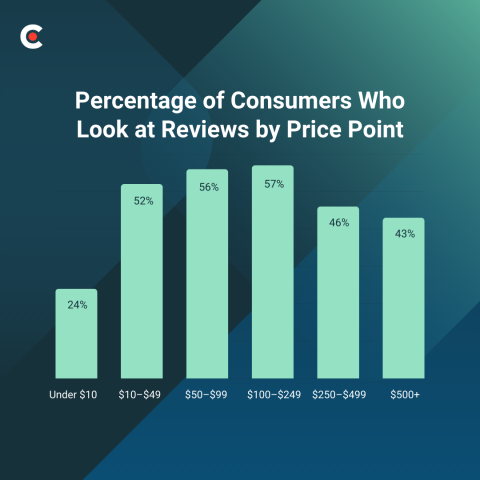
While review usage peaks in the $100–$249 range, the data shows that customer reviews are influential across all price ranges.
More than price alone, the purchase category strongly shapes when and how consumers turn to customer reviews. In categories where quality, safety, or long-term satisfaction matter, review usage is nearly universal.
Percentage of consumers who look at reviews before purchasing, by category:
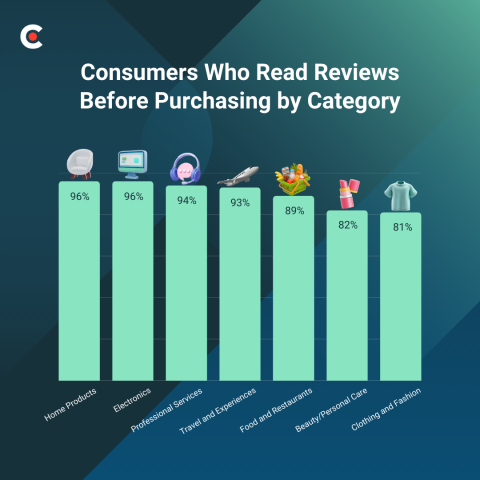
No category falls below 80% review usage, reinforcing that customer reviews are an essential part of the consideration stage across industries. Whether consumers are buying a physical product, booking a service, or planning an experience, reviews help reduce uncertainty, set expectations, and validate choices before money changes hands.
Across every product category and price point, consumers instinctively scan star ratings as a first signal of quality. However, for most shoppers, that average score isn’t the deciding factor. Only 15% of consumers say they trust star ratings on their own, suggesting that stars function more as a filter than a green light.
Jeremy Durant, Business Principal at Bop Design, emphasizes the importance of honest star ratings: “The strong star ratings better be legitimate. A company can have strong star ratings, but sometimes it can be a facade because they paid for fake reviews.” He continues, “The strong star ratings serve as a brand promise, and if the service delivery is not consistent with that brand promise, that facade is quickly exposed, and trust is immediately lost.”

In addition to losing trust among customers for using fake or manipulated reviews, you also risk losing trust among one other key traffic driver. Jon Hedges, President of Hedges and Company, shares, "You won’t get away with scaling reviews artificially and it can result in losing trust with AI platforms," and losing trust on AI platforms could result in a major, long-term hit to your revenue.
Sometimes, high star ratings and recent written feedback don’t fully align. As Landon Murie, Founder and CEO of Goodjuju Marketing, explains that this happens when “a brand/company with a great track record and reputation that suddenly has a pivot in strategy or leadership [has had] a negative effect.” If customers notice the discrepancy, they dig deeper. Nearly half (48%) read recent negative reviews more closely to understand potential trade-offs, while another 16% seek out reviews on a second platform to validate what they’re seeing. Just 16% say they would proceed based solely on a high star rating.
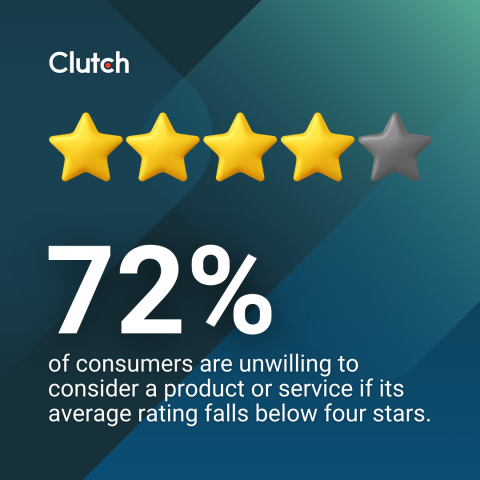
That said, star thresholds still play an important role. Most consumers (72%) are unwilling to consider a product or service if its average rating falls below four stars, reinforcing that ratings set the baseline for consideration.
True confidence, however, is built through balance. Nearly half (49%) say they feel most confident when a product has both a large number of reviews and detailed feedback, while others lean either toward depth (24%) or volume (23%).
In practice, high star ratings may attract attention, but detailed social proof is what ultimately drives buying decisions.
For consumers, credibility in reviews is rooted in specificity and proof. The strongest signal of trust isn’t who wrote the review or how it’s labeled, but how clearly it explains real-world use. In fact, 43% of consumers say they prefer and trust reviews that include detailed descriptions of how the product or service was actually used.
Maxime Siebinga, Marketing Manager at Flowium, speaks to the importance of honest, detailed reviews: “The goal is to show real people explaining why they bought, what problem they were solving, and how the experience actually went. A small number of thoughtful, specific reviews builds far more credibility than a high volume of short, generic praise.”

While written context leads online review credibility, visual evidence reinforces it. Photos of the product or service in action rank second in terms of preference and trust (34%), followed by videos (9%).
Photos, in particular, have become a powerful confidence booster. More than 80% of consumers say photo reviews are at least somewhat influential in their purchasing decisions, with 17% calling them essential.
According to survey respondents, just 9% consider verified reviewer badges as a top form of credibility, 9% consider the recency of the review essential in building trust, 7% say reviewer history matters, and personal details about the reviewer, such as name, age, or background, carry the least weight, with just 4% of consumers citing them.
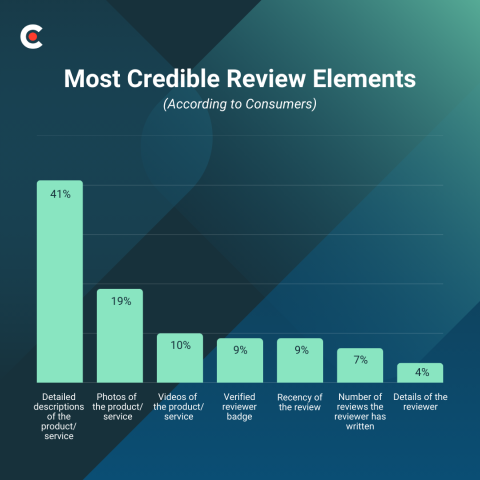
Together, the data points indicate that trust is built through detailed, experience-driven storytelling supported by visual proof. Signals that feel performative (influencer endorsements, AI summaries, badges, or sheer review volume) struggle to inspire confidence without authentic, specific customer voices behind them.
Additional Reading: “The Clutch Commitment to Authentic Online Reviews”
AI has fundamentally changed how consumers approach online customer reviews, making shoppers more skeptical, more selective, and more attuned to authenticity. As AI-generated content becomes easier to produce at scale, consumers have adapted by scrutinizing review patterns, language, and volume more closely than ever before.
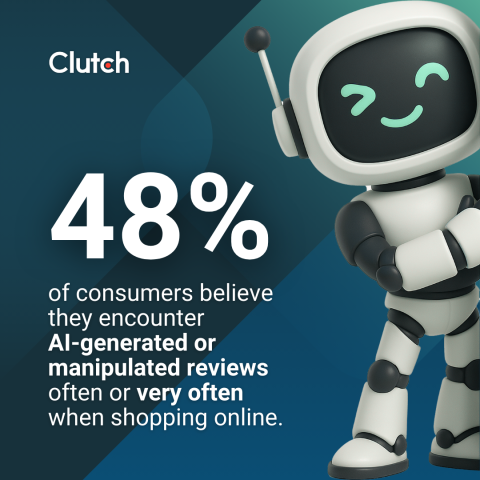
The presence of AI-generated reviews has grown rapidly, particularly on large e-commerce platforms. For example, since the launch of ChatGPT, Amazon has seen a reported 400% increase in AI-generated reviews. And consumers are noticing: nearly half (48%) believe they encounter AI-generated or manipulated reviews often or very often when shopping online.
This awareness has reshaped how shoppers interpret online reviews. A product with a high volume of exclusively five-star reviews, which was once a strong trust signal, now often triggers suspicion. Only 35% of consumers say they would fully trust a listing with only five-star reviews, while half say they would feel skeptical.
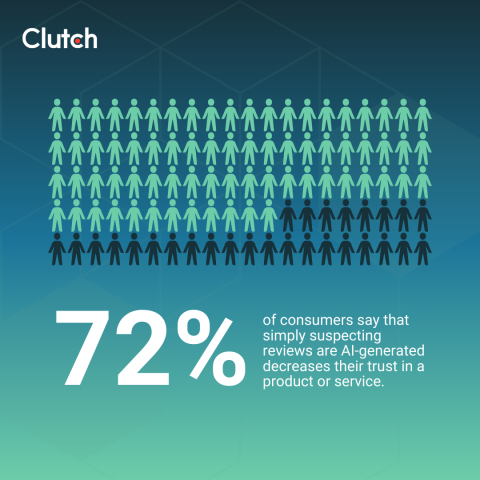
Even a hint of AI involvement carries real consequences: 72% of consumers say that simply suspecting reviews are AI-generated decreases their trust in a product or service.
As a result, chasing perfect ratings through review-writing services or AI-generated content is likely to backfire. Consumers are increasingly skilled at spotting patterns that feel artificial, and perceived manipulation pushes them to abandon a purchase, often in favor of a competitor with more believable reviews.
As consumers grow more skeptical of automated or manufactured social proof, brands are being pushed toward earned credibility rather than shortcuts. Public relations efforts that prioritize transparent storytelling, third-party validation, and authentic brand narratives can help reinforce trust when consumers question what they see online. For brands navigating this shift, partnering with a highly rated PR agency can help strengthen reputation and credibility beyond customer reviews alone.
While AI-generated review summaries are more accepted than AI-written reviews, they are still met with caution. Only 31% of consumers say they trust AI-generated summaries completely or mostly, and 42% trust them only a little or not at all.
In practice, shoppers continue to rely heavily on individual written reviews: 41% skip AI summaries entirely and read only individual reviews. Another 37% use summaries as supplements to written reviews rather than replacements.
When consumers do engage with AI-generated summaries, trust hinges on transparency and alignment with real feedback. Shoppers say summaries feel more credible when they:
Ultimately, AI summaries can play a helpful supporting role during the consideration stage, but they should clarify and synthesize authentic customer feedback. Transparency, balance, and clear ties back to real customer reviews are essential if AI is going to enhance trust rather than erode it.
When it comes to customer reviews, where those reviews live matters just as much as what they say. Platform reputation plays a major role in how credible those reviews feel.
Established marketplaces continue to benefit from built-in trust. Amazon leads the way, with 73% of consumers saying they completely or somewhat trust customer reviews on the platform. Google follows closely at 65%, while TripAdvisor earns the trust of 57% of consumers. These platforms benefit from familiarity, scale, and the perception of stronger moderation and verification, which collectively reinforce confidence in the reviews they host.
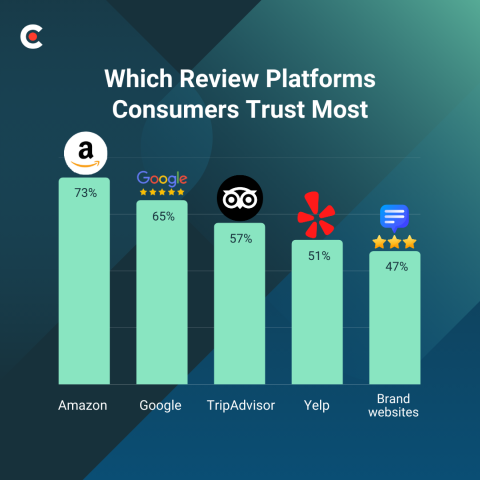
In contrast, customer reviews on brand-owned websites are met with greater skepticism. Only 46% of consumers say they trust reviews hosted directly on a brand’s site, and more than 21% actively distrust them. This trust gap suggests that shoppers are more cautious when brands control the environment in which reviews appear, even if the content itself is authentic.
For brands, this doesn’t mean customer reviews on owned channels don’t matter, but it does mean they can’t stand alone. Familiar marketplaces come with built-in credibility, while brand websites often need additional signals of transparency, balance, and authenticity to earn the same level of trust.
Customer reviews remain one of the most influential factors in e-commerce purchase decisions, but consumers are approaching them with greater scrutiny in 2026. Star ratings alone are no longer enough, as shoppers are looking for detailed experiences, visual proof, and signs that feedback is authentic.
For brands, effective social proof isn’t about collecting a high number of reviews. Instead, it’s about helping authentic experiences surface clearly so customers can make confident decisions.
To build a stronger foundation for trust in 2026, consider working with a top-rated reputation management company that can help you collect, manage, and showcase customer reviews in ways that align with how consumers actually evaluate and trust them today.
This report is based on a survey conducted on January 15, 2026, using the online polling platform SurveyMonkey. We surveyed 402 consumers in the United States between the ages 18-99 of all income levels. The respondents were 49% male and 51% female.
Participants were asked a series of multiple-choice and single-selection questions about their experiences and preferences for online customer reviews. Quotas were applied to ensure a balanced distribution across demographic segments. All respondents were required to complete the survey in full to be included in the final analysis.