Lead Quality vs. Lead Quantity: Why B2B Teams Are Rethinking Their Funnel in 2026
Bigger buying committees and tighter budgets are forcing B2B teams to rethink lead quality vs. quantity. Here's how top teams rebalance the tradeoff in 2026.
Updated February 20, 2026

Regardless of price point or category, 96% of consumers regularly read reviews when purchasing a product or service they’ve never bought before. If they head to your product page’s review section, will the negative reviews drive them away?
Online reviews shape consumer purchasing decisions across a wide range of consumer segments. But how exactly are they using reviews to find, assess, and ultimately choose products and services? And how are businesses responding to the constantly evolving needs and expectations of today’s research-driven, social-proof-seeking consumers?
In this article, learn the impact of both positive and negative reviews, as well as how to start prioritizing your online review efforts.
Looking for a Digital Marketing agency?
Compare our list of top Digital Marketing companies near you
According to the 2018 Online Reviews Survey by customer feedback software company ReviewTrackers, negative reviews and low ratings continue to drive away customers, with 94% saying they will avoid a business if it has been rated negatively online.
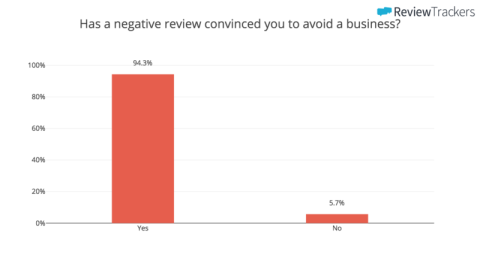
Plus, according to survey findings, a negative experience is more likely to prompt a review than a positive one, meaning dissatisfied customers often shape a disproportionate share of your online reputation.
This imbalance can have real consequences. A handful of unresolved complaints can outweigh dozens of neutral or positive experiences, especially when prospective buyers are researching a business for the first time.
Today’s consumers don’t just glance at star ratings. In fact, Clutch data shows that only 15% of consumers say they trust star ratings on their own. Instead, they actively read negative reviews to evaluate risk. They look for patterns in complaints, assess how businesses respond, and determine whether issues appear isolated or systemic.
In many cases, it’s not simply the presence of negative reviews that drives customers away, but how recent they are, how severe they seem, and whether the business has taken steps to address them.
For companies that fail to monitor and manage feedback, negative reviews can quickly erode trust, reduce click-through rates, and push high-intent buyers toward competitors.
While 85% of consumers look for validation beyond star ratings, nearly 72% say they would walk away from a product or service if the average rating drops below four stars, even if other trust signals are strong. This means that if your business doesn’t have a rating of at least 4 stars, you could be easily overlooked.
However, having a perfect 5-star rating isn’t necessarily the goal. Only 35% of consumers say they would fully trust a listing with only five-star reviews, while half say they would feel skeptical. That distrust is directly related to the rise of manipulated and AI-generated reviews.
Maxime Siebinga, Marketing Manager at Flowium, shares, “We’ve seen brands with strong star ratings struggle when reviews feel generic, outdated, or inconsistent with current customer experiences. In those cases, shoppers tend to discount the rating entirely and rely more on recent, specific, and credible feedback.”
So, while you want to maintain a rating of 4 stars or above, it’s actually a good thing to not have only 5 stars. Ultimately, you want your online reviews to be largely positive, but having some honest customer feedback also presents a great opportunity to build trust.
The growth of online reviews is strongly driven by customers’ genuine desire to engage with businesses.
Just as they did previously in traditional channels, such as surveys and support and service phone calls, customers want to be heard individually and addressed personally.
But businesses aren’t meeting their expectations.
According to ReviewTrackers’ survey, 53% of customers expect businesses to respond to their online reviews within a week. But 63% (nearly two-thirds) say a business has never responded to their review.
Managers must learn to address the gap between review response expectations and reality.
Responding to customer feedback makes a real, measurable difference: 45% say they’re more likely to visit a business that responds to negative reviews.
Taking the time to listen to customer feedback to respond to a negative review in a professional manner with a solution-focused approach has several benefits:
While bad reviews can negatively impact your business, they can also be an opportunity to grow and improve.
Negative reviews are an unavoidable part of doing business. The goal isn’t to eliminate bad reviews entirely, but to manage them in a way that protects trust and reinforces credibility.
As review platforms continue to shape brand perception, businesses must take an active role in monitoring, responding to, and learning from customer feedback. Here’s a four-step process you can adopt within your organization to better handle your online reputation:
Consumers leave feedback in more places than ever before — from Google and Yelp to industry-specific review sites. Consistently tracking new reviews helps businesses identify issues early and respond before negative sentiment spreads.
Setting alerts or using reputation management tools can make this process more manageable, especially for multi-location or high-volume brands.
Knowing how to respond to a bad review is critical to maintaining customer trust.
A timely, professional response shows accountability and signals to prospective buyers that concerns are taken seriously. Even when feedback feels unfair, maintaining a calm, solution-oriented tone can prevent escalation and demonstrate brand integrity.
In some cases, thoughtful review responses can even encourage customers to update their rating after an issue has been resolved.
Individual complaints may be isolated, but recurring themes point to deeper operational challenges.
Common patterns businesses uncover include:
Treating negative reviews as a feedback loop rather than just a reputation threat allows companies to make improvements that reduce future complaints.
One of the most effective ways to manage negative reviews is to ensure they don’t dominate your review profile.
Actively inviting satisfied customers to share their experiences helps create a more balanced, trustworthy reputation. A steady flow of positive feedback can dilute the visibility and impact of occasional bad reviews.
Negative reviews are a natural part of doing business. In fact, a balanced mix of feedback often builds more trust than a perfect rating.
What matters most is how businesses manage them. Left unaddressed, bad reviews can erode credibility, impact star ratings, and drive potential customers toward competitors. But when handled thoughtfully, they create opportunities to demonstrate accountability, resolve issues, and strengthen customer relationships.
For businesses that lack the time or resources to consistently manage feedback, working with a reputation management (ORM) agency can help.
Reputation management partners support businesses by:
With 96% of consumers reading reviews before making a purchase, proactive reputation management is essential to maintaining trust and long-term growth.
Max Schleicher is the head of content at ReviewTrackers, where he enjoys culling data from online reviews to write about customer behavior and sentiment.
See full profile