
How to Define Brand Values That Guide Every Business Decision
Brand values are the principles that guide company decisions, define what a brand stands for, and shape how it treats customers, employees, and partners.
Updated May 26, 2026

Credibility is the silent force that moves markets. Given the sheer number of options and information consumers have today, trust has become the ultimate differentiator. Key drivers of credibility in business decision-making include expertise, transparency, consistency, social proof, and trust signals. Businesses that cultivate credibility inspire action, loyalty, and lasting growth.
Credibility is one of the main forces steering every choice, contract, subscription, and commitment. When buyers search for products or services today, they take credibility into account. That's why word-of-mouth recommendations, user-generated content (UGC), and influencer recommendations are so impactful.
When credibility speaks, hesitation fades. Credibility has become the currency that fuels buyer decision-making and loyalty. Higher brand credibility results in more revenue and retention. The guide below explains the correlation between credibility and decision-making while suggesting best practices for improving your brand's credibility.
Looking for a Public Relations agency?
Compare our list of top Public Relations companies near you
Trust is the silent architect behind every buying decision. When buyers evaluate options, they are not simply weighing features or price points. They instinctively calculate risk, and credibility acts as a reassurance that tilts the scale toward action.
Neuroscience research shows that the brain's amygdala, the center for threat detection, becomes active when people assess risk in unfamiliar situations. In contrast, when buyers encounter a brand or expert they perceive as credible, activity shifts to the prefrontal cortex. It's the part of the brain responsible for future planning and rational decision-making.
However, credibility doesn't only feel right to buyers. It taps into deep-seated cognitive patterns or biases that naturally guide human decision-making. Some of these well-documented cognitive biases include:
Authority bias describes our tendency to attribute greater accuracy and weight to the opinions of an authority figure. Stanley Milgram first studied this concept in the 1960s. In the business world, this plays out when companies show their awards, certifications, and accreditations to signal credibility.
Many businesses highlight third-party validation because authority reduces the mental energy required to assess options. If an expert or trusted source endorses a solution, the brain shortcuts to acceptance.
For example, the Clutch verification program is a form of trust signal. The Clutch Verified credential shows potential clients that companies listed in the platform’s directory have been thoroughly vetted.
Clutch verification provides companies with external credibility, which increases client trust in them. It taps directly into authority bias, making prospects more likely to choose a verified provider over one without that endorsement.
The halo effect occurs when a buyer's positive impression of one attribute (such as perceived expertise or professionalism) influences their perception of everything else. Take any well-established brand as an example. Since they appear credible in one area, buyers are likely to assume that they are trustworthy across the board.
For example, if you find Apple to be credible based on your experience with the iPhone, you will likely trust the brand's other products, too.
Humans are social learners. We often look to others to determine the correct course of action, especially in moments of uncertainty.
In 1984, psychologist Robert Cialdini identified social proof as a key factor in persuasion. He regarded it as one of the six principles of persuasion. Case studies, user reviews, and testimonials are forms of social validation.
Interestingly, your product or service doesn't need to have thousands of reviews to influence buyer decision-making. A study by the Spiegel Research Center found that having just five reviews increases the chances of a purchase by 270% compared to a product with zero reviews.
Once a buyer leans toward trusting a brand, confirmation bias kicks in. It leads people to seek out information supporting their initial belief and disregard evidence contradicting it.
A company that establishes early credibility sets off a cascade effect, so each new interaction feels like proof that the buyer is making the right decision. So, credibility also reinforces ongoing trust.
These biases have become even more prominent in today's world since buyers conduct independent research. Then, they cross-verify their findings through social media and friends or family recommendations. They may also consult peer networks, such as online forums, for more information. Finally, they make a purchase.
Credible brands across all these channels have a higher chance of being selected for a purchase. These businesses use the psychology of trust to their advantage and build long-standing relationships with their customers.

It's important to remember that credibility is not static. Instead, it's a dynamic asset that is built moment by moment through every interaction and promise you keep (or break) as a brand. The following credibility determinations influence how potential customers and partners perceive you.
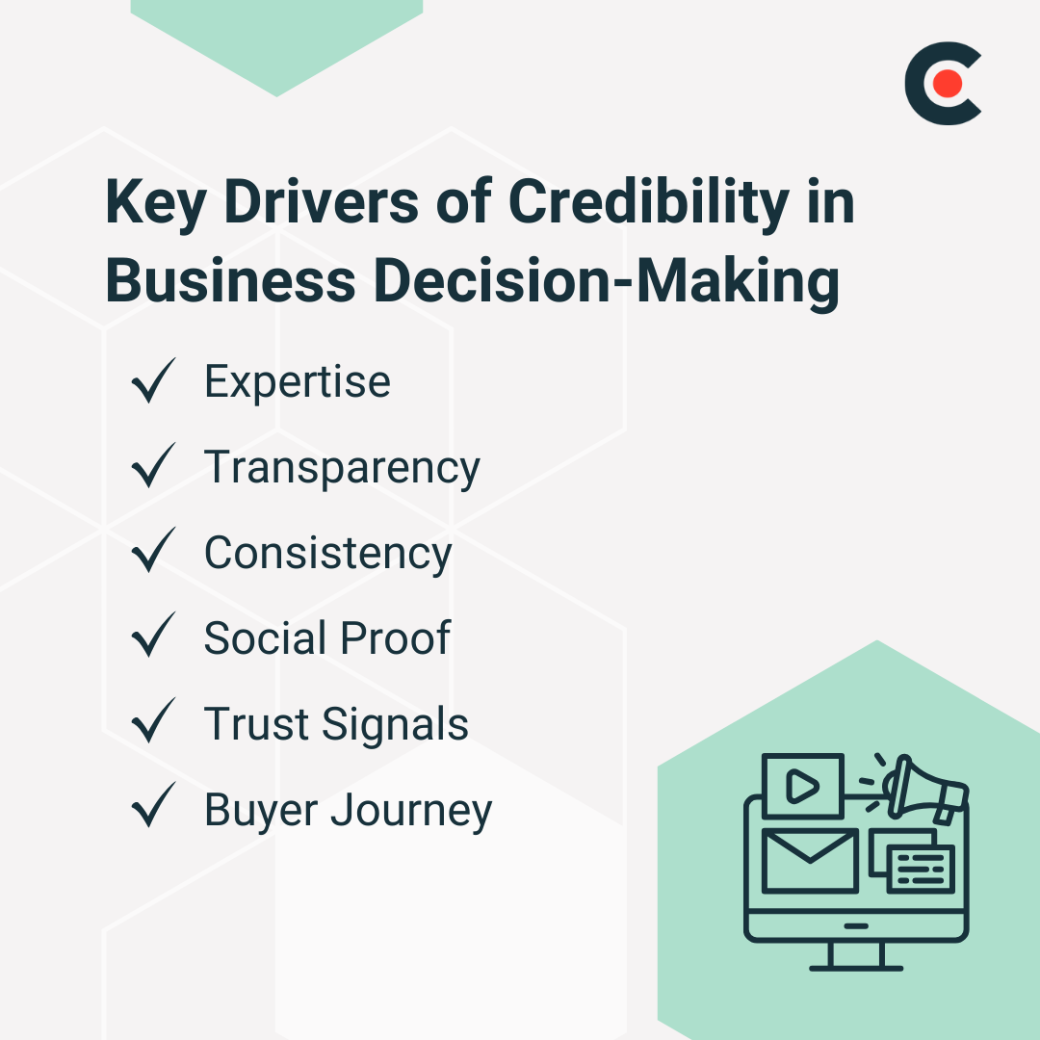
The concept of authority bias is associated with this driver of credibility. Expertise signals mastery, which ultimately gets people to trust your brand. That's why consumers have the highest level of trust (41%) for expert reviews, contrary to a popular belief that celebrity endorsements drive the most trust.
Buyers are drawn to providers who can demonstrate deep knowledge, not just through marketing materials but through every conversation, publication, and product experience. Google does a stellar job of this. The company doesn't only push out products. It also has courses, certifications, a newsletter, forums, a developers' blog, and much more.
Google's approach shows its users that the company knows what it's talking about. So, people are likely to trust the brand.
Educational content, technical leadership, patents, and speaking engagements reinforce the perception that a business understands its domain. In B2B spaces, expertise further shortens decision cycles since prospects already see a brand as an authority in their field.
Additional Reading: ‘The Clutch Ongoing Commitment to Trustworthy Reviews in 2025’
Transparency transforms credibility from theory into lived experience. Buyers want to see how a company operates behind the curtain. They value businesses that speak plainly, disclose limitations, and show how they arrive at recommendations or pricing models.
A Nielsen report found that 75% of consumers consider brand transparency to be important. And nearly two-thirds said they would switch to a company that prioritizes transparency. Similarly, research shows that high transparency minimizes consumer skepticism about a business.
Transparency builds trust because it removes the fear of hidden agendas. It signals that a business has nothing to hide, that it respects the intelligence of its buyers, and that it is confident enough to operate in full view. In fact, 60% of the respondents in a global survey stated that transparency and trustworthiness are the most important attributes of a brand.
One thing you shouldn't doubt customers for is their pattern recognition skills. They are quick to notice when a brand's message or image is inconsistent.
A consistent message and predictable follow-through create a psychological contract between the brand and the buyer. When businesses are consistent, they reduce friction in the decision-making process. However, when they fail to do so, consumers lose trust.
An example of this comes from Peloton, which has always promoted a healthy lifestyle for (predominantly) women.
However, in late 2019, Peloton launched a holiday ad called "The Gift That Gives Back," featuring a woman who receives a Peloton bike from her husband and shares her fitness journey through video clips.
What was intended as a heartwarming story quickly backfired. Many viewers perceived the ad as reinforcing negative stereotypes about body image and gender roles, interpreting it as a husband pressuring his already-fit wife to change.
Criticism spread rapidly across social media, spawning memes, parody videos, and a wave of public outrage. The reaction was so intense that Peloton's stock plunged by nearly 10% in a single day, erasing around $1.5 billion in market value.
While Peloton played it off as a misunderstanding, the underlying issue was the inconsistency in the brand message. The brand's target audience expected empowerment and motivation, not shaming and judgment.
We've already covered how social proof influences business decision-making. It answers the unspoken question every buyer asks: "Has this worked for someone like me?"
In high-risk decisions, social proof is often the final confirmation buyers need before making the purchase. It reduces uncertainty by tapping into the human instinct to follow the crowd when making important choices.
Trust signals are tangible and visible markers that reassure buyers at a glance. On your website, these could include certifications, secure seals, verified partnerships, industry awards, and professional design. These signals show customers that they can trust your company because so many other authoritative figures and organizations already have.
While trust is built over time, trust signals create critical first impressions. They help buyers quickly filter out options that seem risky or unreliable. In many cases, buyers will disqualify a brand in seconds if trust signals are missing or inconsistent.
Credibility does not influence the buyer's decision-making at just one point. It shapes every stage of the customer's buying journey. Here's how it plays a defining role throughout:
Credibility is something you have to build intentionally over time, not just from the outside but also from the inside. Here's how.
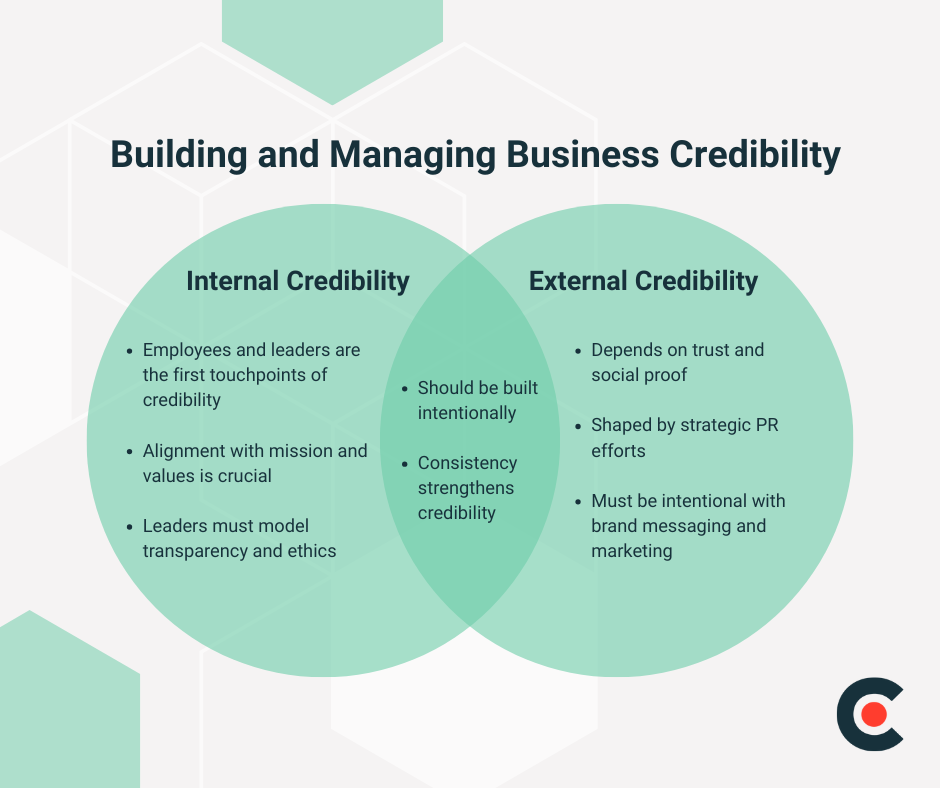
The two segments of people closest to your business are the leadership and the employees. So, credibility begins with them and naturally extends outwards to your consumers.
Strong internal credibility starts with clear alignment. Employees must understand the company's mission and values. More importantly, they should believe in them. Consistency between what a brand says externally and what it lives internally is one of the strongest markers of true credibility.
Similarly, leaders who model transparency and ethical decision-making set the tone for the rest of the organization. When employees see their leaders embodying the company's values, they follow suit. As a result, credibility becomes a daily reality rather than just a stated goal.
Brand culture is another contributor. A culture that prioritizes integrity and excellence creates an environment for credibility to thrive.
Teams are more likely to advocate for the brand and innovate in ways that stay true to the business's core identity. When customers see this consistency, their trust strengthens.
Externally, credibility shows up in every interaction with the marketplace. Buyers are more discerning than ever, so they need proof before making decisions. You need to offer it to them in the form of trust signals and social proof.
Businesses with strong external credibility often find that prospects come to the table pre-sold as they are already confident in the brand's expertise and trustworthiness. Public relations also helps in this regard.
Strategic PR efforts can amplify a brand's credibility by positioning it as a thought leader. As we've covered earlier, expertise is one of the signals customers look at. So, a credible public image can be built on meaningful achievements and industry expertise.
Since online sales make up a big chunk of many brands' revenue, online reputation is also important for external credibility. It includes everything from your social media presence to reviews and digital interactions.
You need to avoid inconsistencies in your brand messaging and marketing. At the same time, steer clear of tone-deaf messaging since that's a sure-shot way to erode credibility. Manage your online presence with honesty and authenticity to build lasting trust.
Credibility and decision-making go hand in hand. Credibility determinations are important in both personal and professional contexts, especially when your brand's perfection and long-term success are at stake.
Brands that consistently invest in building and protecting their credibility close the gap between hesitation and action at the point of decision. They also attract advocacy while increasing retention. So, credibility is a business asset that you can't afford to overlook, especially at a time when consumers are spoiled for choice.