
How to Delegate: A Step-by-Step Guide for Agency Owners
Learn how to delegate effectively as an agency owner — what to delegate first, how to hand off work without losing quality, and the hiring sequence that...
Updated August 4, 2026

Trust drives every successful B2B decision. While buyers turn to reviews to find reliable partners, and providers use verified feedback to stand out in a crowded market. Now, as AI platforms like ChatGPT and Perplexity shape vendor discovery, reviews are becoming the foundation of reputation in both human and AI search. This report explores how Clutch is protecting trust and transparency as fake reviews become more prevalent.
The prevalence of fake reviews is a growing issue, undermining the credibility of platforms and distorting the reality of the marketplace.
At Clutch, we take our responsibility to foster transparency and trust seriously. As a platform that connects businesses with service providers, we understand the impact reviews have on purchasing decisions and the importance of ensuring that feedback reflects genuine customer experiences.
As buyers increasingly rely on AI to research and evaluate service providers, maintaining accurate, trustworthy review data is more important than ever.
By strengthening our review verification efforts, Clutch helps ensure that buyers and AI platforms alike have access to reliable information, while preventing fake reviews from influencing decisions and compromising trust in the marketplace.
At Clutch, we define a fake or falsified review as a review left by someone who is intentionally misrepresenting their identity or relationship with the service provider.
This can include:
Fake reviews are a problem in any marketplace, but they are particularly harmful in the B2B space due to the relatively high costs of products and services.
For example, a fake review that influences a buyer to purchase a $25 toaster on an e-commerce platform is bad, but the stakes are far higher with a fake review on a B2B marketplace that influences a buyer to invest in a $45,000+ software development campaign. In addition to the cost of a roject, companies risk delayed deadlines, lost productivity, and damage to their business if the vendor they chose based on fraudulent reviews can't deliver.
When searching for service providers, decision makers derive immense value from online reviews. Not only can reviews provide a subjective opinion of the quality of a provider’s work, but they often also contain key objective data such as the cost of a project, the scope of the work, or the tech stack used by the provider.
This is why it is vital that buyers have access to reviews from real customers who have hired a provider — transparent and trustworthy reviews can help buyers be informed and confident that they are choosing a provider who can meet their specific business needs.
AI engines like ChatGPT and Perplexity are changing how buyers discover service providers, but not what’s most important to them: finding trustworthy and verified partners.
Often, these AI platforms pull from structured review data and can recommend vendors based on their online reputation, making verified reviews a critical factor in both human and AI-assisted search.
But fake reviews can distort brand sentiment and how businesses appear in AI results. Inaccurate or manipulated feedback can make companies appear more credible, experienced, or capable than they actually are, influencing AI-generated recommendations and potentially steering buyers toward the wrong providers. Even worse, competitors will post fake negative reviews to discourage competition.
Verified reviews help ensure that AI systems have reliable information to work with and that businesses are recognized for their actual performance.
Unfortunately, the problem continues to grow. Clutch’s review rejection rate has increased by nearly 20% in just two years.
This market-wide trend poses a significant threat to the integrity of the information that buyers use when researching potential service providers. That’s why Clutch has invested in new measures to combat this issue and further strengthen our industry-leading review verification.
Clutch is 100% committed to promoting transparency and trust in the B2B space, and this transparency covers all aspects of our directories and profiles. However, trust between buyers and service providers starts with the provider’s reviews.
Since our founding in 2013, Clutch has taken review verification incredibly seriously. Our team lays eyes on every review submitted to our platform to thoroughly assess its authenticity before it is ever published. Additionally, we don’t publish reviews that have an unfair bias or competing interest, such as the reviewer being employed by the service provider.
In recent years, we’ve continued to reinforce our review verification process as we received increasing reports of people trying to sell fake reviews to providers on our platform, known as review brokers. This challenge was not unique to Clutch, due to generative AI lowering the barrier to making fake accounts and reviews.
Since buyers place high value on online reviews during their research, both B2B and B2C marketplaces began to see a rise in suspicious content submissions. To combat this, Clutch created a task force that prevented these reviews from being published and has since expanded this initiative to a formal Trust & Safety function.
Clutch’s Trust & Safety function is responsible for monitoring review broker trends and working quickly to shut down any tactics that brokers begin to use. This function works closely with other internal teams that help service providers succeed on Clutch.
However, the function does not directly answer to those teams. This separation allows our Trust & Safety function to be impartial when making rulings about the integrity of our content and ensures that all service providers are treated the same under our Trust & Safety procedures, regardless of their level of engagement with the platform.
Today, we use proprietary internal software that helps our team identify falsified reviews based on the digital footprint of the reviewers, and our tools evolve according to the specific trends that we see on our platform. This enables a best-in-class verification process, strengthened by the detailed information that we collect about each reviewer and project.
While we can’t discuss the specifics of our verification software in order to protect the integrity of our program, there are a few details that we can share:
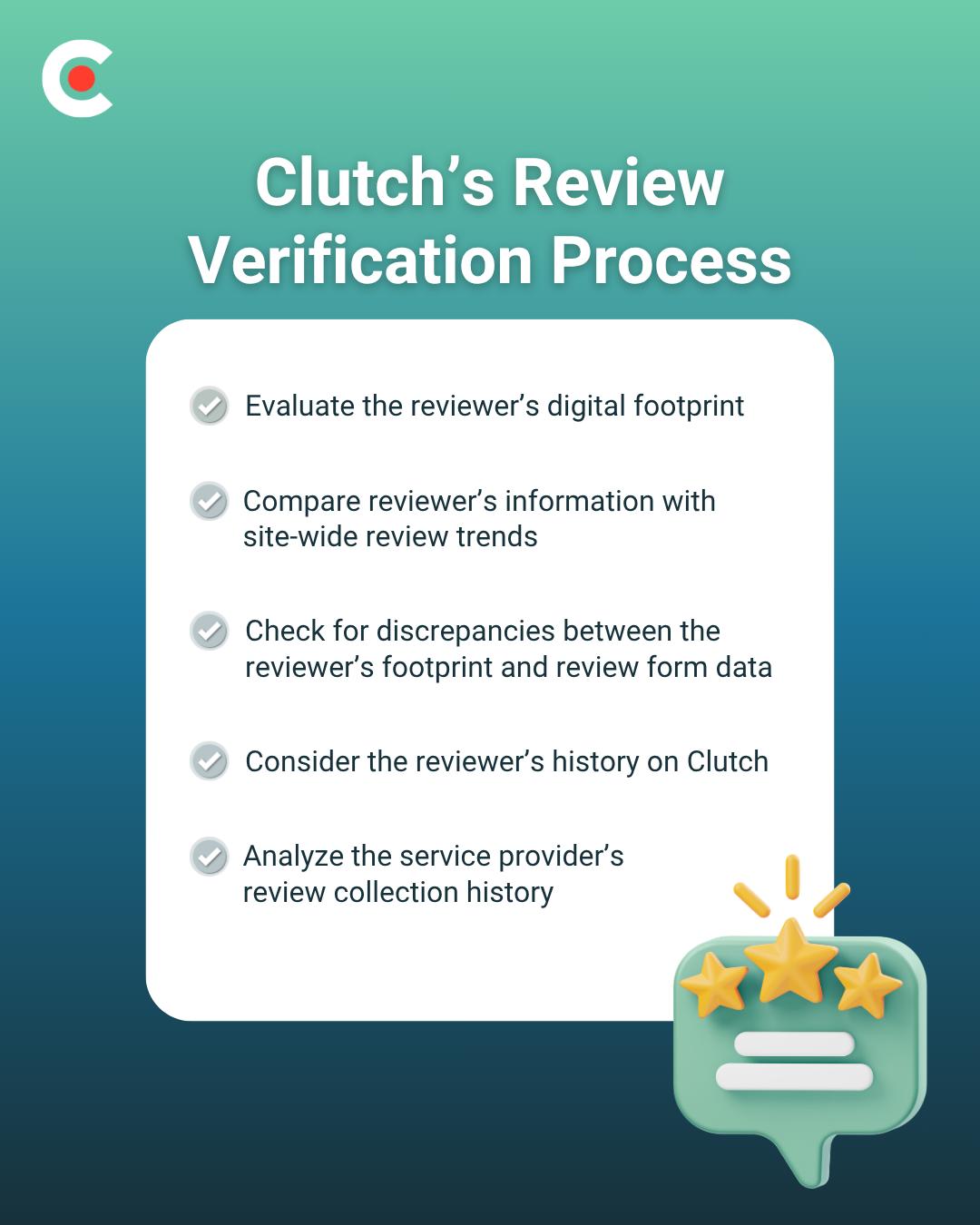
Clutch editors manually assess every review prior to publication, using a combination of our internal verification software and online research to confirm that the reviewer is a legitimate representative of the reviewing company. Here’s how we act depending on the results of each assessment:
We also continue to penalize providers who consistently use review brokers to try to boost their online reputation. Providers who are found to violate our Review Guidelines and Terms of Service — which include soliciting fake reviews — face penalties including:
Together, these efforts help Clutch maintain a trusted marketplace where buyers can rely on authentic reviews to make informed decisions.
The impact of the Trust & Safety function is no small feat. As Clutch works tirelessly to enhance its review verification processes, the results highlight the scale and complexity of the task at hand.
Here’s a look at the data that demonstrates the scope of our commitment to transparency and integrity:
As we continued to evolve our detection methods, we realized there was even more work at hand to retroactively review past reviews. We performed thorough profile audits and re-vetted older reviews. Consequently, we removed many reviews that had been published originally but do not meet our current Review Guidelines.
Trust is more important than ever in the B2B space — it’s critical that buyers and providers invest in platforms that proactively, manually, and thoroughly verify the content that’s submitted to their site.
That’s why the Clutch verification process will continue to evolve. We are continuously improving our systems to identify and remove falsified content. By adding new signals to our verification software, we can stay ahead of review brokers and strengthen our ability to detect manipulation.
Clutch remains unwavering in its commitment to fostering a transparent and trustworthy B2B marketplace, where the authenticity of reviews is essential for informed purchasing decisions.
By safeguarding the integrity of our platform, we help businesses make confident choices— whether they're searching on Clutch directly, through Google, or asking AI.
While buyers can feel assured that every review on Clutch reflects a real buyer experience, Clutch also provides additional tools to help buyers make confident purchasing decisions. These layers of verification and protection give businesses more insight into a provider’s credibility before entering a partnership.
For instance, Clutch Verified providers have confirmed their business registration, completed legal and financial history checks, and passed a credit review through Clutch’s partner CreditSafe. This helps buyers verify that they’re considering a legitimate and financially stable company.
For buyers seeking greater assurance, the Clutch Guarantee offers an additional layer of confidence. Participating providers include a two-week trial period in their contracts with a full refund if the partnership isn’t the right fit, giving buyers added protection before making a commitment.
Together, these tools help buyers reduce risk and evaluate providers with greater confidence. Choosing the right B2B partner is a major decision, and Clutch is committed to giving businesses the reliable information and safeguards they need to make informed choices.