
How to Use Claude Code if You're Not a Developer
Learn how to use Claude Code to build your own AI agents without a coding background, including setup, first steps, and safety tips backed by Clutch data.
Updated September 9, 2026

AI has become one of those topics that are almost impossible to avoid in any board meeting.
Companies are experimenting with copilots, AI assistants, autonomous agents, recommendation engines, document processing, customer support bots, and dozens of other applications. New models appear constantly, promising better reasoning, lower costs, and more impressive results.
The temptation is obvious: pick a model, find a use case, build something, and get it into production.
Looking for a Artificial Intelligence agency?
Compare our list of top Artificial Intelligence companies near you
But after working with companies at different stages of AI adoption, we've found that the technology is rarely the hardest part.
The harder question is deciding where AI should actually be used, what it should achieve, and whether the investment is worth it.
Let’s view the problem in more detail.
The AI market is growing at an extraordinary speed. Statista estimates that the global AI market will reach $617.62 billion in 2026 and $1.42 trillion by 2032.

Market size of AI worldwide from 2020 to 2032 (in billion U.S. dollars). Source: Statista
At the same time, companies are discovering that investing in AI doesn't automatically translate into business value.
Just imagine that 95% of generative AI pilots produced no measurable impact on profit or loss, with only a small share generating measurable business value.
RAND discovered a similarly uncomfortable conclusion in its research based on interviews with experienced data scientists and engineers: more than 80% of AI projects fail to deliver their intended value.
The problem isn't disappearing as companies move from experimentation to more advanced AI.
S&P Global reported that the share of companies abandoning most of their AI initiatives before reaching production increased from 17% to 42%. The same research found that organizations were abandoning an average of 46% of AI proof-of-concept projects before production.
And the numbers around more advanced AI are not particularly reassuring either. Gartner predicts that more than 40% of agentic AI projects will be canceled by the end of 2027, citing escalating costs, unclear business value, and inadequate risk controls.
The numbers vary by study and methodology, but the direction is remarkably consistent.
Companies are struggling because they aren't always clear about what they want AI to accomplish.
One of the easiest mistakes to make with AI is measuring what is easy to measure.
These numbers can look great in a presentation while telling you very little about whether the business is actually better off.
Consider what happens after an AI tool generates something useful.
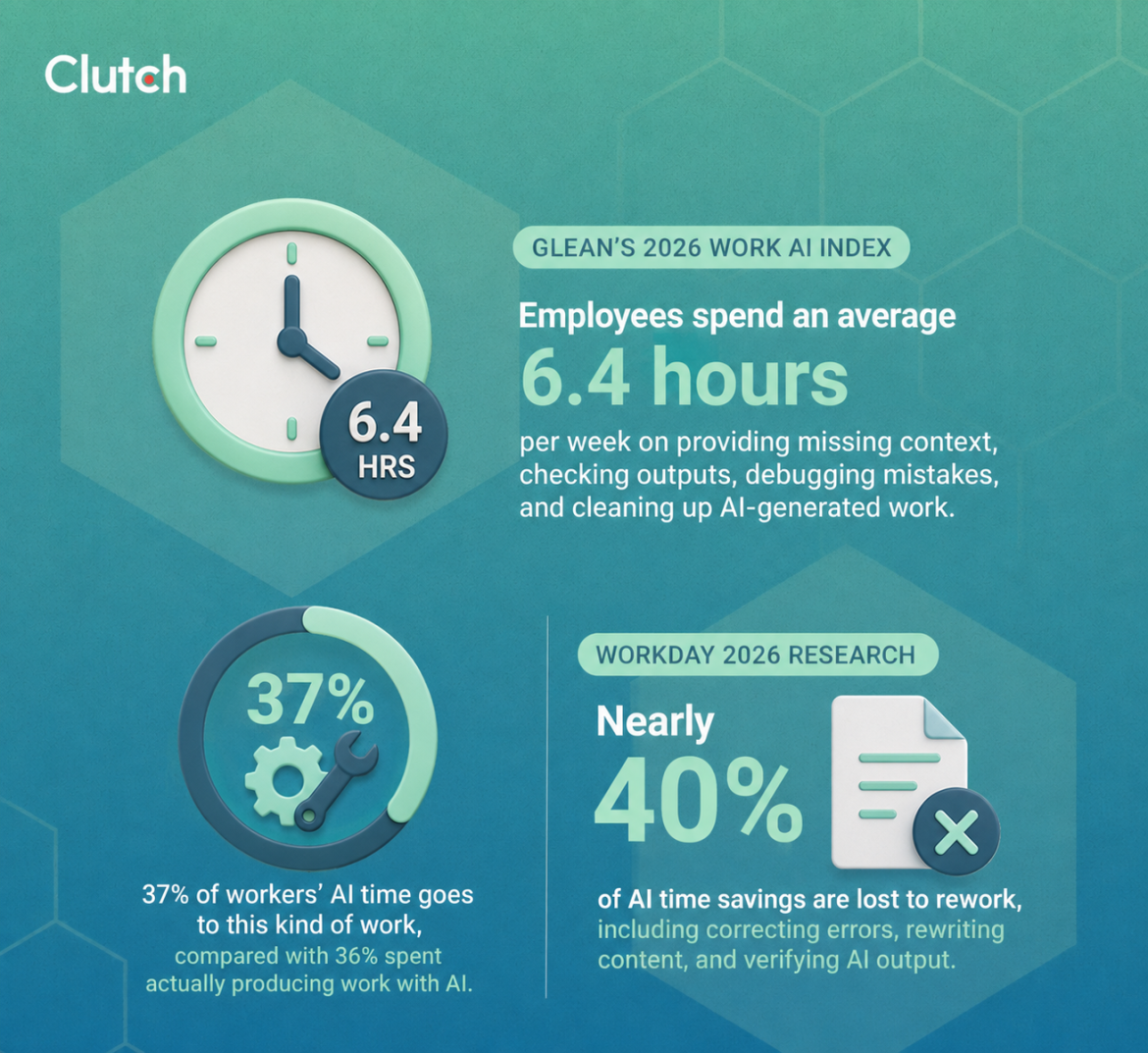
Glean's 2026 Work AI Index found that employees spend an average of 6.4 hours per week on providing missing context, checking outputs, debugging mistakes, and cleaning up AI-generated work. Glean's research also found that 37% of workers' AI time goes to this kind of work, compared with 36% spent actually producing work with AI.
Workday's research points to a similar problem from another angle: nearly 40% of AI time savings are lost to rework, including correcting errors, rewriting content, and verifying AI output.
AI ROI can't be calculated from the AI system's output alone. You have to look at the whole workflow and consider whether the process becomes faster end-to-end, whether the cost per transaction decreases, whether customer satisfaction improves, etc.
These are the numbers that matter.
When a company opens a new office, launches a product, or enters a new market, leadership typically expects a business case. They analyze investments, expect returns, consider risks, and count profitability or losses. And there is usually a point at which the company decides whether to continue investing.
AI deserves the same discipline.
In fact, this is one of the biggest gaps between AI adoption and AI value.
Boston Consulting Group's 2026 CEO research found that only 14% of companies clearly define the P&L impact of all their AI initiatives.
That means many organizations are investing in AI without being able to clearly connect those investments to financial outcomes.
Before starting a significant AI initiative, we recommend answering three questions.
Be specific.
"Improve productivity" isn't a measurable objective. On the contrary, "reduce the average time required to process an application by 40%" is.
"Use AI to improve customer service" is too broad. At the same time, "reduce first-response time while maintaining or improving customer satisfaction" gives the team something it can actually measure.
Depending on the project, the target might be revenue, operating costs, conversion rate, processing time, employee capacity, customer retention, or risk.
The important thing is to define the metric before building the technology.
The cost of AI isn't necessarily the price of the model or software subscription. There can be integration costs, infrastructure, data preparation, monitoring, security, maintenance, retraining, human review, and ongoing optimization.
An AI system isn't necessarily a project you build once and then forget about. Models change, vendors change pricing, APIs change, as well as internal business processes change.
A realistic business case needs to account for the cost of keeping the system useful over time, not just the cost of launching it.
The following questions are often skipped:
A good AI workflow needs a fallback.
Sometimes that's another automated process. Sometimes it's a human employee. Sometimes it's simply an explicit failure state.
The important thing is that the fallback is designed rather than discovered after launch.
There is another reason strategy matters: AI can make a bad process faster without improving it.
A company might spend months building an AI assistant around a workflow that is fundamentally inefficient. The result may be technically impressive but economically disappointing.
This is why, at Empat, we often recommend looking at existing workflows before jumping into AI development.
These workflows can offer relatively low-risk opportunities to introduce AI and automation. They also give the organization something that is often more valuable than a flashy pilot: experience.
Teams learn where AI works, where it doesn't, what data is required, and how much human oversight is necessary. That experience becomes valuable when the company is ready to tackle larger AI initiatives.
The cost of a poorly designed internal AI workflow may be measured in wasted employee time. At the same time, the cost of a poor customer-facing AI experience can be a lost customer.
Clutch's June 2026 research of 422 consumers found that 67% had considered or actually stopped doing business with a company after a poor AI customer-support experience. The same study found that 81% of consumers felt that AI support was intentionally preventing them from reaching a human agent.
That's an important distinction.
AI shouldn't be introduced into customer support simply because it can reduce human interaction.
The objective should be to resolve customer problems faster and better.
If AI can handle a straightforward request in seconds, that's a win.
If a customer has a complicated problem and the AI creates a frustrating loop that prevents them from reaching a person, the automation has created a new problem instead of solving the original one.
Automation should remove friction, not simply remove people.
AI models will continue to improve. Today's leading model may not be the leading model next year. Pricing will also change. New approaches to agents and automation will emerge.
That's exactly why an AI strategy shouldn't be built around a particular model or vendor. The most important part of the strategy is the business problem.
If you know which process you're improving, which metric you're moving, what level of investment you're willing to make, and what risks you're prepared to accept, the technology can evolve underneath that strategy.
That's a much stronger position than building a business process around whichever AI tool happens to be trending this month.
AI can create enormous value. But the companies that get the most from it aren't necessarily the ones adopting the most tools or running the most pilots.
They're the ones making better decisions about where AI belongs in the business. They start with a measurable problem. They understand economics. They make sure the data is ready. They choose the right level of investment. They plan for maintenance and failure. And they measure the result honestly, including the hidden cost of human review and rework.
The advantage is knowing what to build, why to build it, and how to prove that it was worth building.