Lead Quality vs. Lead Quantity: Why B2B Teams Are Rethinking Their Funnel in 2026
Bigger buying committees and tighter budgets are forcing B2B teams to rethink lead quality vs. quantity. Here's how top teams rebalance the tradeoff in 2026.
Updated July 7, 2026

The marketing industry has decided video is the answer to everything. Consumers, however, don’t always agree, and the divide between where video reigns and where it underperforms is wider than most content teams realize.
If you ask the majority of content teams what content format you should use to approach a new topic, the answer will most likely be, “video.” That’s the industry consensus right now. Video is everywhere: short-form, long-form, animated, live-action, AI-generated, take your pick. SERPs are flooded with pieces crowning videos as the universal winner.
The actual consumer data tells a more complicated story. Consumer preferences for video vs. written content are more nuanced than many marketers think.
Looking for a Digital Marketing agency?
Compare our list of top Digital Marketing companies near you
In May 2026, Clutch and Compose.ly surveyed 444 consumers about how they prefer to consume content online, what they finish reading, what they skip, what they watch, and how they decide which format to trust. The spread is striking: 72% choose video over written content for how-to and tutorial topics. For finance or business subjects, the number collapses to 17%.
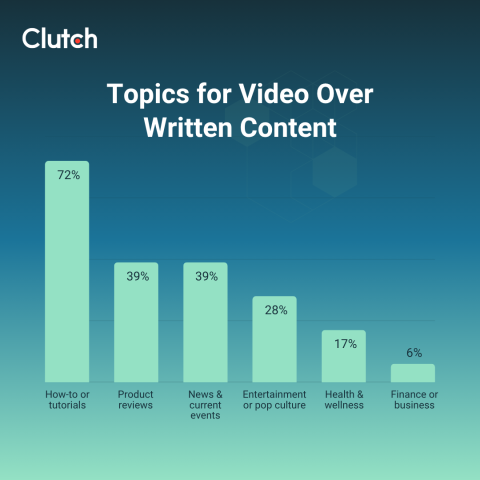
This isn’t a story about text loyalists holding the line. Only 6% of those surveyed said they prefer written content across the board. The differentiator is the content’s topic. This means the industry-wide assumption that video is the answer to everything is a bit too black-and-white.
That’s why we’re focusing today on topic-specific content consumption behavior.
We’ll explore why it’s not enough to decide between video and written content, full stop. We’ll detail why you should consider the vertical, the audience, and the piece’s intent in that decision. Most importantly, we’ll provide a topic-by-topic map detailing where to allocate your video marketing budget and when to default to written content.
The industry trend toward video isn’t entirely off-base. For how-to and tutorial content, 72% of consumers prefer video to written material. Product reviews follow at 39%. The “news and current events” and “entertainment and pop culture” categories came in tied at 37%.

For reference, 81% of consumers say they’d rather watch a video than read an article on the same topic at least sometimes, while only 17% said they’d prefer to read. There’s an obvious lean toward video, but it doesn’t apply universally to every topic.
If you’re wondering what these high-performing categories have in common, it’s simple: they reward demonstration over description. A software tutorial that would take 500 words to explain step by step only requires 90 seconds on-screen. A content creator can’t fully convey in text a product review or unboxing video that hinges on physical texture, sound, or real-world scale. A breaking news moment has more impact when you’re watching it happen.
The bottom line is that, inherently, visual or sequential information hits harder in the video format. Demonstration compresses what text would struggle to describe as succinctly.
As a concrete example, think about the how-to content you can find on YouTube. Channels that cover everything from home repair to Excel shortcuts to sourdough starters to doll-hair punching have grown massive audiences, not because video is trendy, but because watching someone perform a process is categorically easier than reading the same steps.
For content teams in software, technology, or any product that features a visible interface, the same logic applies directly to the brand content they produce.
When you’re creating a content strategy for procedural and demonstrative topics, video is more than a nice-to-have. Your audience actively chooses video content in these verticals, so this is where you should focus your video production budget.
This is where the “video always” strategy hits a wall. Only 17% of consumers — the lowest of any vertical the proprietary survey tracked — prefer video for finance or business topics. Health and wellness isn’t far ahead at 28%.
Remember, though, that a mere 6% consider themselves loyalists to written content in general. That means the people who prefer their finance and business content in written form aren’t just text purists; they’re making a deliberate call for these specific topics. When the subject involves money, regulation, risk, or complex, high-trust subjects, they reach for the format they can annotate, reread, scan for specific numbers, and fact-check at their own pace.
This mirrors a well-established pattern in content strategy: Stat-heavy, high-trust, deep-dive topics belong in writing. People don’t retain specific numbers or pick up nuance from video the way they do on a page of text. They don’t want to scrub through a video to find the one sentence or figure that captured their attention; they want to Ctrl+F a document, highlight a paragraph, and forward it to someone else or insert it into a presentation.

“Short-form video is often the first touch, but it rarely closes the thinking,” says Jérôme Bergerou, International Director at Accuracast.
In other words, you can use a short video to guide the audience to your written content, but don’t stuff the entire informational content into a single video.
Many competing articles claim that over half of people prefer to consume complex topics in video format, but the vertical-level data fragments that picture. Complexity in a tutorial context, such as “How does this tool work?” works best in video format. Complexity in a financial context, such as “What are the tax implications of this structure?” belongs in written form because the stakes are higher and so is the likelihood that you’ll need to return to reference the material.
In regulated, high-consideration, or detail-dense verticals, defaulting to video can actively cost you consumer trust. Audiences in these categories aren’t avoiding video because they’re old-fashioned. They prefer written content because it’s more practical for these specific topics.
Keep the substance in written form. If you’re going to use video at all, use it as an on-ramp, such as a 90-second overview that guides the audience to a link to the full written piece.
When you make video content, two major factors determine whether anyone watches — and finishes — it.
Of the 444 consumers surveyed, 65% said they go directly to YouTube to find informational or educational videos. Every other social platform ranked far lower:
That’s significant enough to consider it a strategic directive. YouTube isn’t a conventional social platform,, and you shouldn’t treat it the same. Instead, consider YouTube as a search engine with intent.
Users arrive on the YouTube homepage looking for something specific. Content published there competes for search placement much more frequently than scroll attention, and that distinction changes how you should create titles, descriptions, and content structure.
The finish-rate sweet spot for informational videos is between 3 and 7 minutes, where 37% of viewers are most likely to watch until the end. 81% said they will finish watching a video with a runtime of 15 minutes or less. Only 7% cap out at under a minute, which tells us something important: Short-form video grabs people’s attention, while people are most likely to watch mid-length videos to the end.

“The video should act as the preview or teaser to the longer content,” says Jeremy Durant, Business Principal at Bop Design.
Short-form content has considerable top-of-funnel value. A 30-second clip can introduce a concept, generate awareness, or earn a follow. However, mid-length is ideal for informational videos— the kind that digital marketing teams produce to build their brand’s topic authority and move buyers through consideration. When the goal is transferring knowledge, a four-minute YouTube explainer optimized for a search query people are already using outperforms a 45-second clip optimized for social scrolling.
In the video vs. written content battle, the handoff is the point. Catch their eye with a three-to-seven-minute video (specifically on YouTube over any other platform), and fulfill their curiosity with a linked, written article. The two formats complement each other rather than competing for the same, either-or audience segment.
The survey data all point to a single operating principle: Map each topic to the format the audience already prefers, then deliberately connect the two formats. “Video vs. written format?” shouldn’t be your content team’s blanket question because it will produce the wrong answer roughly half the time. Instead, your team should be asking per vertical.
A directional framework for a successful video content strategy breaks down the survey’s video content preferences along three lines:
This isn’t about choosing a favorite format and dying on that very hill. It’s about building a deliberate bridge between the two, such as:
Neither format carries all the weight on its own. Treating content format as a per-vertical question prevents unnecessary spend on video content for the topics where consumers prefer the written word, and it reminds you to put written content to work where trust and detail demand it.
Data that paints a picture this clear is impossible to ignore. As our survey found, 72% of consumers prefer video over written content for how-to, tutorial, unboxing, or product review topics, while only 17% prefer it for detailed, figure-heavy finance or business topics. Only 6% categorically prefer written content irrespective of the topic.
Now is the time to act on these findings, stop treating content format as a trend question, and start treating it as a vertical question. In the right context, video is a powerful tool. Written content isn’t going out of style, either; your audience is just more selective about where they prefer to see it.
It’s not a competition between video and written content. When you match format to topic and connect the two, you’ll outperform the other content teams stuck in the “video always” hamster wheel.