
How UGC Video Ads Outperform Traditional Creative in Paid Social Campaigns (With Real Examples)
Learn why UGC video ads outperform traditional creative in paid social, with real examples, best practices, and proven strategies.
Updated July 7, 2026

Viewers often scroll away the moment short-form video content feels manufactured. But getting skipped isn't only about feeling fake — it's also about running long. This article shows how to create ad content that earns the watch and fits it.
In 2025, Clutch surveyed 483 consumers to understand their responses to short-form video content. A staggering 36% of viewers said they will scroll away the moment they sense a video is “really an ad” disguised as content. That's the hook problem. There's also a duration problem: in Clutch and Compose.ly's May 2026 survey of 444 consumers, the largest share of viewers — 37% — will watch an informational video for only 3–7 minutes before tuning out. In other words, brands can't afford ads that feel salesy, scripted, or inauthentic — and they can't afford to overstay their welcome, either.
So how do you make natural ad content that holds attention without losing your audience in the first three seconds — or the eighth minute? This article breaks down the strategies, formats, and production approaches that help brands balance authentic storytelling with promotion, keeping viewers engaged from the hook to the call to action (CTA).
Looking for a Video Production agency?
Compare our list of top Video Production companies near you
Traditional video ad content follows a predictable formula: polished visuals, brand-first messaging, and a clear sales agenda. Billboards, pop-ups, and pre-rolls all immediately signal “marketing,” prompting viewers to ignore them.
Native ad content was supposed to solve this by blending into the feed and mimicking the tone, pacing, and perspective of organic posts. But audiences have caught on. They now have a sixth sense for anything that feels like an ad, even if it’s wrapped in an Instagram influencer’s “honest opinion” or a blogger’s heartfelt suggestion.
Research suggests that ad avoidance stems from reactance, the pushback people feel when they sense that you're deliberately trying to capture their attention. And because traditional and “native” interruptive advertising still hijacks the viewer’s space, the result is often the same: the viewer numbs out, scrolls, mutes, or swipes out.
But inauthenticity is only half the story. Viewers also tune out when a video simply runs too long. In the May 2026 Clutch survey, 81% of viewers said they'll give an informational video 15 minutes or less, and only 19% will push past 15 minutes even when they're engaged — with most capping out at the 3–7 minute mark. The lesson: attention is finite in two dimensions. You have seconds to earn the watch, and only minutes to keep it. A video that's authentic but bloated loses people just as surely as one that feels scripted.
Fortunately, there's an antidote to the authenticity half of the problem: authenticity in digital storytelling. When a video feels like a genuine moment rather than a brand asset, people stay, watch, and absorb the message.
Follow these strategies to make your video ads impossible for viewers to skip:
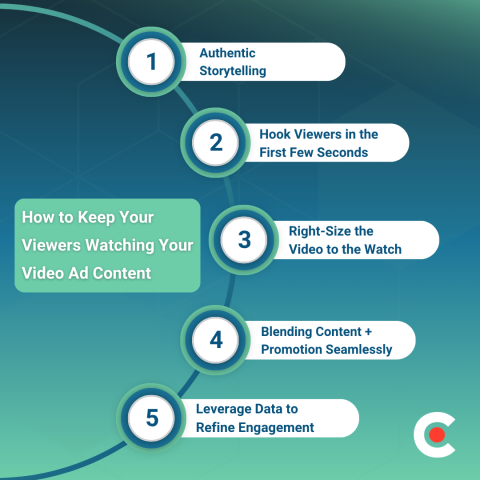
In advertising, authentic storytelling means starting with a lived experience, a relatable moment, or an emotional truth, rather than the product itself. This narrative-first approach earns trust because it mirrors how real conversations unfold. Because viewers connect with the people, tension, and situations first, by the time they connect with your brand, they’re already hooked.
To integrate product mentions naturally, put them inside the story rather than front-loading them. You should also let the product appear when it’s meaningful — for example, during a turning point, personal reveal, or a problem-solving moment. Colloquial voice-overs, founder-origin anecdotes, and point-of-view (POV) clips also help avoid the hyper-polished “brand script” tone that triggers disengagement.
Here are some examples of authentic storytelling in action:
Explore these strategies to see which works best for your audience.
Clutch data shows that 88% of consumers say a video needs to grab their attention in 30 seconds or less, and short-form platforms like YouTube Shorts, TikTok, and Instagram Reels shrink that window to three seconds or less. This is the hook window — the seconds you have to earn the watch. (Keeping the watch is a separate, longer budget measured in minutes, which we'll get to.) In this environment, the hook itself determines whether the viewer stays or vanishes.

Strong hooks usually begin with tension, surprise, or recognition. A surprising fact or visual — like “Did you know most people waste 40 minutes a day doing this wrong?”— forces the viewer to pause for context.
A relatable problem also works well. For example, you could show a creator slamming his laptop shut and saying, “If one more app glitches on me today, I’m done,” pulling the viewer into a shared frustration instantly.
Another effective hook is the use of humor and curiosity. Picture a marketer opening a fridge full of identical meal-prep containers and whispering, “Okay, don’t judge me yet,” creates both a smile and a reason to keep watching without making the product you’re selling — the containers — the star.
“Start with something unexpected, like a visual hook, a surprising statement, or a relatable moment that makes people stop scrolling,” notes Stephen Conley, Founder & Creative Director, Gisteo.
When the first second feels disruptive in a way that reflects real life, viewers naturally want to see what happens next.
Once you've earned the watch, the next job is to fit it. The May 2026 Clutch survey found that 81% of viewers will give an informational video no more than 15 minutes, and the single largest group — 37% — tunes out somewhere in the 3–7 minute range. That makes 3–7 minutes a practical sweet spot for most informational and branded video: long enough to tell a real story, short enough to respect a finite attention budget.
Length discipline in practice means a few things:
The most effective video ads blur the line between content and promotion. Instead of announcing themselves as marketing, they draw viewers into a story or moment that happens to feature a product. When the narrative feels authentic, the viewer becomes invested in it.
For example, a meal-prep brand might follow a creator rushing through his morning, grabbing containers from the fridge and muttering, “I barely slept, but at least breakfast isn’t a disaster today.” The product appears naturally, mid-routine, without the creator ever formally “introducing” it. Similarly, a tech tool could appear inside a real workflow demonstration as the user narrates how she used it to solve a problem that morning.
These scenarios work because the product behaves like part of the story world. Soft demonstrations, behind-the-scenes POVs, and UGC-style clips all create the sense that the viewer is observing real life, not sitting through a pitch. Creator-driven formats excel at this.
As Marlowe Stone, Co-Owner and Co-Founder at 336 Productions, explains, “User testimonials, founder POV, or genuine ‘I tried this’ content can easily outperform polished brand messages.”
The more unscripted the ad feels, the more likely the audience will be to watch it willingly.
Creating engaging video ads isn’t a one-time effort. The only way to keep creating engaging ads is to pay attention to how people actually watch your content. Pay special attention to when attention spikes, when it fades, and which moments pull people back in. That’s where your next round of creative ideas will come from.
Metrics like watch time and average view duration indicate whether your story is engaging beyond the first few seconds. If there’s a big drop-off in views after the first few seconds, you may need to see whether the tone suddenly became too commercial.
Also, take a look at drop-off points, which indicate the exact time frame when viewers bail — typically right after an abrupt product shot or a jarring change in pacing. Meanwhile, interactions and shares show when something truly resonates, especially on platforms like TikTok, where rewatches can push a video back into the algorithm.
A/B testing enables you to determine why your statistics are the way they are. By changing the opening line, tightening the first cut, softening a voice-over, or reordering scenes, you can completely change how long people stay. For instance, you can test two hooks — one starting with a problem (“I almost quit today”) and another with a surprising fact — to see which earns the longer initial pause. You’ll be surprised how small differences can lead to outsized results.
Ultimately, by combining behavioral data with consistent testing, your ad content will get sharper, more intentional, and more aligned with customer needs.
Some formats naturally get longer watch times since they feel native to how people already consume content. They also tend to respect the duration limits viewers told us about: with 81% unwilling to go past 15 minutes, the formats that win are the ones built to deliver value fast. These include:
Experiment with different visual formats.
Today, viewers have little patience for anything that sounds, moves, and feels like an ad — or for anything that runs longer than it needs to. Accordingly, brands must rethink their approach to video content from the ground up. Authentic storytelling, strong hooks, seamless product integration, right-sized length, and data-driven changes all play a role in keeping viewers engaged from the first second to the last. The formats that work best, such as short-form videos and story-driven mini-series, are effective because they spotlight the viewer's experience rather than the brand's agenda — and because they fit the watch.
The takeaway? Brands don't just need to earn the watch — they need to fit it. If your video ads feel real, relevant, and worth someone's time — and no longer than they need to be — they won't get skipped. They'll get watched, which means viewers will remember your brand.
It depends on the job. For a feed-based hook or brand recall, short-form (under ~30 seconds) wins. For informational or branded storytelling, aim for the 3–7 minute sweet spot — the range where the largest share of viewers stays engaged, per Clutch and Compose.ly's May 2026 survey — and deliver your core message well before the 7-minute mark.
Most won't go long: 81% of viewers will give an informational video 15 minutes or less, and only 19% will watch past 15 minutes even when engaged, according to the May 2026 Clutch and Compose.ly survey of 444 consumers.
Two main reasons. First, the content feels inauthentic — 36% scroll away the moment a video feels like "really an ad." Second, it runs too long and exceeds their attention budget. Winning ads solve both: an authentic hook plus a right-sized runtime.
Open with tension, surprise, recognition, or humor — a surprising fact, a relatable frustration, or a curiosity gap — before the product appears. On short-form platforms you have about three seconds, so lead with the most disruptive, real-feeling moment you have.