
Why Your B2B Outbound Emails Never Reach the Inbox (And What It Costs You)
Your B2B cold emails might be landing in spam, not inboxes. Learn how to check placement and the 4 fixes that actually move the needle—not copy edits.
Updated July 7, 2026

Marketers produce content in formats that are the easiest to make, not the ones readers actually finish. A May 2026 survey found that 57% of readers give up on an article in under five minutes — and most of them left for reasons the content team could have fixed.
Most format decisions are made backward, with marketers choosing based on what's fastest to produce or trending rather than on whether readers will still be there at the end. This gap has real consequences, since a piece that gets views but isn't completed has less ability to explain how a product works or to move someone toward a conversion.
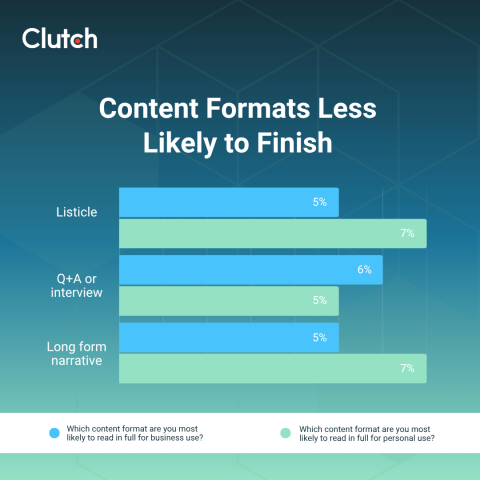
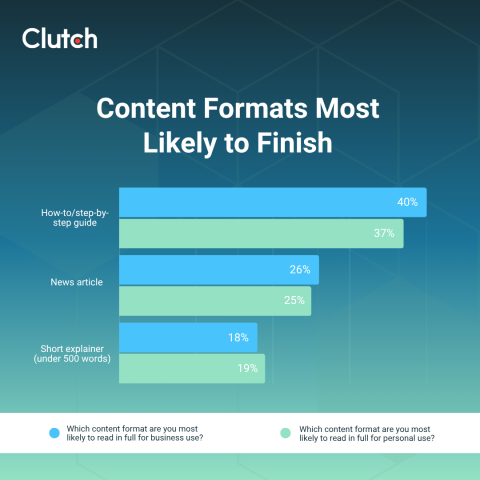
In May 2026, Clutch partnered with Compose.ly to survey 444 consumers on their thoughts about content. How-to and step-by-step guides ranked the highest for completed reads for work (40%) and personal use (37%), followed by news articles at 26% and 25%, respectively. Short explainers under 500 words came in at 18% and 19%. At the bottom, listicles and long-form narratives performed identically: 5% completion for business content and 7% for personal.
Looking for a Content Marketing agency?
Compare our list of top Content Marketing companies near you
The formats content teams typically choose — listicles and long-form narratives — aren't the ones readers actually finish. For maximal cost-effectiveness, format strategy should be optimized for the finish, not the click. This guide explores content completion formats, the formats marketers overproduce, and the importance of a clear structure and narrative. You'll also learn how to build a format strategy for higher completion rates.
Certain formats finish more quickly than others. According to our data, how-to and step-by-step guides lead completed reads for both business (40%) and personal use (37%). News articles follow at 26% and 25%, while short explainers under 500 words come in at 18% and 19%.
These three format types — call them the "completion middle" — have a common thread: clear utility with a visible payoff right off the bat. From the first encounter, the reader knows what they're getting into before committing attention to it. Also, the structure is scannable enough to move through. Ultimately, the lesson for content teams is that format should follow the reader's task, not the writer's preference.
A how-to guide works because it matches what someone is trying to accomplish — finding the best generator for their cabin in rural Ohio, for instance. Similarly, a news article works because it delivers a defined piece of information without asking the reader to work for it — for example, someone who needs to know what the Fed decided this morning doesn't want an essay about central banking history. Short explainers work for the same reason: a reader who needs to understand what an LLC is before a 3 PM meeting wants the answer in 400 words, not a 5,000-word encyclopedia article.

Jeremy Durant, Business Principal at Bop Design, puts the implication plainly: "Utility-first content should be 90% of content creation, especially for lead generation — there is very little room for long-form or long-winded content." His logic is straightforward: if most content goals, such as lead generation and thought leadership that converts, are utility jobs, then most content should be in utility formats.
Narrative and long-form have their place, but they shouldn't be the default.
At the bottom of completed reads sit listicles and long-form narratives, at 5% for business and 7% for personal, for each. Q&A and interviews are close behind at 6% and 5%, yet content marketers continue to create these formats.
The listicle is worth taking a closer look at because it's built to win the click-and-skim, not the finish. Contrary to conventional content wisdom, prioritizing the click-and-skim over the finish is precisely the problem. People open the articles but never read the content in full. The result? Missed conversions and wasted budget.
Consider a typical listicle: "10 Best CRM Tools for Small Businesses in 2026." The headline is specific, promises a shortlist, and answers a question buyers are actively searching for, so it earns the click. But the format's structure works against the finish. Each item is a self-contained unit with a 2–4 sentence intro describing the tool, followed by a table of pros and cons. This means the reader is likely to just skim one item, decide it doesn't fit, jump to a random item, lose the thread, and maybe look at one more random item before leaving.
Overall, there's no argument being built and no reason to stay until the end.
While long-form narratives also rank at the bottom of completed reads, content strategists shouldn't trash them outright. They do a different job by earning memory and preference even when they can't win completion. Case in point: a reader who finishes a well-told brand story may not convert today, but may still remember the company six months later.
The mistake is using long-form narratives as default workhorses. If the reader of your piece is looking to learn or make a decision, consider creating utility content like news, explainers, and how-tos, which are written to serve immediate needs.
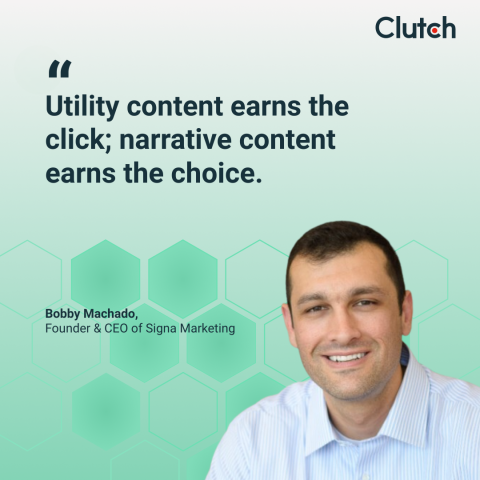
Bobby Machado, Founder & CEO of Signa Marketing, draws a direct distinction between these two formats: "Utility content earns the click; narrative content earns the choice." The 'choice' he's referring to is the choice a buyer makes when they pick one brand over another after repeated exposure, which can lead to conversion later.
Utility content, on the other hand, has a shorter horizon, leading to more immediate clicks.
The survey reveals additional interesting information. When consumers want to gain a deep understanding of a topic, 35% prefer a long-form article. Yet only 5–7% finish a "long form narrative." While this looks like a contradiction, it isn't.
A structured long-form article or explainer has a clear hierarchy, a scannable structure, and a defined payoff, and gets finished. Meanwhile, an unstructured, long-form narrative — which is story-driven and slow-burning, think a New York Times story about someone's midlife revelation after an unexpected chance meeting with a high school friend — gets abandoned.
The completion data makes this concrete. Twenty-six percent of readers quit a piece because it was "too long." In most cases, they meant it felt too long, which is a structural issue, not a length issue. A 2,000-word article with clear headings and subheadings and a bullet-point summary box at the top doesn't feel long, but a 900-word piece that reads as a novel with the point only at the end feels like work.
The lesson for content teams? Length isn't the enemy. Shapeless narrative is. You can publish long articles as long as they're built to be navigated rather than endured.
To maximize finish rates, content strategists should deliberately choose formats based on the reader's task and intent, not by production habit or what's trending on social media. In practice, this means three main directional shifts in content format strategy:
For examples of how these look in practice, see Zapier's how-to content. These step-by-step guides on connecting apps and automating workflows consistently front-load the outcome. Right from the beginning, readers know the payoff thanks to a short intro and table of contents with links to each section. Investopedia's short explainers follow the same logic: a question in the headline, a direct answer in the first two sentences, and structured elaboration below for those who want more.
Neither Zapier nor Investopedia asks the reader to trust the writer all the way to the end before getting what they came for, and that's why their format strategy gets higher completion rates, not just clicks or views.
Ultimately, the data reveals that the formats content strategists produce and the formats that get read aren't the same.
Fortunately, it also shows that the gap is fixable through various formatting changes. If 40% of readers finish a how-to guide for business purposes, while only 5% finish a listicle or a long-form narrative for the same purpose, this suggests that content strategists can boost completion rates simply by adopting a different format.
To pick the best content format for engagement, teams must match the chosen format to the reader's task, structure long content for scanning, and avoid overproducing formats readers abandon. They should also measure completed reads instead of clicks, so they get a clear idea of how many people actually stayed long enough to get the point.