Lead Quality vs. Lead Quantity: Why B2B Teams Are Rethinking Their Funnel in 2026
Bigger buying committees and tighter budgets are forcing B2B teams to rethink lead quality vs. quantity. Here's how top teams rebalance the tradeoff in 2026.
Updated July 7, 2026

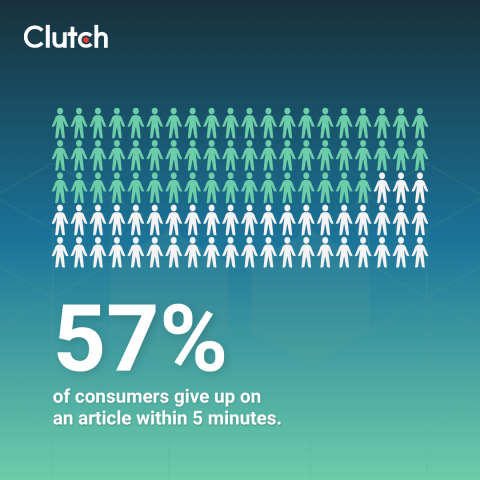
57% of people give up on an article in under five minutes. Have marketers been obsessing over the wrong metric — clicks instead of what happens after readers arrive?
Content marketing has long treated earning readers' clicks as the problem it's supposed to solve. Get the click, the visit, and the conversion naturally follows.
But in May 2026, Clutch partnered with Compose.ly to survey 444 consumers about how they actually read online — probing how long people spend reading an article and why visitors leave a webpage. They discovered that 57% of readers give up on an article within 5 minutes, and 6% don't even make it past the first minute. Additionally, only 32% say they read most articles in full, and 52% skim headlines before deciding to read at all.
Looking for a Digital Marketing agency?
Compare our list of top Digital Marketing companies near you
Most lost readers leave for specific, fixable reasons, such as a piece running too long without a clear payoff, a headline that doesn't match the content, or jarring ads that don't align with the user experience.
This guide breaks down why readers skim before they commit, why people stop reading articles, and what content teams can do about it.
Content marketing often treats a click as a stand-in for readership. Marketers assume if someone lands on a page, they read or, at the very least, read enough. But the survey data doesn't support that.
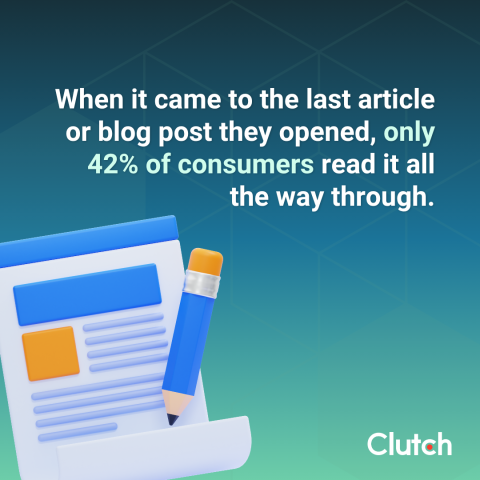
52% of readers skim headlines before deciding whether to read the content, and only 32% read most articles fully. And when it came to the last article or blog post they opened, only 42% read it all the way through, meaning 58% skimmed, jumped around, or left.
The implication is uncomfortable: getting someone to your page isn't the same as getting their attention. In fact, the headline and the first screen are only an audition, and readers are constantly re-deciding whether to keep going at every paragraph and subheading.
To increase the chances of holding readers who are still deciding, content teams should signal value early. They can do this by installing a key-points box near the top that summarizes what readers will get if they stay.
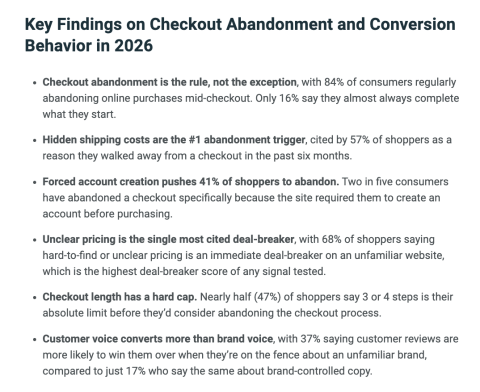
Clear headings and subheadings help, especially on the first screen, giving readers a chance to assess the structure before they commit.
The bigger shift, though, is how teams measure success. Instead of focusing on clicks, they should focus on scroll depth, time on page, and completion rates. That's because clicks only tell you someone arrived, not whether someone read. As such, teams that treat clicks as wins are working with incomplete data: they don't know who actually absorbed the content, which means they don't know who is likely to convert.
On the other hand, scroll depth, time on page, and completion rates more clearly reflect what happens after readers click. Scroll depth shows how far into the article readers actually got before leaving, while time on page indicates whether readers slowed down to read or moved through too quickly to have absorbed much. Finally, completion rates show what percentage of readers made it to the end, where a call to action is most likely to land. Together, these metrics give teams a clearer picture of whether their content, not just the headline, is doing its job.
You don't have much time to convince the reader that your article is worth their time. Per the May 2026 survey, 57% of readers will spend under five minutes on an article before giving up, while 6% give up in under a minute, 21% give up in 1–3 minutes, and 30% give up in 3–5 minutes.
But 29% say they'll stay "as long as it takes" if they're interested. So, attention isn't dead; it's conditional and selective rather than shrinking, and the numbers support that. The five-minute ceiling is the default, and genuine interest removes it entirely.
For content teams, this means structuring content for a reader who is giving you five minutes of attention by default. Deliver the core value early by stating the main argument and the most useful finding up front. The depth is still worth including, but it only works for roughly 3 in 10 readers who will spend more time; it doesn't work in the intro for the general audience.
According to the survey, only 12% of readers who quit say they left because they got the answer they needed. That means their visit was successful, not abandoned. The content delivered what it promised quickly enough that they didn't need to stay longer.
The other 88% are a different story. They left before getting what they came for, for reasons content teams can fix:
When readers land on a long-form article that's over 1,000 words, 49% say the deciding factor for whether they keep reading is that the topic is something they care about. A compelling headline or intro came second at 25%, and subheadings that provide structure came third at 10%.
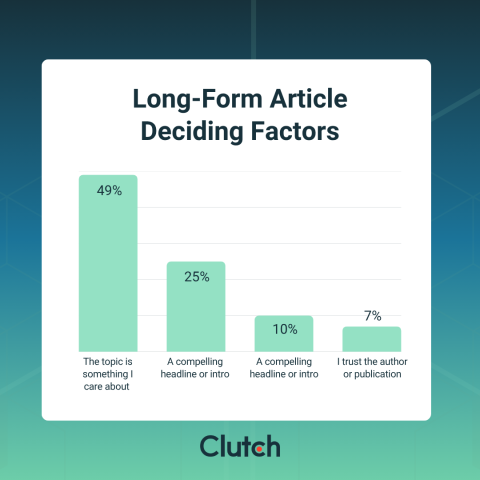
Marketers need to take this order seriously and remember they can't manufacture interest in a topic the reader doesn't care about. In reality, relevance and audience targeting do most of the work before craft ever enters the picture. While headlines, intros, and structure matter, they only do on top of that baseline of genuine relevance. Imagine it this way: a well-written article about the hottest stock market trends still loses if it lands in front of people looking for the best generator for a camping trip in Arkansas.
For readers who do care about the topic, the four preventable exit reasons in the survey serve as your guideposts. If something is "too long", edit tightly. If the content "got boring or repetitive," vary pacing and structure. Scannable subheadings help address both. And an honest headline that delivers on its promise answers ït wasn't what I expected."
Besides understanding their audiences better and writing to address exit reasons, teams should also look at analytics rates to see what keeps readers coming back (or not). Keep in mind that a high bounce rate on a quick-answer article can be fine — that may just be the satisfied 12% from the previous section. Article bounce rates should be read alongside engaged time, not in isolation.
Readers aren't leaving because of the lower reader attention span in 2026. They're leaving because they're selective, and most content doesn't earn the attention it assumes it already has.
Fortunately, most bounces are preventable. Per the survey, 57% give up in under five minutes, but 88% of those who quit do so for fixable reasons — length, pacing, ads, and headline-to-content mismatch.
Ultimately, the teams that win in 2026 are the ones that stop blaming the attention problem and start designing for selective attention. This means earning the reader at every stage by writing a headline that delivers, including a structure that signals value early, and creating content that doesn't waste the five minutes readers give off the bat.