Lead Quality vs. Lead Quantity: Why B2B Teams Are Rethinking Their Funnel in 2026
Bigger buying committees and tighter budgets are forcing B2B teams to rethink lead quality vs. quantity. Here's how top teams rebalance the tradeoff in 2026.
Updated July 6, 2026

AI can transform your e-commerce email results, or just help you send mediocre campaigns faster. The difference is in structure. Here is a practical, no-hype framework for putting AI to work across the customer journey, from deliverability to win-backs.
Email still quietly outperforms almost every other channel. Litmus puts the average return at about $36 for every $1 spent, and retail and e-commerce brands often do even better.
Meanwhile, paid ads keep getting more expensive. That combination makes the list; you already own your most valuable asset.
Looking for a Digital Marketing agency?
Compare our list of top Digital Marketing companies near you
AI is now built into nearly every email platform, and it is tempting to treat it as a magic button. It is not.
Point it at a solid system, and it is a force multiplier. Point it at a broken one, and it just produces polished, generic emails faster. Think of AI as an amplifier: it scales whatever strategy you already have. Here is where it actually helps, in the order I would tackle it.
None of your clever subject lines matter if the email lands in spam. Since February 2024, Google and Yahoo require bulk senders (anyone sending 5,000+ messages a day) to clean up their setup (Google sender guidelines):
Here is the counterintuitive part: this is a great place to use AI, just not for writing.
Feed it your Google Postmaster and blacklist data, ask it to flag anomalies, spam-trap risks, and negative trends, and then hand you a fix-it checklist. It is good at catching patterns that a busy marketer would miss, and a clean sender reputation protects every campaign that follows.
Personalization is not “Hi [First Name]” anymore. McKinsey found that the fastest-growing companies earn 40% more of their revenue from personalization than their slower-growing peers. AI finally makes that practical for teams without a data department.
One approach we lean on is affinity mapping. AI reads how someone browses and buys, tags them, and triggers content that fits. For example:
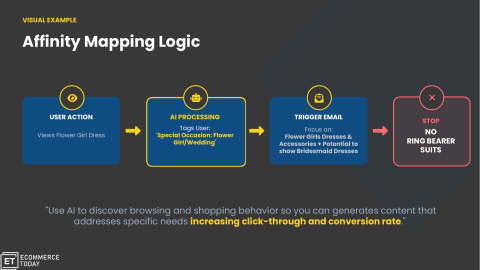
Affinity mapping: AI tags a shopper by behavior, then triggers relevant content. Source: eCommerce Today.
The result is higher click-through and conversion, without the spray-and-pray feel of a batch send. You set the rules; AI handles the volume.
Triggered flows are where AI pays off fastest. They run around the clock and catch revenue that one-off campaigns miss. Three areas matter most.
Most stores show every visitor the same pop-up and the same welcome email. AI lets you match the message to the moment: mobile versus desktop, a casual blog reader versus a high-intent shopper.
And your welcome series should earn trust before it asks for the sale. Lead with your story, not a coupon, so you don't train people to wait for discounts.
Roughly 70% of carts get abandoned, but the cart is only one of five moments worth recovering:
Search abandonment is a favorite. AI can spot a zero-result search for a brand you do not carry and auto-suggest one you do, turning a dead end into a sale.
Structure matters too. Klaviyo reports abandoned-cart flows earn the highest revenue per recipient of any automation, and multi-email sequences far outperform single sends . AI drafts and personalizes each step, and splits the message: reassurance for first-timers, a quick nudge for returning VIPs.
The second order is where the margin lives. A repeat customer is far cheaper than a new click.
AI shines at timing. For a consumable, it can predict when someone is about to run out and send a refill nudge at the right moment, rather than a random guess.
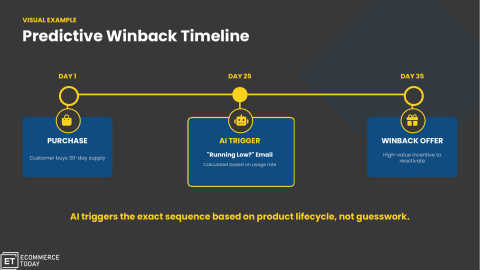
Predictive win-back: AI times the message to the product lifecycle, not a fixed calendar. Source: eCommerce Today.
Sunset flows finish the job: AI helps set the inactivity window and write a last re-engagement email that either wins someone back or clears them off your list to protect deliverability.
Most of us pick subject lines on instinct. There is a better way.
Feed AI your past A/B results (subject lines, opens, clicks, revenue) and ask which patterns actually drove sales, then test its new ideas. It does not replace experimentation; it makes every test smarter by grounding it in your own data.
These habits separate brands that get real value from AI from those that just send forgettable emails.
You do not need to do all of this at once. A sane order:
And keep expectations honest. AI will not invent your strategy, fix a weak offer, or rescue a dead list. What it will do is take repetitive work off your plate, surface patterns in your data, and make one-to-one email possible at a scale that used to need a much bigger team.
If you remember three things:
Email already rewards the brands that own their audience. AI just widens the gap between those who treat it as a system and those who treat it as a send button.