Lead Quality vs. Lead Quantity: Why B2B Teams Are Rethinking Their Funnel in 2026
Bigger buying committees and tighter budgets are forcing B2B teams to rethink lead quality vs. quantity. Here's how top teams rebalance the tradeoff in 2026.
Updated August 4, 2026

With so many options out there, finding the perfect podcast production company for your brand can feel overwhelming. That’s why we put together this guide.
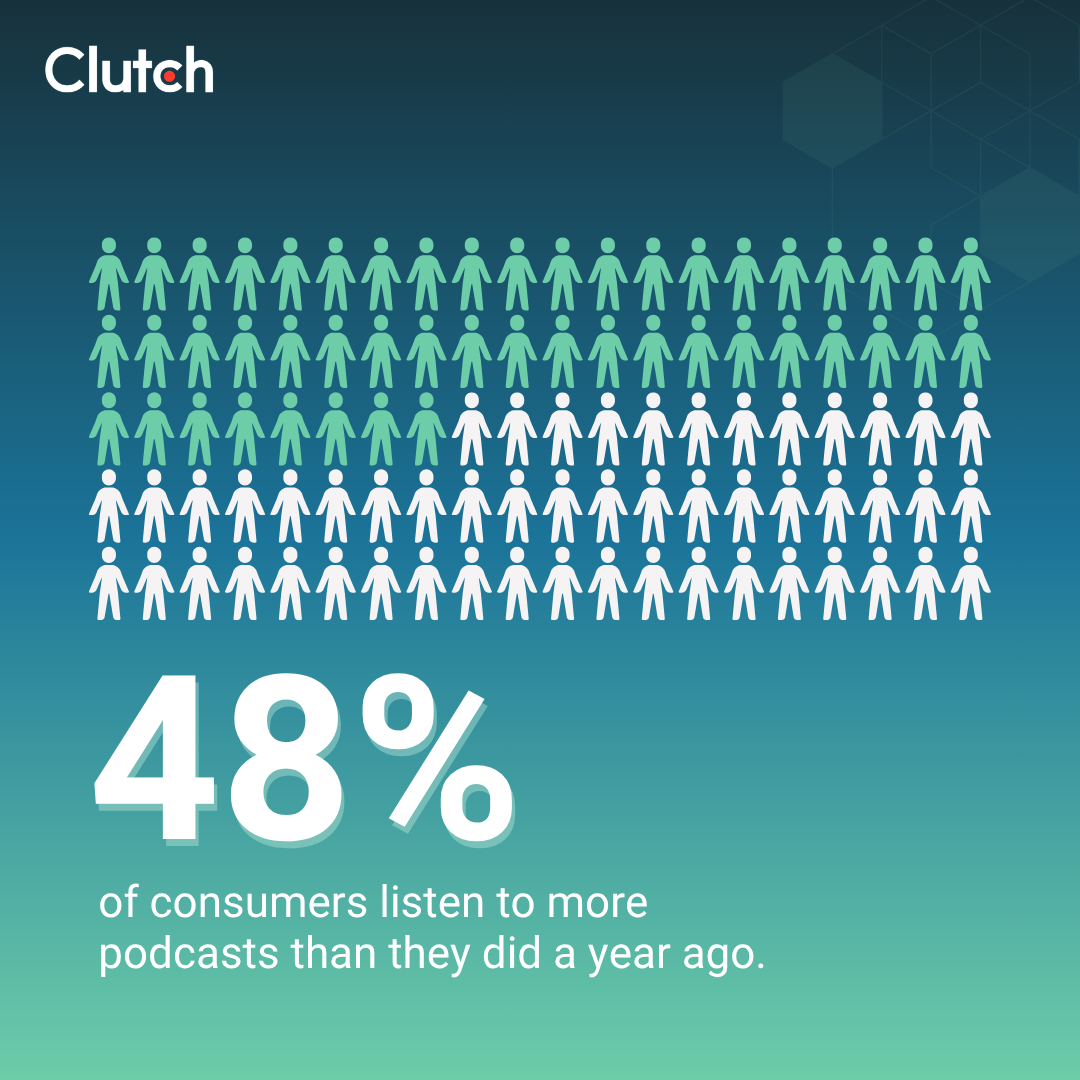
Podcast listening keeps climbing. In a June 2026 survey of 412 consumers, Clutch found that 48% listen to more podcasts than they did a year ago.
Looking for a Digital Marketing agency?
Compare our list of top Digital Marketing companies near you
An increasing number of brands are investing in professional podcast production help instead of producing shows in-house.
A podcast production partner can significantly affect your show's quality, cadence, and cost for a year or more, so it's important to get it right. If you switch partners mid-contract, you will face a steep learning curve with a new team, and possibly a gap in your publishing schedule while the handoff happens.
But finding the right production partner can be challenging. Not only is the web saturated with companies, making it difficult to know which one is best, but most guides on this topic come from a production agency that ranks itself first.
This guide provides a six-point criteria framework for choosing a podcast production company, realistic pricing ranges by engagement model, and a list of discovery-call questions that will help you find the best partner for your brand.
"Podcast production" covers a wide range of services. On one end, you have shops that only edit your raw recording and hand back a polished episode. On the other end, you have full-service partners that handle strategy, guest booking, production, distribution, repurposing podcasts into clips and social content, and growth reporting. Most companies fall somewhere in between.
So, how do you pick the best company for your needs? If you already have a strong show concept, a guest pipeline, and a content strategy, but your episodes sound rough and go out inconsistently, you should get editing and production support rather than a full-service partner. But if you're starting from nothing, you should invest in a full-service partner.
The most common mistake brands make is paying for full-service when they only need post-production. Always match the model to your real gap, not what the sales call recommends.
Look for the following criteria when choosing the best podcast production company for your show:
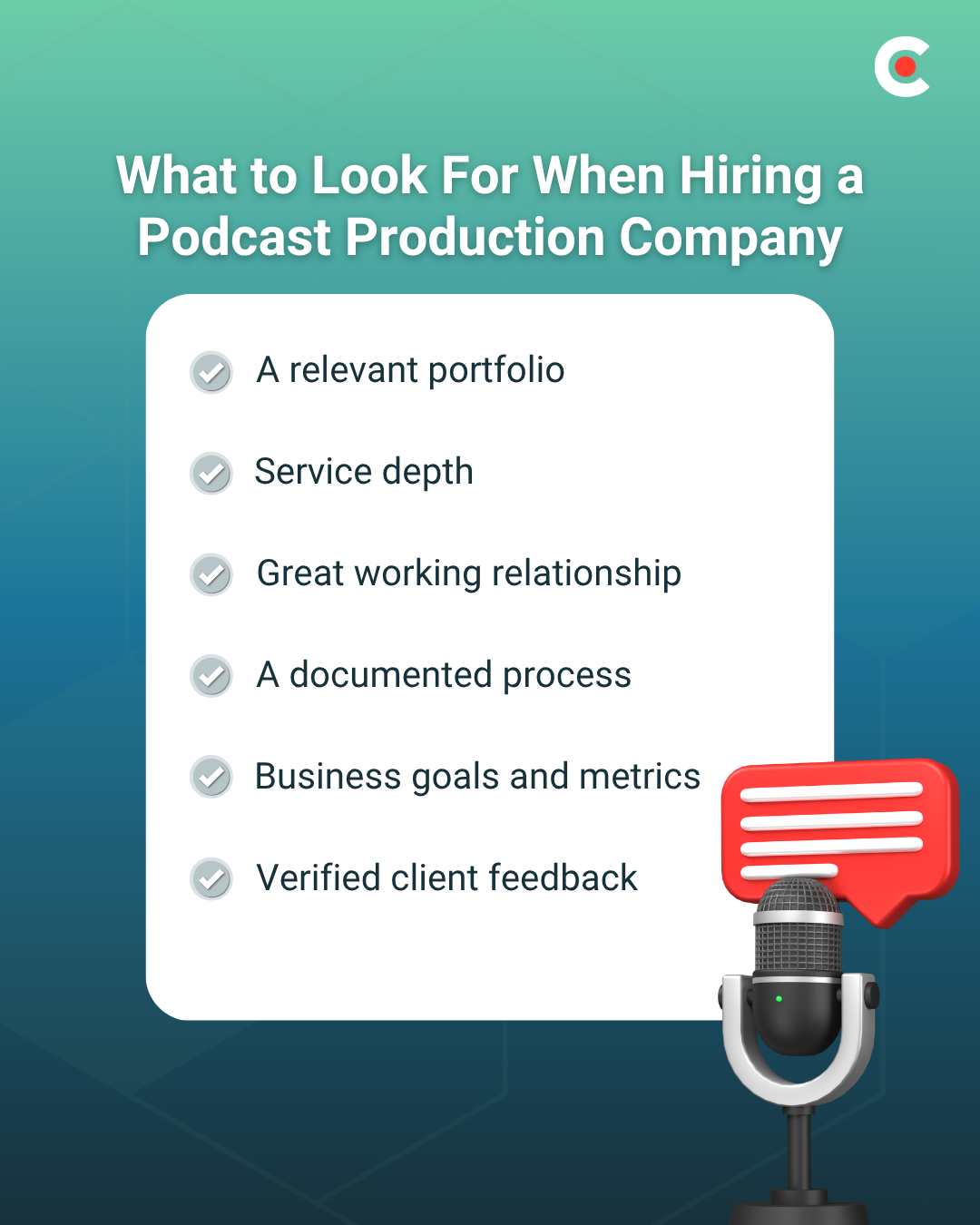
A large client list looks impressive, but it doesn't tell you whether an agency knows your industry or format. On the other hand, a production company that has worked on five shows that are similar to yours will understand the pacing, guest dynamics, and compliance concerns your niche requires.
To properly evaluate whether an agency gets your industry or format, ask to hear episodes closest to your plans, and ask to speak with those clients directly.
Agencies vary widely in what they offer. Some handle strategy, guest booking, editing, marketing, video, and repurposing, while others focus only on post-production. Ask the agency for a clear list of services, and map it against the gap you identified earlier: do you need help with strategy, production, or distribution, or all of them?
Generally, when an agency offers more services than you need, it’s not necessarily a perk — it’s often where extra costs start to sneak in.
The people you meet on a sales call usually aren’t the ones running your show each week. Find out who will handle things day-to-day and what their specialty is. This helps you see if you’re getting dedicated producers, editors, writers, and project managers, or generalists wearing multiple hats.
In general, specialized teams cost more but deliver higher quality and solve problems faster. Generalists are easier on the budget but may take longer to address issues.
A production company that knows its business can walk you through the full workflow — from raw recording to published episode — with timelines at each stage. If they can't describe this clearly, or the process sounds improvised, your show could face delays or inconsistent quality later. A documented process also makes it easier to hold the agency accountable.
Download counts alone don't tell you if a show is working. Ask the agency what it reports beyond downloads — retention, audience quality, or engagement — that ties back to why you started the show in the first place. The right partner should tie their reporting to your business goals, not just vanity metrics.
Finally, agencies should have verified client feedback. Keep in mind, though, that reviews on company websites are handpicked by the agency to present the company in a positive light.
For a more unbiased look at how an agency truly performs, check out platforms like Clutch, which verify client reviews across the vendor landscape. These independent, verified reviews give a clearer picture of what it’s like to work with a company on a day-to-day basis.
Podcast production pricing usually falls into three models:
Here's a table summarizing how podcast production pricing works:
| Model | Typically Includes | Typical Range | Best Fit |
| Per-episode | Editing, production | $1,500–$5,000/episode | Brands testing a partner or with occasional episodes |
| Monthly retainer | Production, scheduling consistency, light strategy | Varies by episode volume | Brands with a steady cadence needing reliability |
| Full-service annual | Strategy, booking, production, distribution, repurposing, reporting | $30,000–$80,000/year | Brands starting from scratch or scaling a show as a growth channel |
When picking the best podcast producer for your brand, keep in mind that the lower per-episode rate isn't always the best value. A cheap quote often excludes strategy, promotion, and repurposing, so you may have to pay separately (or do it yourself). Always ask the vendor what's included in each package or price.
Most guides tell you what to look for in a podcast production company, but few tell you what to actually ask. Here are some questions to ask on a discovery call to get past the sales pitch and see how an agency can work with you. We've grouped them by type.
1. Which shows like ours have you produced?
2. What happened to their audience after six months?
3. Can I talk to that client?
Watch for vague answers about "great results" with no specific show and stats mentioned, or hesitation to connect you with a real client. If they can't point to a comparable show, the agency may not have the sector experience you need.
4. Who exactly works on our show?
5. What does week one to publish date look like?
6. What do you need from us each episode?
Watch for a vague answer about "our team" instead of specific roles. If they can't clearly describe your onboarding timeline, you're likely to encounter the same vagueness once you're a client.
7. Who owns the RSS feed, raw files, and IP?
8. What are the contract terms if we leave?
Be wary of agencies that hold onto your RSS feed.
Even if your show is available on Spotify or Apple Podcasts, you'll lose control of the hosting account, which means you couldn’t upload new episodes, update descriptions, edit the feed, or switch partners without their help. If you lose access, you’d have to start a brand-new feed with a new URL, losing all your reviews, subscribers, and chart history.
You should also watch for agencies that keep the raw files. If they do this, you can’t re-edit older episodes or reuse the content elsewhere.
Most importantly, make sure the agency's IP terms allow you to retain ownership of your show once the partnership ends. Otherwise, they will be the legal owners of your show.
9. What metrics do you report monthly?
10. What do you consider success at 6 and 12 months? Can you share case studies that demonstrate that?
Watch for agencies that limit reporting to downloads only. By themselves, download counts don't tell you if the show is reaching or retaining the right audience.
To finalize your decision on a podcast production company, use the six criteria above to narrow your options to a shortlist of 3 to 5 agencies. From there, filter Clutch's podcast production directory by service focus, budget, and location, and read verified client reviews to pressure-test what each agency told you on the call.
Before signing an annual contract, consider a paid pilot containing one to three episodes. A pilot reveals an agency's process, communication, and quality faster than any sales conversation, and it's lower-risk than fully committing upfront.
Ultimately, the best way to pick the best podcast production company for your brand is to think of it as hiring an extension of your marketing team. Pick the wrong one, and you'll end up with an expensive editing service. Pick the right one, and you'll have a partner invested in growing your audience, not just polishing your audio.
With 48% of listeners consuming more podcasts than a year ago, the audience is there — the question is whether your production partner can help you reach it.