
How to Define Brand Values That Guide Every Business Decision
Brand values are the principles that guide company decisions, define what a brand stands for, and shape how it treats customers, employees, and partners.
Updated May 5, 2026

B2B buyers gather in online communities to trade insights and vet solutions long before they think about sales. But before you jump into a community, you need to know what members actually want from the brands that show up — here’s what the Clutch data reveals...
Most brands have cleared the basics of starting a presence in online communities — they’ve claimed handles, joined Slack channels, and maybe lurked in a subreddit or two. But presence alone isn’t enough. The gap between participating and actually adding value comes down to one variable: what you choose to say once you’re inside the room.
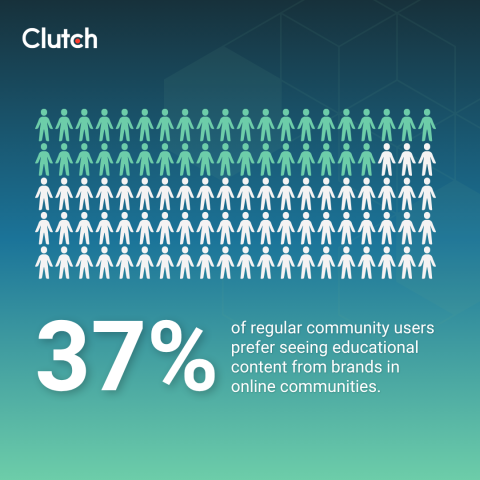
Clutch surveyed 413 consumers who regularly use online community platforms to understand what they actually want from brands in those spaces. The top response, selected by 37% of customers, was educational content and tutorials — a clear margin over the other categories. Exclusive offers and discounts accounted for 21%, product announcements for 16%, behind-the-scenes updates for 15%, polls and interactive discussions for 6%, and user-generated content highlights for 5%.
Looking for a Public Relations agency?
Compare our list of top Public Relations companies near you
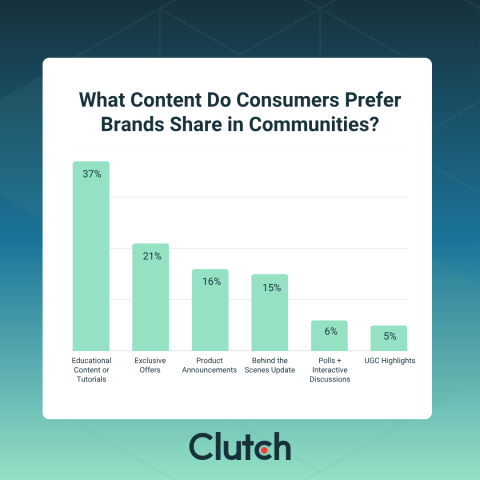
The numbers tell a clear story. Consumers are asking brands to show up differently, putting expertise over promotion to deliver content that makes the community more valuable.
Let’s break down what the survey reveals about the modern B2B buyer, why practical education commands such a strong lead over promotional content, and where offers, announcements, and other content types still fit within a balanced community content strategy.
Showing up in online communities is the easy part. Knowing what to contribute is where most B2B brands still get it wrong.
The data from our survey of online community participants offers insight into the hierarchy of consumer preferences. Understanding what drives these preferences — and what they might mean for brands — is essential for any team refining its community content strategy.
The educational content category claimed more than a third of all responses, outpacing the next-closest option by 16%. The margin suggests that community members view brands primarily as potential sources of expertise rather than entertainment.
For B2B leaders, this preference validates an approach that prioritizes knowledge transfer over persuasion. A software company participating in an operations leaders' Slack community may share a specific workflow tip that solves a recurring bottleneck. Compare that to a promotional post about an upcoming release. One provides value, while the other bogs down social feeds and frustrates community members.
Taking up 21% of survey responses, exclusive deals and discounts are still an important part of any marketing strategy. However, while a meaningful segment of consumers appreciates access to offers, the majority don't consider it as the primary contribution they're seeking from brands.
This is useful guidance for any community content strategy. Offers and discounts have a role to play, but not a leading one. They work best as occasional rewards for active participation, rather than the engine driving your presence online.
A brand that only shows up to distribute discount codes signals that it views the community as nothing more than a sales channel. A brand that contributes educational content and occasionally rewards members with exclusive pricing signals that it values their customer relationships beyond the transaction.
With 16% of consumers prioritizing product announcements, it's clear they remain open to hearing about new products. But only if that information doesn't dominate the conversation.
It's important to be cautious about your framing. A product announcement that reads like a press release will fall flat in community contexts. But the same announcement framed as useful context lands differently.
For example:
It is key for brands to be strategic when interacting in communities while promoting their products.
At 15%, members clearly appreciate the transparency and insider access that comes with behind-the-scenes content. But this category definitely ranks as a nice-to-have rather than a primary expectation. The figure suggests that consumers are curious about how brands operate, but curiosity doesn't drive community participation as much as practical knowledge does.
Behind-the-scenes content performs best when it reinforces the educational value the brand already provides. Think sharing how a product decision was made, what the engineering team is currently wrestling with, or how community feedback directly shaped a recent change. This adds a personal edge to your brand's presence without asking members to care about internal operations for their own sake.
This category's low ranking delivers an important correction to a common community marketing assumption. Brands often default to interactive prompts — polls, questions, discussion starters — believing that driving replies constitutes engagement. The data suggests that consumers see it differently.
Only 6% of respondents selected polls and interactive discussions as their preferred content type. The implication is clear: Community members prefer substance to participation prompts. Any community content strategy that relies heavily on "What do you think?" or "Vote below" is likely misallocating its marketing efforts. Using polls as filler to boost community content engagement metrics misreads what members actually value.
Interactive elements still have a role, but they should be deployed sparingly. And more importantly, they should be used only when the input genuinely informs something — a product direction, content decision, or community improvement.
The lowest-ranked option suggests that while user-generated content remains valuable as a broader marketing strategy, curating it is not what members of community spaces are looking for from brands. The 5% figure reflects that members already see each other's contributions organically within the community. A brand that reposts or highlights the same content adds little value to the experience.
This means that the appropriate venue for amplifying customer voices is likely outside the community itself — on social channels, in email newsletters, or on the company website. Within the community, the brand's job is to contribute original expertise, not curate what members already have access to.
Educational content dominates the preference rankings for a reason — one that should reshape how B2B marketers think about community presence. Communities, at their core, are places where people gather to talk about subjects they care about. Members join these spaces because they face real challenges and want to learn from others navigating the same terrain.
Brands that contribute to that learning goal become part of the community's value proposition. And, by extension, they become a real part of the community. Those who don't contribute become an interruption or an annoyance.
The word "educational" doesn't refer to polished whitepapers, gated webinars, or the kind of content that populates a typical B2B resource center. In community spaces, educational content is practical, specific, and responsive to what members are actively discussing.
What does it look like? A troubleshooting tip dropped into a relevant thread, a concise walkthrough addressing a common pain point, or an expert perspective on a topic the community is already discussing.
Consider how this plays out in practice. In a LinkedIn group for project managers, a brand representative could share a checklist for running more effective meetings, for example. In a private Slack community for e-commerce founders, a brand might share the exact Excel formula its finance team uses to calculate contribution margin after advertising costs.
The important part is that there's no pitch and no link — just a useful model. These contributions are modest in terms of advertising but high in immediate value. That trade-off is intentional, and it can pay off for brands that keep up community engagement efforts.
Every useful contribution serves three purposes at once:
A community content strategy built around education also scales in ways that promotional content can't. A single thoughtful response to a common question can be referenced, linked, and revisited for months.
Promotional posts, by contrast, have a short half-life. And with more repetition, you're more likely to accumulate negative sentiment, as users get annoyed by seeing the same ad again and again.
Educational content should anchor any community content strategy. But the remaining categories still play supporting roles, as long as they're deployed thoughtfully and in proper proportion. The goal isn't to eliminate offers, announcements, or behind-the-scenes content. It's to ensure those formats serve an intentional purpose rather than just filling up space.
The best branded content in a community doesn't announce itself. It simply helps, and, in doing so, earns the kind of trust that overly promotional content never will. Shifting to that approach means answering more questions than you ask and measuring contribution by value rather than engagement metrics.
Brands that get this right stop being visitors in online communities. They become active participants who build real connections with the surrounding members.