
How to Define Brand Values That Guide Every Business Decision
Brand values are the principles that guide company decisions, define what a brand stands for, and shape how it treats customers, employees, and partners.
Updated May 5, 2026

Most marketers still think of Slack as an internal tool. But it can also be a powerful platform for building external community engagement.
Community marketing means more than developing a following on social media. Some of the most impactful work in this space today happens in smaller, more focused spaces — like Discord channels, Reddit communities, and, increasingly, Slack.
To understand the level of opportunity for brands, Clutch surveyed 413 consumers who regularly use online community platforms. Just 4% say they use Slack regularly, but that number jumps to 7% for Millennials and working professionals. The adoption is very low across Boomers, Gen X, and Gen Z.
Looking for a Public Relations agency?
Compare our list of top Public Relations companies near you

This may seem like a small opportunity. Is a Slack community even worth it?
For certain types of brands, it’s a chance to connect more deeply with their most important users. B2B brands, SaaS companies, and professional service firms can all benefit from Slack’s narrow focus and emphasis on community.
Learn what makes Slack communities different, which brands tend to benefit the most from investing in them, and how to get started.
Slack was purpose-built for work, which makes it a naturally different environment from alternatives. Reddit is built around niche interests, Discord is connected to gaming and content creation, and LinkedIn Groups are more about professional networking than getting work done.
Slack communities can be either open or invite-only, and tend to focus on professional interests, industries, and tools. Many SaaS platforms are creating Slack workspaces where users can join to ask questions and connect with other people using the tools. For example, data transformation company dbt Labs runs a community Slack to support industry networking and advanced skill development.

The company says its Slack has over 100,000 members, which shows just how large these communities can become.
There are also some structural aspects setting Slack apart from other community marketing channels, including:
The key differentiator for Slack is that people join it not to scroll, but to learn, network, solve work problems, and stay current in their fields. This purpose-driven use is why the platform’s lower overall usage percentage isn’t necessarily a problem.
Smaller communities like this tend to be more engaged and active, with members returning frequently. For the right brand, that can mean forming a more direct, ongoing relationship with the users who drive purchasing decisions within their organizations.
Clutch data shows that Millennials adopt Slack communities at the highest rate — 7%. Still modest in absolute terms, it’s significantly higher than any other generation. And that’s not a coincidence.
Millennials are the generation that grew up alongside Slack’s rise in the workplace. Many have already been using it as a primary communication layer for work for some years. That makes your pitch to them an easier sell. It’s not about joining an entirely new platform but simply adding a new community to their account.
The typical Slack community member can be highly valuable to certain brands. They tend to fit a certain profile:
Many of these users are already decision-makers within their organizations, and others will grow into that role in the coming years. That profile is an ideal match for B2B brands, SaaS companies, and professional service firms.
If your company is already spending significant resources trying to connect with these users through LinkedIn ads or conference sponsorships, Slack communities may be worth some of that spend. They offer a path to a more direct and useful partnership with these power users than other marketing channels.
Slack communities can be one of the most impactful marketing initiatives available — for specific types of brands. It’s best for the following types of brands:
The common threads across these examples are a defined audience and a professional context. If that describes your brand, Slack is worth a serious look.
Slack’s low adoption rate of 4% means it’s not the right fit for some consumer brands. The platform probably isn’t for you if your product is impulse-driven or your marketing depends on volume and reach.
Showing up on Slack is a good start. But it doesn’t always translate into the kind of community-building brands hope for. Here are some of the key practices that differentiate effective companies on Slack from those that get ignored.
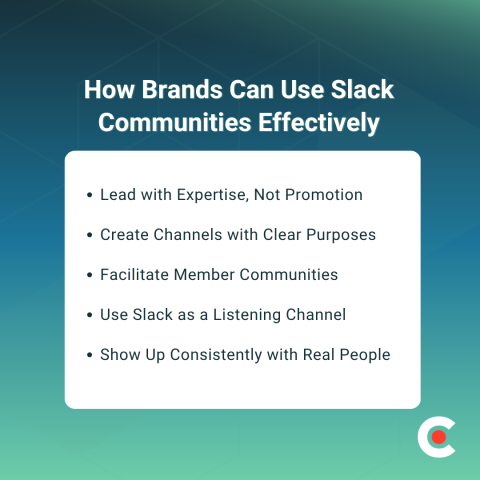
The fastest way to lose credibility on Slack is to treat it like a distribution hub for advertising your services and products. People who use Slack have a low tolerance for noise and pushy marketing on the platform. The brands that build and maintain attention do it by sharing genuine insights, answering technical questions, and contributing to discussions without a visible agenda in every post.
Promotion should typically be indirect on Slack, if it happens at all. People won’t stick around in your communities unless they feel like they’re getting value, and that rarely happens when ads are frequent.
If you’re creating your own Slack community, start by organizing channels around the topics your members need. Look for specific problems, workflows, or industry verticals where you think people want to have ongoing conversations.
You should also let the community’s behavior inform which new channels you add over time. If you try to add too many channels at once, you risk diluting the conversation and making the whole community less useful to your target audience.
The best way to establish your brand’s long-term value on Slack is to help community members find value in each other. For example, you can organize a space for members to introduce themselves, create channels for peer-to-peer exchange, and spotlight relevant expertise within the community.
People join Slack communities primarily to connect with and learn from other experts who work in their field. That’s why, as a brand, your role on Slack is often more that of a facilitator than a marketer.
Your Slack channel will likely surface insights that you can use to improve your products and services. For example, users may discuss pain points, make feature requests, or talk about how your platform compares to another. You’ll miss out on those valuable details unless you have an active social listening strategy for Slack.
It’s critical to get real employees within your company involved in the conversation. Most brands on Slack assign specific team members to engage regularly, respond to questions, and build relationships within the workspace.
Emilio Garcia, managing partner at Boundify, advises his clients to “show up regularly, answer questions genuinely, and eventually, people start paying attention to what you say. That’s when your actual message lands, because you’ve already earned the trust.”

You can also schedule special events within the community, like question-and-answer sessions with a technical lead. These types of one-off opportunities can make your Slack community feel more urgent to your target audience.
For some brands, Slack communities are one of the most impactful marketing opportunities available. Just make sure to avoid the following mistakes, so you don’t dilute the impact unnecessarily:
Be careful not to treat your Slack community like every other marketing channel. The content you share should come from experts within your company and deliver real value to your target audience without promotion. Over time, this naturally gives people a more favorable perception of your brand, which leads to sales.
Slack communities don’t revolve around one-off campaigns. They reward consistency and patient engagement over time. You can start working toward that with the following strategies:
The keys to a successful community are consistent engagement and participation in conversations, rather than trying to steer them to benefit your brand.
Slack communities may not move the needle for the average brand. But for B2B companies, SaaS providers, and professional services firms, they offer something most channels don’t.
Creating a Slack community can help you connect with key decision-makers in your niche on an ongoing basis. That makes it a valuable tool for relationship-building, which is worth pursuing if it fits your business model.