
The Community Advantage: Why Reddit and Quora Are Reshaping B2B Marketing
Reddit and Quora now shape B2B buying decisions long before a sales call. Learn how community trust, expert answers, and peer proof win buyers over.
Updated May 5, 2026

Brands that depend on rewards and promotions to grow their online communities are solving the wrong problem. Clutch's recent survey of 413 consumers probed what actually motivates people to join, stay, and participate.
During flash sales, you lead with an incentive and watch the numbers climb. Many brands operate under the misconception that building an online community works the same way, assuming that discounts, perks, and promotions will attract members. It’s an understandable instinct, as discounts are easy to deploy and track. When it comes to online community engagement, however, the data paints a different picture.
To better understand what actually drives online community participation, Clutch surveyed 413 consumers who regularly use these platforms about their preferences and use cases. When asked their reasons for joining online communities, 69% of participants cited learning tips and gaining knowledge, and 65% said connecting with like-minded people. Discounts and promotions ranked fifth, cited by just 26% of respondents, trailing behind entertainment (33%) and access to exclusive content (36%).
Looking for a Social Media Marketing agency?
Compare our list of top Social Media Marketing companies near you
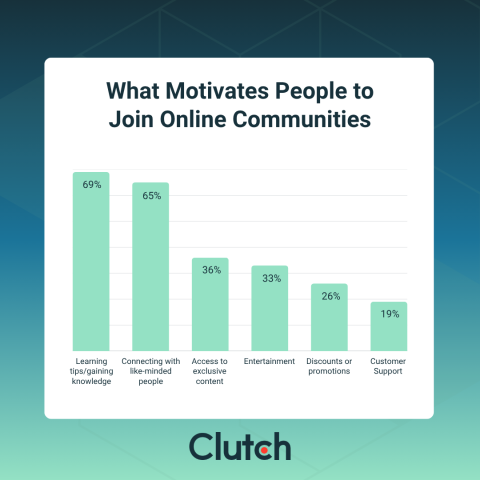
There is a significant chasm between what brands offer and what members want. We’ll break down the real reasons motivating people to join and remain active in online communities, why incentive-first strategies fall short in these digital spaces, and how your brand can realign your community marketing efforts with what your audience truly wants.
The motivators behind online community membership aren’t complicated, but you may need to rethink your perspective. Rather than seeking what your brand will give them, people participate for what they can learn, who they can meet, and how your online community makes them feel. When you understand the real drivers, you can build an effective strategy.
Seeking knowledge is the top reason that consumers join online communities by a wide margin. This makes sense when you consider that traditional content marketing typically provides polished brand messaging when your audience is looking for answers rooted in real experience.
Consumers are increasingly turning to online communities to get practical, peer-validated information. They treat these communities as resources for getting smarter, solving problems, and staying informed. People want to know:
“People don’t want generic advice,” says Ribana Hategan, Director at FOUNDCOO. “They want answers that help them move forward.”

This is an undeniable opportunity for your brand. If people are showing up to online communities to learn, the brands that consistently teach, inform, and help their members through expert Q&As, member case studies, practical how-to guides, and other methods will earn more customer loyalty than brands that lead with product promotions.
Connection with others is close enough in importance to knowledge-seeking that it’s hard to deny the two are intertwined. However, “connection,” in a community context, is more than networking. It’s about finding people who understand your experience, validate your professional frustrations, or share your niche interests or industry-specific challenges.
That sense of recognition is something that passive content consumption can’t provide. A blog post can’t actively validate someone's concerns like a community member who’s been through the same thing and has real-life, actionable tips to help weather the storm.
Communities give people a sense of belonging. For brands, the practical implication is that a strategy focused on content delivery misses half of what keeps members engaged. The environment is as important as the content. If members have no meaningful opportunities to interact with each other, ask questions, share experiences, and build relationships, the community functions as little more than a newsletter mailing list.
When brands intentionally design for member interaction through means such as facilitating structured discussions, peer-to-peer problem-solving threads, or community-led events, they can build something members are much less likely to walk away from.
The next most important reason the survey cited for motivating online community engagement is access to exclusive content. Members want to feel like insiders. Content they can’t get anywhere else, such as early access to data, behind-the-scenes perspectives, or member-only resources, gives the community a sense of value beyond the feed.
The important thing is that the content is exclusive. Content that could as easily belong on the brand’s blog or public social profiles doesn’t create that insider feeling. By treating your community as a VIP channel rather than a place to repurpose content, your community members feel special and are more likely to want to stay.
In addition to being utilitarian, community membership is also social and recreational. Entertainment was the fourth most motivating factor that our survey respondents cited, a reminder that people don’t show up to online spaces purely to solve problems. Sometimes they just want to enjoy themselves.
Humor, personality, creative formats, interaction, and energy within a community all play a role in member retention. A community that feels like a chore to belong to will likely lose members to one that doesn’t.
Only about one in four community members says that discounts and promotions motivate their membership and ongoing participation. That comes last place in our survey, and for brands that have built their community programs around coupon drops and exclusive deals, it’s something to think about.
The appeal of incentives is understandable. They’re tangible, easy to offer, and simple to measure. Including a coupon code in a community post seems like an obvious value-add.
The problem with this approach is structural. Promotions are transactional by nature. A promo code gives someone a reason to drop by once. It doesn’t, however, give them a reason to return a few days later with a question or hang around to answer someone else’s. After they’ve used the benefit, they have no incentive to stay.
True communities, on the other hand, are relational. Knowledge and connection with other people give people a reason to come back and stick around. A coupon can’t replace the value of a community member whose post about their experience helps someone else solve a problem.
The results of our survey show that online community engagement grows when you pay attention to what your community members want, rather than settling on what’s easiest to offer and measure. Translating that into an effective strategy requires rethinking the space communities occupy in the broader marketing picture. We recommend starting with these tips:
So what do these tactics look like in practice?
If 69% of community members are there to learn, your content calendar should reflect informational intent, not just product announcements. For example, consider featuring:
These formats drive online community participation more than any promotional marketing push.
A useful example is Conductor’s customer community, which centers on product education and peer problem-solving.

Members show up, participate, and return again and again because the content is legitimately helpful to them. Brand announcements can be part of your content calendar, but they’re not the reason people make visiting a habit.
Posting great content isn’t enough if members have no mechanisms to engage with each other. Your community needs structures that encourage members to talk to each other and make their interactions feel natural, such as discussion prompts, peer feedback threads, collaborative problem-solving spaces, or even informal channels where members can discuss topics adjacent to your community’s main focus.
Salesforce created its entire Trailblazer Community around this principle.
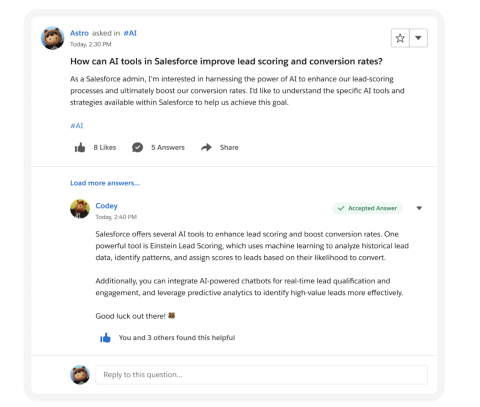
According to Salesforce’s own member survey data, 80% of active community members said the peer connections they made through the community helped them increase adoption and productivity, and 73% said it helped them grow their professional networks.
That didn't happen because Salesforce posted great content. Although that did factor in, what also mattered were the groups, peer Q&A threads, local meetups, and role-based channels that made member-to-member interaction the default.
Aim to create an environment in which, in addition to receiving content from your brand, your members are also talking to each other. That dynamic is how a community begins to sustain itself.
The survey respondents who cited exclusive content as a motivator emphasize the importance of access. Content that only community members can access, such as early research, internal frameworks, or members-only perspectives from practitioners, shows people that membership is worth the time and effort investment.
Sephora’s Beauty Insider Community is one of the best examples of doing this well. Higher-tier members get early access to product launches, invitations to members-only events, and content that general audiences don’t see.
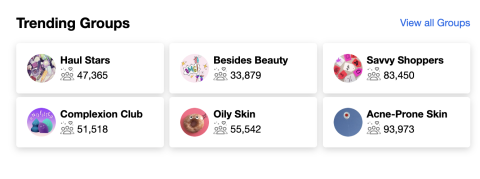
The program’s focus is on delivering experiences only Sephora can provide, and that philosophy extends into its community structure.
When the same content is available everywhere, the exclusivity proposition disappears, and with it goes a meaningful reason to engage with the community. Many people would just as soon follow your brand’s public channels if you don’t provide community members with access they can’t get elsewhere.
A community with no personality will plateau. In the right measures, humor, creative formats, and energy make participation feel less like an obligation and more like a choice.
Keep in mind that balance is important. Entertainment without substance wears thin, and a community that leans too far into levity can begin to lose credibility with its more serious members. Conversely, one that takes itself too seriously tends to lose the casual participants who bring much of the community’s day-to-day energy.
Don’t take discounts entirely off the table. Rewards and promotions can work well as supporting elements rather than as a community centerpiece. For example, a welcome offer for new members or an occasional members-only exclusive deal adds value without defining your community’s reason for existing.
Our survey found that the single biggest frustration community members report (24%) is too much promotional content. In online spaces designed for peer trust and authentic exchanges, promotional content annoys people and actively undermines what makes the community worth participating in.
Instead, promos and benefits should supplement a community that focuses on knowledge and social connection. When you strike this balance, those benefits don’t create the churn problem that arises when members join just to nab a deal and abandon ship after receiving it.
Consumers join online communities not to access deals but to learn and connect. Promotional strategies can be great in other channels, but our survey makes clear what communities are specifically for and what members expect from them.
Dropping a promo code is easy. Constructing a community around education and connection is harder. It requires ongoing investment in truly helpful content, an environment that facilitates interaction rather than only content consumption, and the patience to build trust within your community before pushing for anything in return. The payoff is a community that retains members, generates trust, and creates organic advocacy that promotions can’t buy.
An effective online community engagement strategy starts with understanding people’s motivations to join and participate. Before you decide which platform to use or what content to post, start with the question the data answers unequivocally: Why do people show up in the first place?