
How to Define Brand Values That Guide Every Business Decision
Brand values are the principles that guide company decisions, define what a brand stands for, and shape how it treats customers, employees, and partners.
Updated October 19, 2026

AI assistants now recommend products and brands, and with ads arriving in tools like ChatGPT, businesses have to track organic mentions alongside paid placements. New Clutch data shows that 32% of AI assistant users spot ads because they name a specific brand or product, and 18% say they can't really tell and just assume. That means even a brand's organic mentions can look like paid ones. This guide covers how to audit what AI says about your business, fix misrepresentations, and build an ongoing monitoring process.
AI assistants are ubiquitous across customer service, healthcare, finance, and other industries for automating tasks, analyzing data, providing support, and searching the internet.
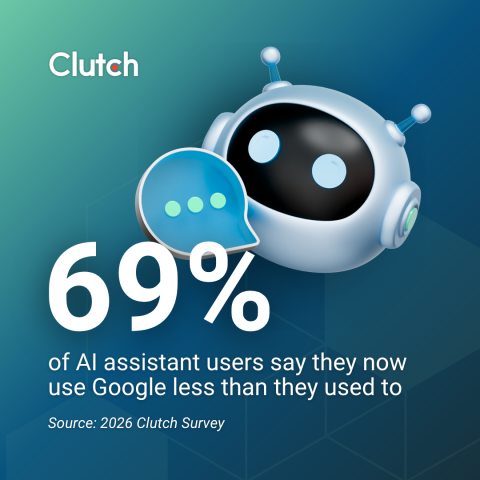
Recent Clutch data reveals that 32% of people who have tried AI assistants now turn to them first when seeking information. Only 28% of AI assistant users still go immediately to Google with their queries. Meanwhile, 69% of AI users rely less on Google because of AI assistants. Even with the presence of ads in AI assistants.
Looking for a Public Relations agency?
Compare our list of top Public Relations companies near you
Many consumers use AI assistants to research, compare, and recommend products, services, and brands.
The problem is that most businesses have no idea what AI is saying about them during those “conversations.” They simply don’t know whether AI accurately represents their brand, positions it fairly against competitors, or even mentions their brand at all.
AI brand monitoring is the recurring practice of sampling how AI assistants mention, describe, recommend, and cite your business. Start with a fixed set of customer questions, save the answers and visible placements, verify factual claims against current sources, and assign an owner to corrections. The result is a record of the experiences you tested, rather than a complete view of every customer’s conversation.
Record brand mentions in the generated answer separately from advertisements. OpenAI’s advertising FAQ says ChatGPT ads are labeled as sponsored, visually separated from responses, and do not influence answers. Ads may appear on eligible Free and Go accounts; several paid plans, including Business and Enterprise, do not have ads. Check the current policy and the exact surface you are testing.
For your audit, classify a brand reference in the generated answer without a sponsorship label as an answer mention. Record a visibly labeled sponsored unit as a sponsored placement, with its advertiser and destination. If the label or surrounding interface is missing from the evidence, mark the placement as unclear. A product name alone cannot tell you whether a placement is paid.
Capture the full rendered experience when inspecting ads. If your monitoring tool captures only answer text and cannot show sponsored units, mark ads as “not observable” in that dataset. Do not turn that limitation into a conclusion that no ads appeared.
Clutch’s AI adoption and usage survey reports the following AI use cases among people who have tried assistants. These are reported activities, rather than measurements of what every user does immediately before purchasing:
“The biggest risk is losing control of your own narrative,” says Charlie Marchant, CEO of Exposure Ninja. “If you’re not actively shaping how your business appears across the web, AI will fill in the gaps for you, and it will base that on whatever it can find, whether that’s outdated information, inconsistent messaging, or third-party opinions that don’t reflect your business well.”
The same survey reports that 56% of users regularly encounter wrong or unhelpful responses and 42% completely or mostly trust AI information. Those figures do not establish that the same people accept every response without checking it. They do support reviewing the accuracy of the brand information your sampled answers contain.
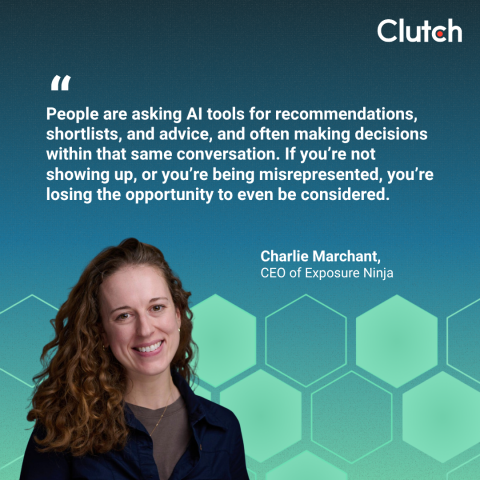
“This is happening earlier in the search journey than ever,” says Marchant. “People are asking AI tools for recommendations, shortlists, and advice, and often making decisions within that same conversation. If you’re not showing up, or you’re being misrepresented, you’re losing the opportunity to even be considered.”
Without AI brand monitoring, you’re entrusting your online brand reputation to a system built on pattern-matching across millions of web sources. There’s no reason to assume it accurately represents you.
Misrepresentation doesn’t always mean that AI invents false information about your business. More often, it loses nuance and fills in the gaps in less-than-flattering ways.
“We’ve already seen cases where businesses are labeled as ‘expensive’ or ‘slow,’ when that’s not how they position themselves at all,” says Marchant. “But from the AI’s perspective, it’s just pattern matching based on what exists online.”
The most common misrepresentation patterns include:
Separate a verifiable error from an opinion or an absence. An obsolete price is a factual issue; “expensive” requires context about the offer and comparison; a low position in a list does not by itself prove inaccuracy. Record the evidence needed to assess each claim before deciding on a correction.
A real-world case from Exposure Ninja illustrates how this plays out and how fixable it can be.
“In a recent AI Search audit we performed for a client, we noticed that they were repeatedly flagged as ‘overpriced’ in AI answers,” Marchant says. “In reality, they were competitively priced, but they had a different pricing structure from their competitors. That nuance was not being communicated clearly across their website and third-party sources, so AI interpreted it negatively.”
From there, correcting the issue was intuitive.
“Our team raised this insight, and the business made changes to how their pricing was structured and explained,” says Marchant. “Within just a few weeks, the AI responses shifted, and the ‘overpriced’ label disappeared.”
She explains, “The key point is that you cannot simply adjust messaging and expect AI answers to change. You have to address the underlying signals, like the pricing structure in this case. When those improve, the way AI represents your business usually updates quite quickly.”
Marchant’s example is a reported client experience, not a guaranteed correction timeline. Keep evidence of the original claim, the source changes, and subsequent responses so you can see whether a problem persists across repeated checks.
An AI visibility audit requires no special software to start.
“For most businesses, the first step is simply to audit where they stand now,” says Marchant. “Go into the main AI platforms your customers are likely to use, like ChatGPT or Gemini, and search for the products, services, and questions that matter to your business.”
To understand how AI represents your brand, you’ll want to look at:
Essentially, when you conduct a brand audit, you’re method-acting the role of a consumer.
Start with the platforms your customers use. Clutch data on AI assistant usage shows the most popular platforms among AI assistant users:
| Platform | Percentage of Users |
| ChatGPT | 74% |
| Google Gemini | 55% |
| Meta AI | 40% |
| Microsoft Copilot | 31% |
| Perplexity | 20% |
Test each platform separately. Responses will vary significantly depending on the model’s training data, retrieval methods, and how each model weights different source types. You may be happy with your brand’s representation on ChatGPT, but dislike the way Gemini describes it, while it might not even surface as a potential solution in Perplexity.
Define the test environment for each platform: app or website, account tier, visible model or mode, search setting, language, market, and any relevant history or personalization. Begin each baseline prompt in a fresh conversation and use a consistent history policy. Log any setting you cannot control. Keep customer-like personalized checks in a separate series so they do not silently change the baseline.
Don’t just ask the AI about your brand name. The higher-stakes queries are ones customers use before they even know your brand’s name. Invisibility and misrepresentation do the most damage in category searches, comparison questions, and problem-based prompts.
Test queries like:
These are the questions customers ask before making purchase decisions. If AI assistants describe your brand inaccurately — or not at all — you’re losing ground.
Use customer interviews, sales questions, support requests, and search-query data to build your initial prompt set. Keep branded fact checks separate from unbranded discovery prompts: a response to “What does [brand] sell?” does not show whether an assistant recommends you without being asked about you.
For a manageable starting protocol, choose 10 prompts and run each three times per platform in fresh conversations under the same conditions. This is a suggested sampling plan, not a statistical confidence threshold. Version the prompt list and retain a fixed comparison set when you add new questions.
With systematic documentation, you can turn observations into actionable data. For each query, track:
“That gives you a really clear starting point,” Marchant says. “You can’t improve your AI visibility if you don’t know what AI currently thinks your business is.”
Record the AI’s exact responses with timestamps. AI answers can change quickly, and documentation lets you track patterns and improvements over time.
Use one record per prompt run. Include the prompt ID and exact wording, date and time, platform and settings, full answer or saved capture, cited URLs, mention and recommendation flags, visible sponsored units, and a factual-accuracy note. Keep missing citations separate from “no factual error found,” and mark failed or incomplete runs rather than silently dropping them.
Compare factual claims with current product, pricing, service, and company information. Then review how positioning differs from the evidence and the audience’s needs. Common issues to flag include:
“From there, you can work out whether the biggest issue is technical, content-related, or reputational,” says Marchant. “But the audit has to come first, because it shows you the gap between how you want to be represented and how you’re actually being represented today.”
Following your brand audit, you can begin the work to position your brand properly.
Correct the factual information you control, request documented corrections from third-party publishers where appropriate, and retest the answer. A cited page is a useful lead, but do not assume it reveals every input behind an assistant’s response.
How to fix each issue depends on the source of the problem. Some common scenarios:
In the Exposure Ninja case described above, Marchant says the client changed how pricing was structured and explained. The lesson is to address a genuine source of confusion; it is not a reason to change prices simply to obtain a preferred AI description.
For Google’s AI experiences on Search, Google recommends useful content and a clear technical structure, while stating that crawling, indexing, and serving are not guaranteed. Apply that guidance to Google’s surface; do not present it as a promise of inclusion across every assistant.
Track the source update date separately from the first later response showing a correction. That record helps you distinguish work completed from an improvement actually observed.
“When those improve, the way AI represents your business usually updates quite quickly,” says Marchant.
Retest the same prompts under the same recorded conditions every two to four weeks as a starting cadence, with earlier checks for material factual errors. Record both corrections and unrelated changes in the testing environment. A better answer after an update shows sequence, not proof that the update caused it; compare repeated results and report unresolved errors too.
Because AI’s sources and answers are constantly evolving, a one-time brand audit isn’t enough. New misrepresentations can emerge as competitors change their positioning or sources publish new content. An ongoing AI brand monitoring system allows you to correct new issues quickly.
Rather than treating it as a separate initiative, build monitoring into your existing marketing rhythm.
We recommend:
Revisit cited sources to confirm they are current and accurate. Keep the baseline prompts when expanding the audit, and review severe factual errors promptly rather than waiting for the next monthly check. Judge opinions on their evidence, not whether they are favorable to your brand.
Define metrics before comparing periods. For this manual audit, use the same set of completed response observations for each platform and prompt group. Record excluded or failed runs separately. Count a brand once per response for mention-rate calculations, even if its name appears several times.
Keep mentions and linked citations separate. A recommendation without a link is still a recommendation; a cited page is not automatically an endorsement. Track tone and source diversity alongside the measures below.
| Measure | Calculation or rule | Interpretation |
| Answer mention rate | Completed responses naming brand ÷ completed responses × 100 | Presence in the sampled answer set |
| Recommendation rate | Completed responses explicitly recommending your brand ÷ completed responses × 100 | A narrower measure than any mention |
| Owned-site citation | Completed responses linking to your domain ÷ completed responses × 100 | Links to your site, not all mentions about you |
| Sponsored-placement observation rate | Checks showing your labeled sponsored unit ÷ completed checks capturing the full interface × 100 | Observed interface exposure; exclude text-only checks |
| Factual accuracy review | Record verified errors and unresolved claims against current evidence | Human review; keep opinion and factual error separate |
For example, if your brand appears in 12 of 30 completed answer observations, its mention rate is 40% for that sample. This is an illustrative calculation, not a benchmark, market share, or estimate of how many real users saw your brand. Report results separately by platform, prompt group, and test environment.
Mine My Brand, powered by Exposure Ninja, describes reports covering brand sentiment, competitors, and sources across AI platforms. Treat those reports as evidence to review against your audit protocol. Ahrefs documents custom prompt tracking with selectable assistants, location, and refresh frequency, which can support a recurring prompt set.
Before choosing a tool, check which platforms and response surfaces it captures, whether it retains exact answers and settings, how its metrics are defined, and whether it can observe sponsored units. A tool that collects answer text can be useful without measuring the entire interface. Confirm current coverage and export options; these examples are not independent performance rankings.
You likely already monitor customer reviews, press mentions, and social sentiment. AI representation also deserves a regular check-in. Assign internal ownership. Whether it falls to marketing, brand, or SEO, someone should be accountable for running tests, documenting results, and catching issues early.
Route factual corrections to the team that owns the relevant information, source updates to content or PR, and labeled paid placements to the paid-media owner. Keep one issue log so everyone can see the evidence, action, and retest result without merging paid exposure into answer-mention metrics.
When your business has nipped misrepresentation in the bud and corrected any glaring issues, what should success look like?
Regarding the impact of AI brand monitoring, Marchant references a particular client’s case. “The client reported that they had multiple inquiries where people mentioned they’d asked AI tools like ChatGPT for the best provider in their space, and our client was recommended at the top,” she says. “That’s the real change. AI isn’t just another traffic source. It’s becoming a recommendation engine.”
Track inquiries or conversions that customers attribute to AI separately from your sampled visibility results. Marchant’s account illustrates a reported outcome; a high position in one answer is not proof that monitoring caused an inquiry or that your brand ranks first for everyone.
Start AI brand monitoring with a small set of relevant prompts and a consistent testing environment. Save what the assistant says, distinguish answer mentions from visible sponsored placements, and verify the claims that could affect a customer’s decision.
Marchant says, “You can’t improve your AI visibility if you don’t know what AI currently thinks your business is.”
Assign an owner to each material issue, correct the information you can substantiate, and rerun the same checks. A useful monitoring process tells your team what changed, what still needs attention, and what the evidence can support.
If you’re looking to monitor and improve your brand’s AI presence, a strong starting point is partnering with a branding agency or SEO firm that understands AI search.