
The Community Advantage: Why Reddit and Quora Are Reshaping B2B Marketing
Reddit and Quora now shape B2B buying decisions long before a sales call. Learn how community trust, expert answers, and peer proof win buyers over.
Updated January 21, 2026

Could LinkedIn be the missing piece to your B2B marketing strategy? Learn why the answer could be yes.
LinkedIn continues to prove its importance in the B2B space, with ad revenue projected to reach nearly $4.75B by the end of 2025. The maturing social platform has become especially widely used for thought leadership content and B2B prospecting. It stands out by offering direct access to diverse industry leaders and through its business-oriented user base, which is ideal for professional networking.
However, using LinkedIn isn't the same as using LinkedIn effectively. If you want to leverage the platform to pursue your business objectives, you'll need an authentic, original approach that can cut through the noise. The first step in that process is understanding what makes LinkedIn unique as a B2B marketing platform.
Looking for a Social Media Marketing agency?
Compare our list of top Social Media Marketing companies near you
Founded in 2003, LinkedIn has evolved from a simple professional networking site into a B2B marketing powerhouse. It's become a hub for brand storytelling, content distribution, and overall business growth, especially with features like LinkedIn Ads and integrated analytics.
Today, LinkedIn stands apart from other social platforms because it's been purpose-built for professionals. The context of every interaction is career-driven and based on trust. This means peer-to-peer recommendations carry strong weight on LinkedIn, and decision-makers are often more open to content that helps them solve real business challenges.
But you'll need the right approach to unlock the benefits of LinkedIn for your brand.
Lufti Aydeniz, CEO of fascinatid, says, “In B2B, we see value in micro-creator partnerships—influential LinkedIn voices, respected YouTube educators, or niche podcasters. Instead of flashy brand deals, we focus on co-creating content like webinars, Q&A sessions, or expert-led blog content and technical articles.”
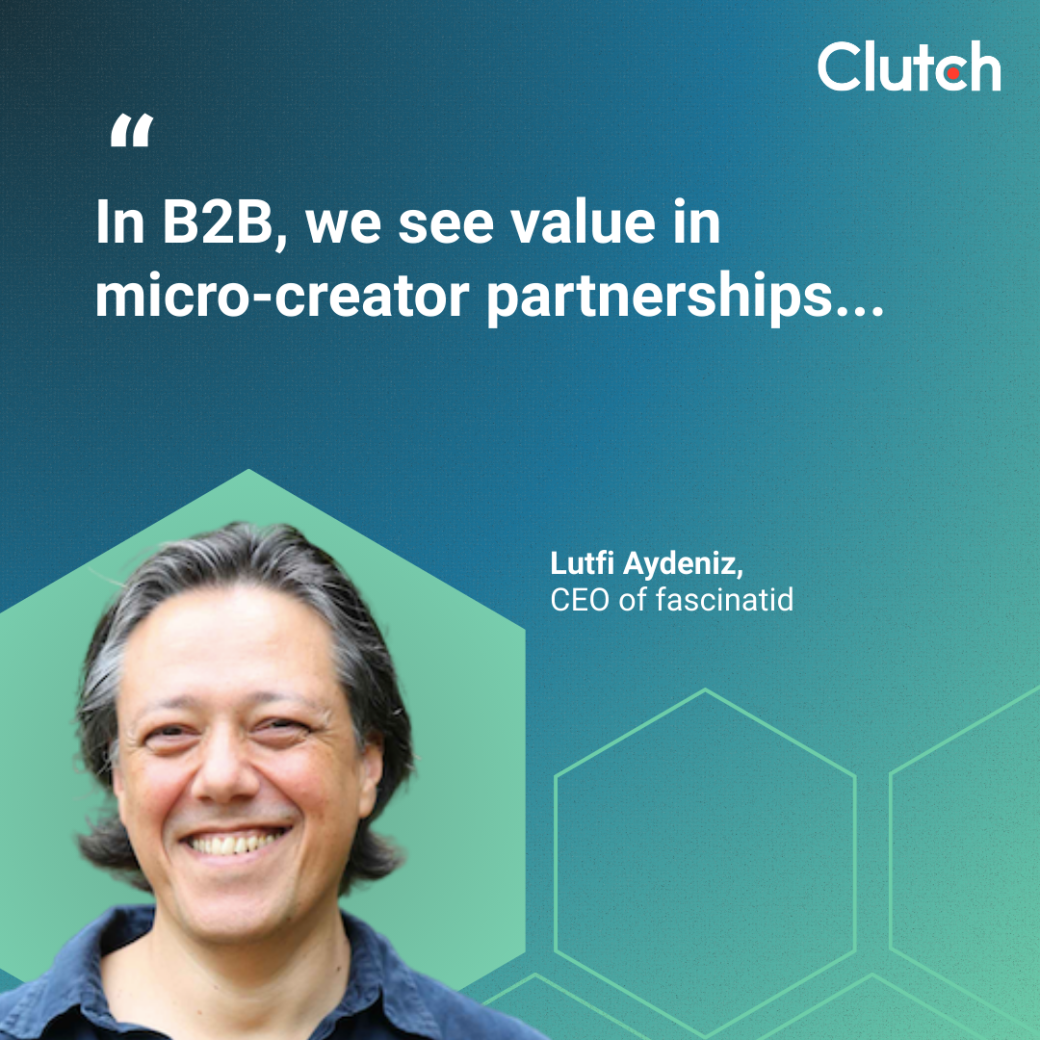
Aydeniz and his team have had success with employee advocacy programs on LinkedIn. But these are just a few examples of the many types of content that can work on the platform.
For example, Tori Dunlap, founder of Her First $100k, uses LinkedIn to share financial literacy content, entrepreneurial lessons, and insights into her journey as a founder.
She mixes personal storytelling with practical expertise to position herself as both relatable and authoritative.

It's a combination that helps Dunlap drive deep engagement with the professional audiences she targets.
The key to doing well on LinkedIn is establishing yourself as a thought leader in a particular field. These are more than frequent posters. They're consistent, credible voices that add a unique perspective and real value to their professional community. That often means displaying:
There's more than one way to share thought leadership content on LinkedIn. You can do so through:
For example, Eileen Kwok is a marketing expert at Hootsuite who has built a large following on LinkedIn. Her posts aim to simplify complex marketing topics for general audiences in all stages of the funnel, and often share clear, actionable tips for execution.
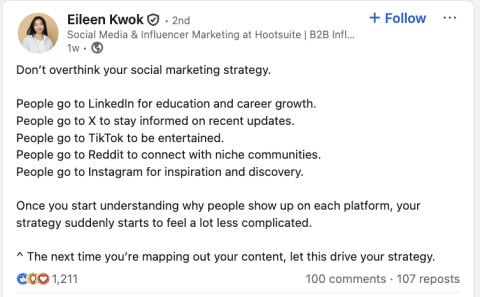
Kwok exemplifies her industry expertise in every post and uses a consistent tone to build authenticity over time. It's just one example of the many different pathways to becoming a thought leader on LinkedIn.
If you're still developing your approach, don't be afraid to experiment. Trying several different forms of content will teach you which types resonate best with your target audience, so you can focus on those posts moving forward.
LinkedIn may be the best social platform we have for professional networking. But building a following anywhere can be challenging, especially on a site where everyone's main interest is advancing their career.
To stand out, you'll need to develop an original point of view, tap into growing trends, and refine your strategy gradually with LinkedIn analytics.
Content strategist Devin Reed demonstrates these principles in practice. He blends an original POV with data-backed insights from his work in storytelling and sales.
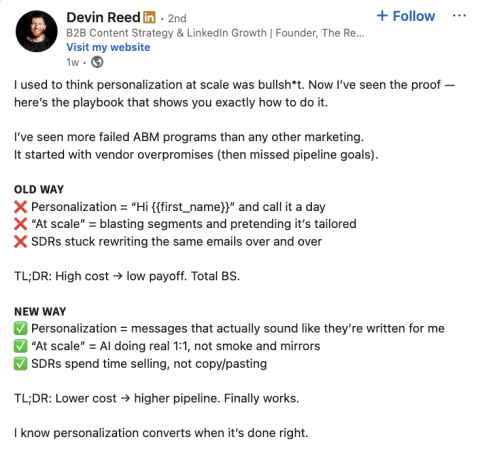
Reed also comments on industry trends and weaves in personal stories for practical, relatable, and compelling content.
Businesses can balance context mixes using the 5-3-2 or 40/40/20 rules.
The ‘5-3-2 Rule’ suggests a mix of five curated pieces, three original pieces, and two personal updates to maintain a balanced feed. The ‘40/40/20 rule’ suggests that the content should include 40% expertise, 40% engagement, and 20% promotional.
Whichever strategy you try for your LinkedIn thought leadership, make sure you value consistency.
The most effective content on LinkedIn starts with a strong, original point of view. So, try to move beyond the ideas you just read about to focus on unique insights, fresh frameworks, and lived experiences. This will differentiate you from others in your industry, helping you cut through the noise.
Establishing an original point of view on LinkedIn starts with recognizing that the platform has evolved far beyond a static digital resume. Today, high-performing professionals treat their profiles as a ‘personal media hub,’ a living ecosystem that holds ideas, expertise, and personality.
By leaning into personal branding, you position your profile as a destination, one that attracts profile visits because it consistently communicates what you stand for and why your perspective matters.
A practical way to activate this mindset is by enabling Creator Mode, which unlocks powerful tools like newsletters, featured content, and live streaming. These features reinforce your role as a creator and thought leader, while helping your audience follow your ideas over time.
It's also important to keep your finger on the pulse of industry trends and broader cultural conversations. Tapping into these with thought leadership content can significantly boost engagement and help you connect with users who may not have found you otherwise.
Trends play a critical role in driving engagement on LinkedIn, especially as the platform increasingly rewards formats that feel personal and immediate. Short-form video has emerged as a standout, not just for its reach but for its ability to humanize the brand behind the message. Quick, authentic clips allow leaders to share human-centric stories that resonate.
When paired with interactive formats like polls or conversations sparked through LinkedIn Live, these moments invite participation rather than passive scrolling, turning engagement into dialogue.
So, pay attention to what's being discussed on LinkedIn and look for opportunities to connect your industry with these trends. Doing so will help you tap into larger audiences and grow your following over time.
Great content isn't always enough to stand out on LinkedIn. That's why most creators also focus on amplification. In this context, that can mean:
Strive to be creative when setting up your LinkedIn content calendar.
Finally, you'll need an objective way to measure your performance on LinkedIn, so you can refine and optimize after some time. LinkedIn Analytics is the perfect feedback loop for that. It can help you track critical metrics like:
Track the key metrics for your business marketing strategy.
If you need to make changes to your LinkedIn thought leadership strategy, think about technical specifications for the content, like ideal character counts, posting during ‘Golden Hour’, or thinking through hooks to attract users.
Thought leadership on LinkedIn can be a powerful marketing accelerant for brands. It offers benefits like:
However, becoming a thought leader on LinkedIn also comes with a fair share of challenges. These include:
Consider all of the benefits and challenges when looking to include LinkedIn in your marketing strategy.
LinkedIn has become a cornerstone of modern B2B thought leadership marketing, and that shows no signs of slowing down in the near future. The platform is a powerful tool for establishing yourself as an industry leader, which can build credibility with B2B buyers and help you stand out when it comes time to pitch.
But thought leadership is more than a marketing trend. It requires genuine expertise and human connections, which can be challenging to establish. If you need help getting started with your LinkedIn strategy, it may be worth contacting a marketing agency.
Learn more about the state of digital marketing in Clutch’s latest survey report.