
How to Define Brand Values That Guide Every Business Decision
Brand values are the principles that guide company decisions, define what a brand stands for, and shape how it treats customers, employees, and partners.
Updated April 23, 2026

As AI reshapes the branding landscape, one thing is clear: creativity isn’t being replaced—it’s being redefined. From why brand voice is now part of your SEO stack to how agencies must act as strategic guides—not just producers—this piece challenges brands to show up clearly, consistently, and unmistakably human.
Whether you’re navigating AI-generated summaries or rethinking your content strategy, this article offers a grounded, human-first perspective on where branding goes next.
For decades, the brand was the anchor. The constant. The thing that everything else pointed back to. Strategy informed it. Creative expressed it. Marketing delivered it.
Now, brand is the variable.
Looking for a Public Relations agency?
Compare our list of top Public Relations companies near you
AI tools are reshaping how content gets made, how it’s found, and how it’s judged—often without a human ever touching the edges. Search engines summarize it. Algorithms remix it. Large language models lift a sentence from a testimonial and use it to define you. It’s no longer just about what you say—it’s about how your brand is interpreted and reassembled across an ecosystem you don’t fully control.
That’s not a threat. It’s a shift—and it’s triggering a quiet recalibration.
For those who’ve helped brands navigate past inflection points—mergers, rebrands, digital transformations—this moment has a familiar feel. Branding has always had to adapt to its environment. First, we treated the homepage like the flagship store. Then came mobile-first, where brand voice had to be compressed down to a headline and a swipe. Social media shifted control even further, placing brand perception in the hands of influencers, followers, and comment threads. Campaigns gave way to ecosystems.
Now, with AI, we’re staring down another shift—but this one feels different. It’s less visible. More distributed. Your brand is being summarized, scraped, and remixed—often without your involvement. This isn’t just another tool to plug into your workflow. It’s a structural change in how brands are discovered, interpreted, and reshaped in real time.
And while the fog hasn’t fully lifted, the path forward is starting to take shape. It’s not disruption for disruption’s sake—it’s the next evolution. Another constraint. Another prompt to sharpen how we speak, how we show up, and how we stay unmistakably human in a machine-smart world.
Branding was never just picking a color and calling it a day—but there was a time when the process, while still rigorous, had a more direct line from research to expression. At Lippincott, I’d get mountains of insight handed over before sketching a single logo. At Nike, we did the research—obsessively—with a laser focus on the consumer. Not the distributor. Not the middleman. And definitely not a large language model.
Today, branding remains just as strategic and multifaceted—arguably more so. We’re still conducting primary and secondary research, facilitating workshops, developing personas, writing manifestos, crafting messaging hierarchies, building visual systems, and refining every customer touchpoint across digital and physical space.
What has changed is the audience we’re now designing for.
Enter AI-powered search. Tools like Google’s Search Generative Experience (SGE) and ChatGPT’s web browsing capability aren’t just indexing your content—they’re summarizing your brand for you in real time. And often, that summary is what a potential customer sees before they ever land on your homepage. Your blog posts, testimonials, PDFs, filenames, even your team bios—these are the ingredients AI uses to define you.
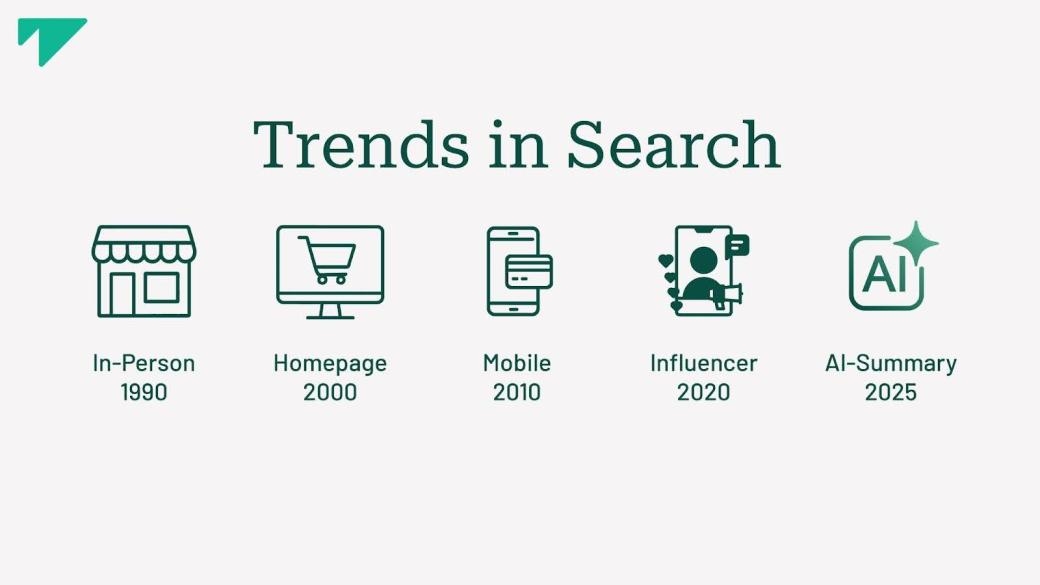
So we’re no longer building brands just for humans. We’re now creating algorithms, crawlers, and systems that interpret, compress, and remix our stories into synthetic summaries.
That doesn’t mean creativity is obsolete. It means our creativity has to be structured. Intentional. Machine-readable and emotionally resonant. We still need that poetic About page—but now it needs to show up in schema.org format and read well when a bot paraphrases it.
Branding isn’t simpler. It’s just moved to a bigger stage—where both people and machines are in the audience.
Brand voice used to live quietly in the style guide—somewhere between “We’re approachable but not goofy” and “Oxford commas, always.” It helped shape campaigns, headlines, and taglines. It kept teams aligned, even if it rarely made its way into the strategy deck.
Now? That voice isn’t just an expression of personality—it’s a search signal.
As AI-powered platforms like Google’s SGE and ChatGPT begin summarizing websites in real time, your brand voice becomes part of the infrastructure that determines how you’re indexed, interpreted, and introduced to the world. If your messaging sounds interchangeable—or worse, machine-written—it won’t stand out to human readers or the algorithms summarizing your story.
According to a 2024 study by Gartner, by 2026, 30% of web browsing sessions will be screenless, driven by voice AI and LLM-powered search. This means many customers may never see your homepage. Instead, they’ll “hear” your brand as a compressed, AI-generated summary—assembled from whatever content you’ve published, structured, and tagged.
So the goal isn’t to rewrite everything in an artificial tone. It’s to double down on authenticity. You need a voice so clear, consistent, and recognizably yours that it carries through—even when chopped into pieces or repackaged by a model that doesn’t care about nuance. That takes research and a unified strategy across an organization.
We’ve seen this play out across a wide spectrum of brands—where voice, mission, and clarity are non-negotiable. And the reality is: most people won’t experience your brand in a single, linear narrative. They’ll absorb it in fragments—a headline here, a testimonial there, maybe a stray sentence pulled into a summary they didn’t ask for.
That’s the new visibility game. Brand voice is no longer just about what you say—it’s how you’re retrieved, recombined, and remembered.
The creative brief used to be sacred. Half Sharpie-on-whiteboard, half war map. A document that captured insight, instinct, tension, and possibility. These days, it’s starting to feel like a battleground—one where human intuition and AI automation are fighting for the pen.
On one side, AI can do what once took hours: pull behavioral insights, surface trending keywords, and generate 50 headline options before your coffee gets cold. It can even A/B test image treatments or simulate which CTA will get the most clicks. Useful? Absolutely.
But here’s the thing: AI doesn’t understand contradiction. It doesn’t know what it means to build a brand that’s both luxurious and accessible. Or scientific and joyful. Or more challenging still—a brand that doesn’t exist yet, but will. That leap from strategy to story to something genuinely new? That’s art. And art doesn’t run on prompts alone.
AI can’t feel stakeholder politics. It doesn’t know how to navigate a founder’s vision, a legal team’s redlines, and a CMO’s gut—all while pushing for something that’s still daring. It can’t tell you when to break the grid. Or when not to say anything at all because the absence of words carries more power than the tagline.
This is where human experience still leads. Real branding is lived-in work. It’s scar tissue. It’s reading the room, not just the data. I’ve worked across categories—from global retail to nonprofits to product launches no one had context for—and the truth holds: the best briefs still require judgment. Not just logic.
Yes, today’s strongest briefs include AI. They’re smarter, faster, and more informed. But the final call still comes from creative instinct, not code.
As someone on our team put it: AI can’t feel your mission.
For cause-driven organizations or legacy brands navigating change, emotional resonance isn’t optional—it’s core to the work. And no model, no matter how well-trained, can replicate the nuance required to speak to multiple communities with different lived experiences, especially in categories like healthcare, sustainability, equity, or education, where trust is earned, not generated.
We saw this clearly in our work with the Autism Society. That project involved more than 150 stakeholders—self-advocates, parents, healthcare professionals, policy voices. The process wasn’t just collaborative. It was essential. The tension between unity and individuality in that community couldn’t be captured in a spreadsheet. It required listening. Empathy. Reflection.
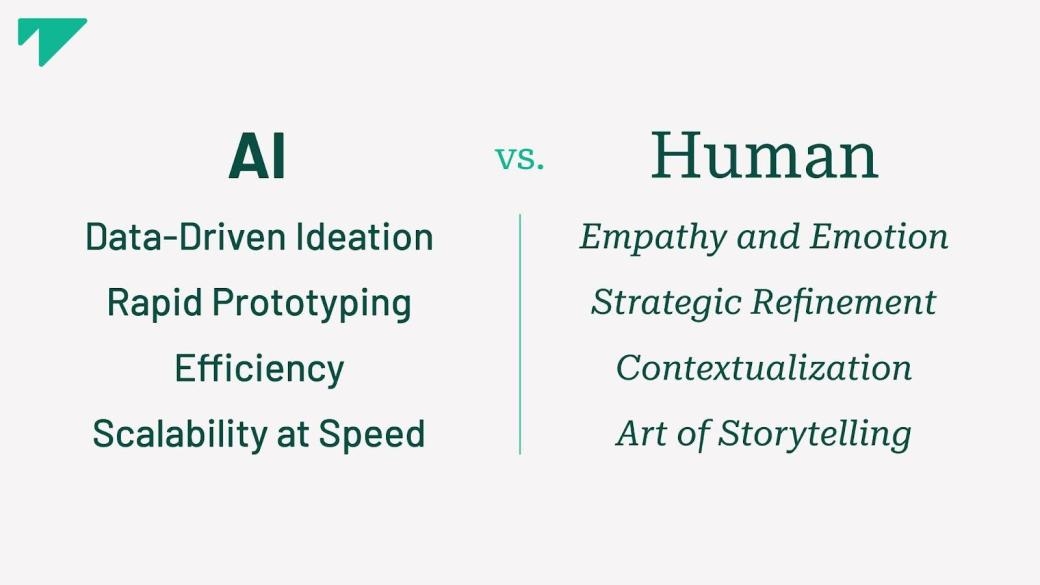
Sure, an AI could’ve summarized the topic. Maybe even drafted a tagline. But it wouldn’t have understood why a phrase might land one way with one audience and fall flat with another. Or why language choices—words like “spectrum” or “support”—carry deep, layered meaning depending on who’s reading them.
That’s why empathy isn’t a “soft skill” in branding. It’s a strategic one. It’s what allows you to navigate contradiction, earn trust, and build something real in a world increasingly filled with synthetic approximations.
The AI conversation isn’t slowing down—it’s accelerating. For many clients, the challenge isn’t whether AI has potential, but what to do with it. They’re trying to decipher what’s signal and what’s noise. Should they rewrite their brand voice with ChatGPT? Optimize for Google’s SGE? Redo their sitemap? Or hold the line?
This is where agencies have a crucial role—not just as producers, but as navigators.
Clients aren’t looking for someone to flood the feed. They’re looking for someone who can read the map while the terrain is still shifting. Someone who knows the difference between an emerging tool and a long-term strategy.
It’s less like steering a ship and more like guiding a hot air balloon—accounting for wind, altitude, and visibility, all while keeping the basket grounded in what the brand actually stands for.
That means helping clients:
The agencies that thrive won’t be the ones who chase every shiny object. They’ll be the ones who ask better questions, earn trust, and help brands show up with clarity—human-first, machine-smart.
Your brand is being pieced together—often without you.
Large language models and AI search tools don’t experience your brand like a person does. They don’t enter through the homepage, click “About,” and read in order. They gather fragments: a line from a testimonial, a product description buried on a subpage, metadata you forgot to update three rebrands ago.
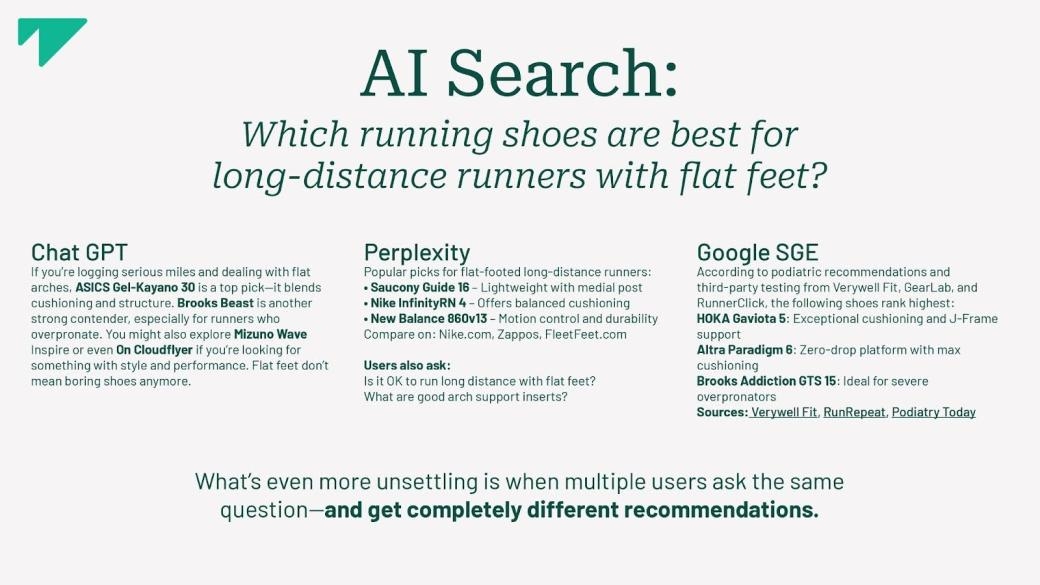
What once felt secondary—alt-text, file names, page structure—is now front and center in how your brand is parsed, indexed, and presented. And those signals are being assembled into synthetic summaries that may be the only version of your brand someone ever sees.
This isn’t a crisis. It’s an opportunity.
Instead of chasing perfection, the smarter move is clarity. That starts with tightening the structure, language, and cues across your entire ecosystem:
When we relaunched our own rebrand, we treated AI search like a second audience. Every headline, case study, and tag was approached not just as content but as a signal. The results have already started to show: more consistent visibility, stronger engagement, and tighter control over how we appear in AI-generated summaries.
You don’t need to start from scratch. But a thoughtful refresh—grounded in this new reality—can make all the difference.
Because in the AI era, everything you publish contributes to the version of your brand the world sees. So make sure the breadcrumbs actually lead back to you.
The most effective creatives moving forward won’t just be storytellers—they’ll be synthesizers. People who can translate human insight into structured systems. Who knows when to lean on data and when to trust their gut. Who understands how to feed the machine—but never loses the plot.
This shift isn’t about doing less creative work. It’s about doing it differently. It means building brands that resonate emotionally and show up cleanly in an LLM summary. It means designing messaging systems that carry across platforms—platforms that evolve weekly. It means bringing instinct and structure into the same room—and knowing how to make them work together.
This is the kind of work we’re doing every day: listening closely, adjusting our process, asking better questions, and building brands that hold their shape even as the landscape shifts.
AI isn’t the end of branding—it’s the next constraint. And creative people have always thrived inside constraints.
The future of branding isn’t louder, or faster, or more optimized. It’s clearer. More intentional. More aligned between what a brand stands for and how it’s represented—by people, by platforms, and increasingly, by machines that summarize everything in a blink.
That doesn’t mean we make work for the machine.
It means we make work the machine can’t ignore—and that people still feel.
Because the future isn’t less human.
It’s more human, on purpose.