Lead Quality vs. Lead Quantity: Why B2B Teams Are Rethinking Their Funnel in 2026
Bigger buying committees and tighter budgets are forcing B2B teams to rethink lead quality vs. quantity. Here's how top teams rebalance the tradeoff in 2026.
Updated February 16, 2026

How can your business leverage these digital marketing strategies to grow its profits and base?
After massive growth over the last decade, digital marketing is still on the rise. Analysts say companies will spend nearly a trillion dollars annually on it by 2027. But where does all that money go?
Increasingly, businesses are choosing to invest their digital marketing budgets in AI. That often means prioritizing workers who specialize in artificial intelligence technologies and investing in emerging AI tools. Your company can do the same as part of your 2026 digital marketing strategy, but driving scalable growth requires understanding emerging trends and tips for AI adoption.
Looking for a Digital Marketing agency?
Compare our list of top Digital Marketing companies near you
The first trend we’re seeing is AI becoming a more foundational piece of the average company’s marketing stack. It’s moving from something that was nice to have to a tool you truly need to keep up with your competitors. That trend will likely only increase as AI marketing platforms continue to improve.
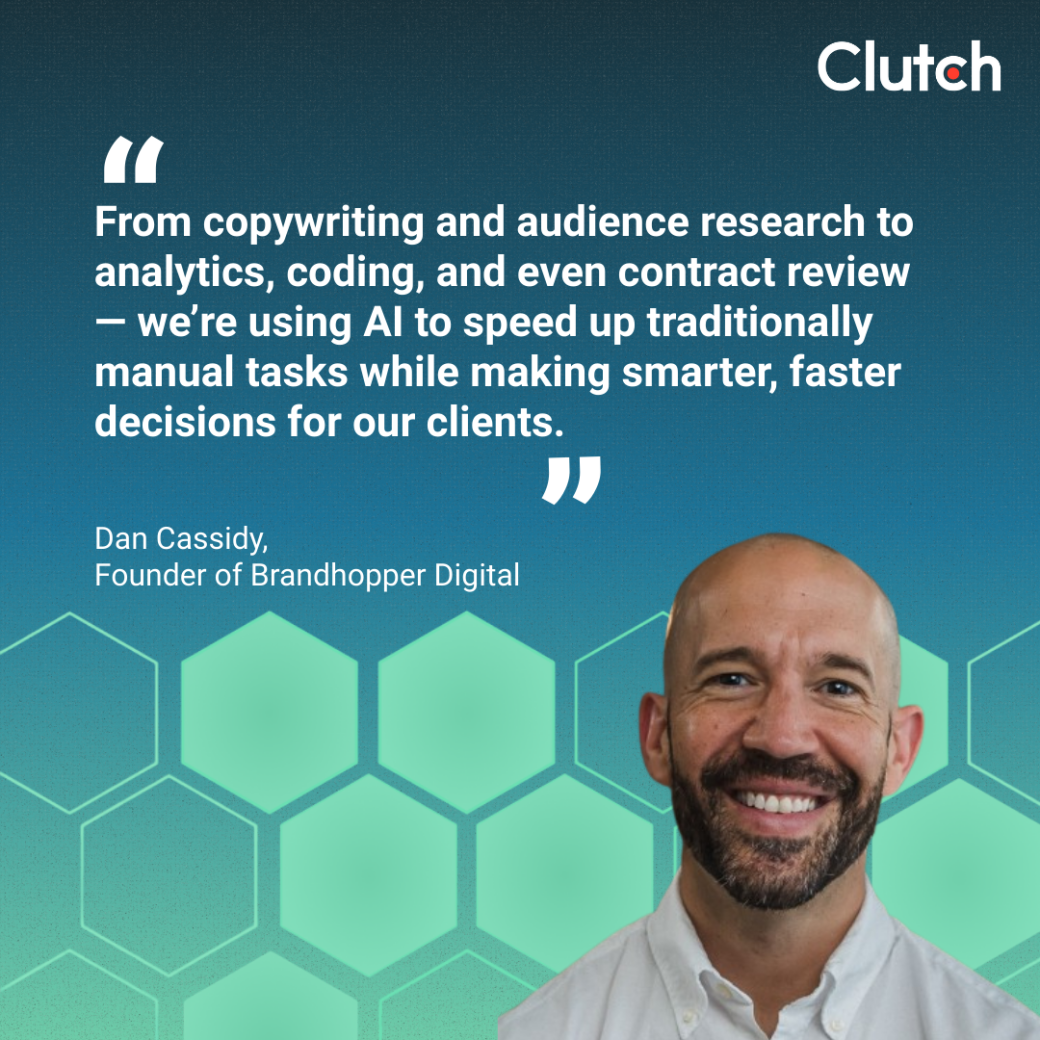
Companies today use AI to enhance many different aspects of the marketing process. For example, Dan Cassidy, founder of Brandhopper Digital, says, “From copywriting and audience research to analytics, coding, and even contract review — we’re using AI to speed up traditionally manual tasks while making smarter, faster decisions for our clients.”
Teams are also using AI image and video generators to speed up the asset ideation process. They generate high-quality images for social, web, and mobile touchpoints as quickly as you can enter a prompt. You’ll spend less time waiting for mock-ups and will be able to work through ideas faster as you iterate in search of the right fit for every campaign.
According to data from Clutch, nearly half of all U.S. businesses now prioritize roles related to AI development and implementation. That represents a significant shift in the marketing industry’s hiring dynamics.
An increasing number of businesses are opting to allocate their limited budgets for AI over other fields and tools. This shows strong belief in the technology as a true difference-maker moving forward. It also means that businesses that don’t prioritize AI spending are effectively betting against a significant percentage of their peers. That sometimes works out, but being a contrarian carries some risk. Wait too long and you may find yourself playing catch-up in the next era of digital marketing.
If you’re wondering where all of this is headed, Jack Oddy, managing director at Soap Media, shares how AI has impacted his team: “Much of our progress has come from teams actively experimenting with how AI fits into their workflows, allowing us to scale innovative practices across the agency. But the result is the same: Our team can spend more time on strategic thinking, creativity, and delivery, without getting bogged down by more laborious tasks.”
Ultimately, AI is helping marketing teams find fresh ideas, execute frequent tasks more efficiently, and deliver more value and thought leadership to clients. As long as those things continue to be true, the field will likely continue growing.
That being said, there’s still a need for cross-functional AI literacy on your marketing team. It’s not always enough to invest in AI marketing tech. You also need people who can help you get maximum value from the tools you purchase — especially as issues like AI and privacy become more important to the public.
AI tools leverage user data to drive powerful outcomes for businesses. But today’s users care more about data privacy than ever. That makes it crucial to consider privacy when integrating AI marketing tools into your processes.
More than 70% of Americans worry about how businesses and the government are using their data. That’s created a preference in the marketplace for companies that have clear policies around data collection and user analytics. It’s also led many governments to create special regulations for how companies use this data. Europe’s GDPR and California’s CCPA are two major examples.
This is worth thinking about in the context of AI marketing because user data tends to play a key role in the technology. The most important thing for your business will be following the data privacy laws that apply to its location.
However, you may also want to think about how you communicate with the public about data privacy. Creating a strategy before leveraging new AI technologies will help you stay on the right side of public sentiment, so you stay moving toward bigger goals.
It’s also important to begin thinking about your first-party data as a core business asset. Metrics like customer purchase history, on-site behavior, app engagement, and email interactions are becoming invaluable for making digital marketing recommendations. Here’s why:
Additional Reading: ‘The Shift to First-Party Data in a Privacy-Driven Marketing Landscape’
As AI becomes more impactful in marketing, we’re also seeing a rise in mergers and acquisitions. Companies are beginning to consolidate in order to offer more powerful, all-in-one marketing tools. As you plan your digital marketing strategies for 2026, consider your current tech stack: Are there new or improved tools that could improve your workflow?
Adam Yaeger, founder & CEO of Llama Lead Gen, says, “We’re staying independent for now. There’s a ton of noise around agency rollups and PE interest, but we’ve built something intentionally lean and expert-led. That said, we’re always evaluating strategic partnerships, especially in MarTech, CRO, or creative automation.”
Similarly, Maxime Siebinga, marketing manager at Flowium, shares that, “We’re focused on staying lean and specialized, but also building smarter collaborations that help our clients convert better and scale more sustainably.”
The key takeaway for most companies is that staying competitive means staying agile in a rapidly changing landscape. That means integrating your tools so customers get a more unified experience, scaling personalization, and continuing to pay attention to and apply new strategies as they emerge.
To keep up with (or ahead of) these trends in 2026, here are some digital marketing strategies to focus on:
It’s worth noting that AI is just beginning to impact the marketing industry. That means the work you put into revamping your strategy in 2026 could pay dividends for years to come.
From radio ads to influencer partnerships, the marketing industry has always evolved with technology. The next step in that process seems to be starting with AI. Powerful new tools are helping teams create, share, and optimize more personalized ads across the digital landscape.
So, how will your company leverage AI to transform your marketing work? If that’s a question you can’t answer, it may be time to contact an agency for help with developing and executing the right strategy.