Lead Quality vs. Lead Quantity: Why B2B Teams Are Rethinking Their Funnel in 2026
Bigger buying committees and tighter budgets are forcing B2B teams to rethink lead quality vs. quantity. Here's how top teams rebalance the tradeoff in 2026.
Updated February 18, 2026

From economic uncertainty to growing concern over data privacy and AI, 2026 could be a challenging year for marketers. Here’s what to expect and how to keep your team on track.
B2B marketing leaders face a pivotal year in 2026. Mounting compliance pressures, economic volatility, and the acceleration of martech disruption are converging to reshape the industry.
In this shifting digital marketing landscape, it’s more important than ever to understand the key challenges that are ahead for your business. By developing awareness today, you can begin planning sooner and potentially sidestep many of the issues that will impact your peers in the year to come.
Looking for a Digital Marketing agency?
Compare our list of top Digital Marketing companies near you
Working with these key marketing challenges for 2026 and identifying the steps you can take to avoid or overcome them is crucial this year.
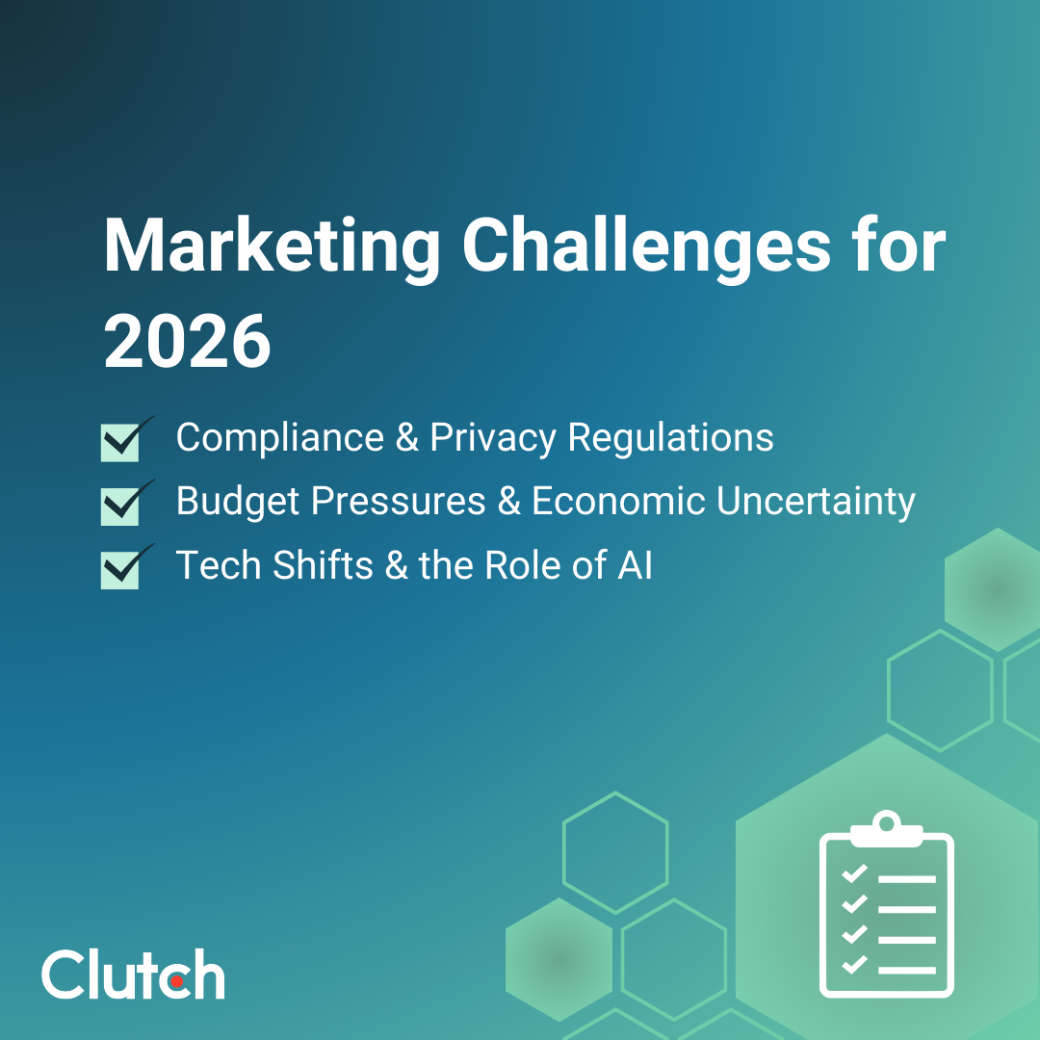
A growing percentage of the population now worries about data privacy. That’s prompted governments to institute stricter regulations, which may impact your marketing strategies.
User data helps marketing teams deliver more targeted, personalized ads. But there are more regulations than ever limiting how you can do so in 2026.
Europe is enforcing its GDPR legislation with growing rigor, as Ireland’s regulator recently fined TikTok €530 million for improper data transfers. The United States is also amplifying its enforcement of antitrust actions, creating new risks in an industry that has come to rely on sensitive user information.
Your company will need to comply with privacy legislation in each market you target. That could mean adapting strategies to fit with more than one privacy framework, especially as emerging markets begin creating their own policies. This has all contributed to where we are today, a moment in which marketers are scrutinized more than ever for how they use data.
Many companies are deploying AI to help with personalization and compliance. There are AI tools that can monitor your data flows, flag anomalies, and automatically check your practices against evolving standards.
It’s a balance: If you’re slow to adapt your digital marketing strategies to incorporate AI, you could risk losing your competitive edge — but over-reliance on AI could backfire. That’s why Berkeley’s California Management Review now says balancing personalization with transparency is a strategic imperative for marketers.
But legal compliance is only part of the equation. Customers still expect clarity on how their data is used and collected, and these expectations often extend beyond what you’re legally required to provide.
Modern AI tools can help you keep up. But you should still try to embed compliance into your campaign design, content or thought leadership strategy, and audience engagement for the best results.
Tighter regulations are just one challenge on the horizon in 2026. Economic volatility could also reshape how marketing teams spend, as rising costs collide with heightened consumer expectations. With that in mind, here are some strategies you can use to overcome any budget pressure you face this year.
Global ad spend continues to rise, reaching over $600 billion annually. But many CMOs report having fewer resources available to meet higher performance expectations. Automation is emerging as a critical marketing solution because of this. That often looks like:
Automation also helps teams do more without increasing their budgets.
Economic pressures often incentivize marketing leaders to prioritize short-term goals. That’s why another key step in 2026 will be finding a way to balance short-term ROI with long-term brand-building.
Maxime Siebinga, marketing manager at Flowium, notes, “Even with tighter budgets, email and SMS remain a core focus for our clients. We’ve seen increased demand for flow audits, high-converting email redesigns, and list growth strategies that turn traffic into owned audience segments.”

The most effective leaders will be those who strike a balance, using automation and fractional support models to stretch resources without sacrificing output.
Martech is evolving faster as artificial intelligence proliferates. This makes 2026 a good time to reconsider your tech stack. You may have opportunities to improve your competitive edge through tool consolidations, upgrades, and process optimization. Finding the right tools can help you overcome many of today’s top challenges in digital marketing.
Many marketing teams now rely heavily on analytics and productivity tools, but struggle to integrate them effectively. Your team could be overpaying for features that aren’t delivering value.
Lutfi Aydeniz, CEO of fascinatid, shares, “Most of our clients come to us overwhelmed by martech fragmentation. Our role is to simplify — not stack for the sake of stacking. We start by auditing the client’s current tools and aligning them with their goals.”

Your team may benefit from a similar audit. It could help you verify that you’re spending your budget as effectively as possible, and reveal valuable opportunities for streamlining or diversifying platforms.
AI is also evolving from a tool for simple automation to a more strategic, intelligent partner. Instead of streamlining workflows, it can also help with campaign planning, predictive analytics, and audience modeling. These insights can help your team understand not just what to do but also why it’s important and how to track progress over time.
Finding ways to incorporate AI could be a game-changer for your marketing strategy. For example, one business in the LA area got 22 million views on TikTok with a video ChatGPT scripted in 10 minutes.
Despite these advancements, human oversight is still essential in your marketing process. AI is a powerful tool for accelerating workflows and revealing insights, but it doesn’t understand branding nuance, ethics, and human values in the same way that people do.
Marketing teams in 2026 will face a complex blend of economic uncertainty, AI-enhanced growth, and compliance challenges. But you can overcome these with the right strategies:
Adopting these practices can position you ahead of the curve as the marketing industry continues to evolve. These strategies could become key differentiators that help you cut through the noise, win more traffic, and increase revenue.
Marketing teams in 2026 face growing pressures from evolving regulations, economic uncertainties, and rapid tech disruption. But these digital marketing challenges don’t have to derail your progress. With a little planning and ongoing attention, you can face these complexities more effectively than your peers. That can become a competitive advantage, as you leverage new technologies and processes more effectively than other brands.
Ultimately, it’ll be important to be proactive, as unexpected obstacles could threaten your market positioning.