Lead Quality vs. Lead Quantity: Why B2B Teams Are Rethinking Their Funnel in 2026
Bigger buying committees and tighter budgets are forcing B2B teams to rethink lead quality vs. quantity. Here's how top teams rebalance the tradeoff in 2026.
Updated February 19, 2026

Users have taken the lead in defining how they want to interact with brands. What does that mean for your company’s marketing strategy? Keep reading to learn more about the rise of younger B2B buyers, mobile-first behaviors in B2C, and global digital adoption strategy trends heading into 2026.
2025 marked a turning point in digital marketing strategy. Buyer expectations and shopping patterns continued to evolve rapidly, finally forcing companies to rethink how they pursue leads.
Now, user adoption trends inform everything from content strategy to platform selection. Companies that ignore this risk may end up sharing underwhelming ads on platforms that their target audience is no longer really using.
Looking for a Digital Marketing agency?
Compare our list of top Digital Marketing companies near you
This article breaks down the key drivers behind this shift in the digital marketing landscape.
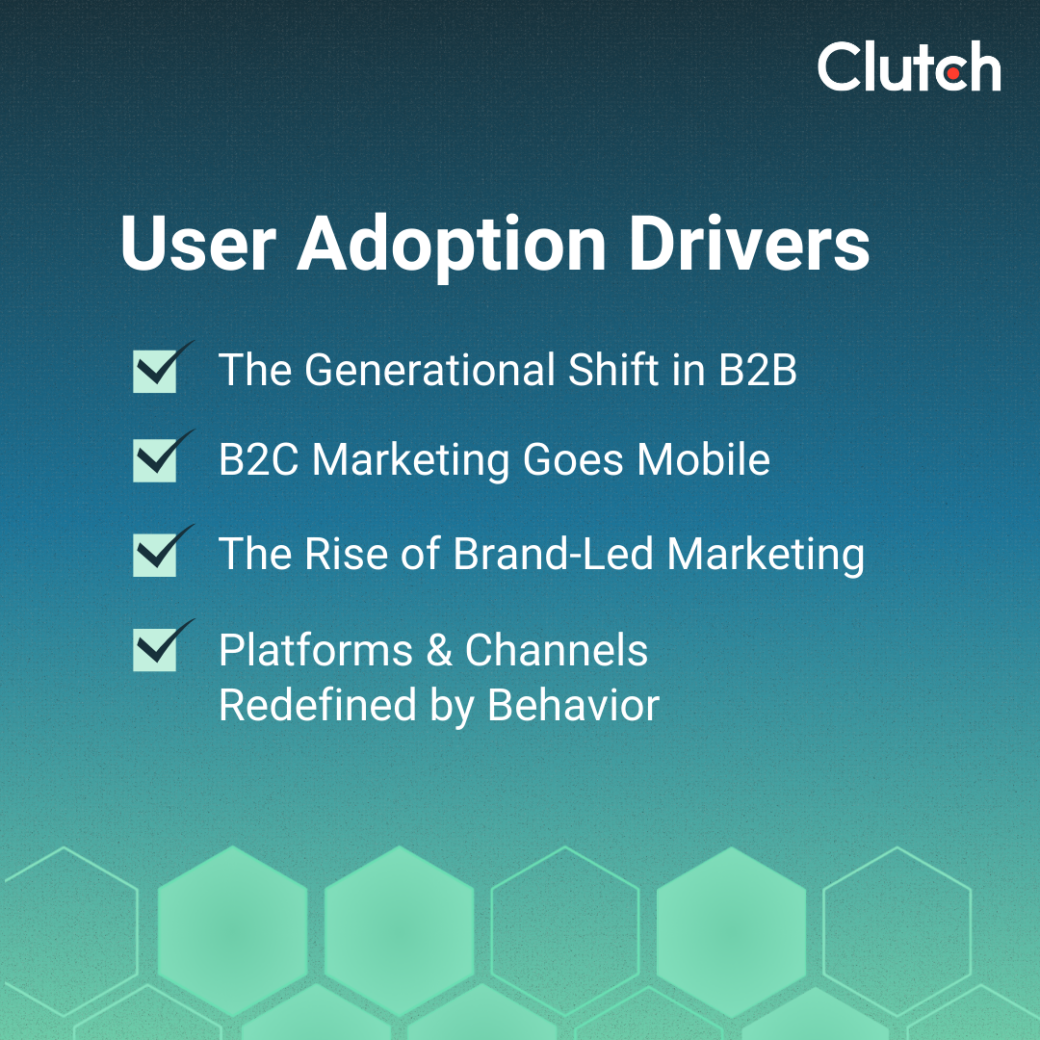
First, you should know that Millennials now account for 73% of B2B buying decisions. This generational shift has impacted the average company's sales funnel in each of the following ways:
Ultimately, younger B2B buyers have different shopping preferences than previous generations. It's important to understand these and shift your content strategy accordingly. Otherwise, your sales figures could dip heading into 2026.
Mobile is becoming more critical in B2B marketing, but it's already the most important vertical for B2C buyers. According to HubSpot, 63% of consumers now prefer to find information about brands and products on their mobile devices.
This means mobile-optimized creative efforts are no longer negotiable; they're foundational to winning business in this new era. That means:
Another factor to consider is that Google now accounts for over 93.9% of the global mobile search market. This dominance means that modern marketers should also prioritize Google-friendly strategies in mobile app marketing. That could involve optimizing for mobile SEO, measuring performance with Google's Core Web Vitals, and sharing content optimized for voice search, among other tactics.
Your ideal approach could also vary based on the region you're targeting. For example, TikTok and Instagram dominate in some regions, but regional platforms like WeChat, Line, and country-specific apps dominate elsewhere. You'll need to understand these nuances to effectively target a global audience in 2026.
We're also seeing an increased push for advertising transparency as we head into 2026. The new generation of buyers is turning away from traditional advertising, often describing it as inauthentic. These shoppers are focusing more on brands instead, prioritizing those that lead with purpose and personality.
According to HubSpot, 37.52% of marketers now prioritize customer experience when designing their brands. This reflects a major shift in marketing strategies and priorities. We're entering an era when winning user adoption in digital marketing is more about building loyalty through lasting brand values than paying for one-off promotions.
So, how can your company stand out with better brand-led marketing? Here are some tips:
The key takeaway is that modern marketing is more about building long-term, brand-level trust than maximizing short-term clicks. In 2026, the most successful brands won't just pay for placement, they'll stand out as clear, authentic voices that users naturally want to follow.
It's also important to watch how these trends continue to reshape platform-specific marketing strategies. In 2025, major algorithm shifts on popular social platforms began to favor meaningful interactions over passive impressions. This means your content will appear on more users' feeds if it sparks comments, shares, and longer watch times.
It also means your campaigns in 2026 shouldn't rely on metrics like pure impressions. Algorithm shifts now favor more meaningful interactions and high rates of engagement, which should impact the kind of content you share.
In general, it's best to follow the user. For example, LinkedIn is great for corporate-level storytelling. But TikTok and Instagram are better for recruiting young talent.
Ultimately, your goal should be to identify the type of content that performs best across each platform you're targeting. Then, share more of that content and refine it over time to improve your performance.
You won't know what works best for your business until you step into the arena and start seeing real metrics. But you may want to share more content like:
Just remember that social platforms are more than distribution channels in 2026. They're living, breathing ecosystems that are constantly evolving as user behavior changes. Marketers who adapt their strategies to align with these behavioral shifts will continue to see the best results. That'll only become more important as the digital marketing adoption curve steepens and the rate of change increases.
In 2026, digital marketing success is more about understanding how people discover, engage, and build trust with brands than ever before. Here are some user adoption strategy ideas you can try to stand out in this new space:
Explore digital marketing strategies that will work best for your mission and target audience.
User adoption trends have become incredibly important to the digital marketing landscape. They shape how today's customers discover, evaluate, and engage with brands, trends that should be reflected in your broader marketing strategy.
Traditional campaigns, with their focus on raw impression numbers, are suboptimal in today's challenging market. Brands that lead with trust and authenticity are likely to outperform, so how will you add these elements to your strategy?
One clear shift is the move from campaign-centric to adoption-centric marketing. That means spending less on one-off promotions and more on long-term content strategies that build trust and follow evolving user behavioral trends. You may want to connect with an agency if you'd like help with this.
Learn more about the state of digital marketing in Clutch’s latest survey report.