
How to Define Brand Values That Guide Every Business Decision
Brand values are the principles that guide company decisions, define what a brand stands for, and shape how it treats customers, employees, and partners.
Updated June 4, 2026

Recently, our team surveyed 408 consumers about what truly draws their attention to new brands while shopping in-store. As it turns out, your small business doesn’t need to meet the budget of a national brand when design and strategy are your secret weapons.
Small retail businesses face a dilemma: Space is limited, and shelves are crowded. When a shopper walks down the aisle and scans dozens of products in a matter of seconds, most of those products never get a second look. The ones that do owe attention almost entirely to in-store display strategies.
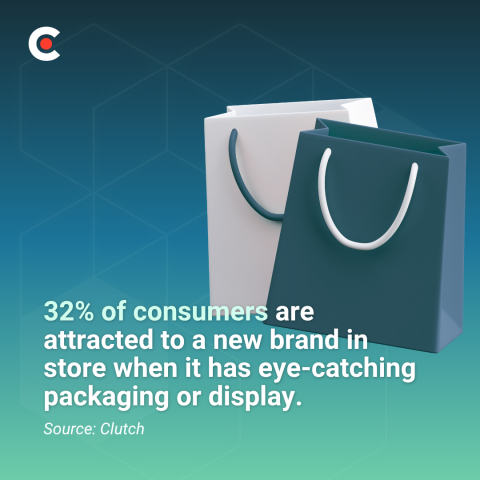
Consumers themselves — 32% of them, according to a recent Clutch survey — say that when it comes to in-store brand discovery, it's packaging or an eye-catching product display that grabs their attention. In fact, among all in-store attention drivers in our survey, it ranked the highest.
Looking for a Public Relations agency?
Compare our list of top Public Relations companies near you
It’s just reality: Small businesses can’t outspend national brands on shelf space or advertising. Fortunately, the data shows they don’t have to. What captures customer attention in-store is often driven less by budget and more by design and strategy.
In May 2026, Clutch surveyed 408 consumers about the attention drivers that draw their attention during in-person shopping. Based on that data, we’ll break down what consumers actually respond to on the shelf, and we’ll provide practical in-store display strategies your small business can deploy, even without a Fortune 500 marketing team.
Shopping in-store is a largely visual experience. People know what they’re looking for, recognize well-known brand names, and often buy what’s on sale. Getting them to notice a smaller brand’s product can be a challenge.
According to the consumers we surveyed, the most common in-store attention drivers are:
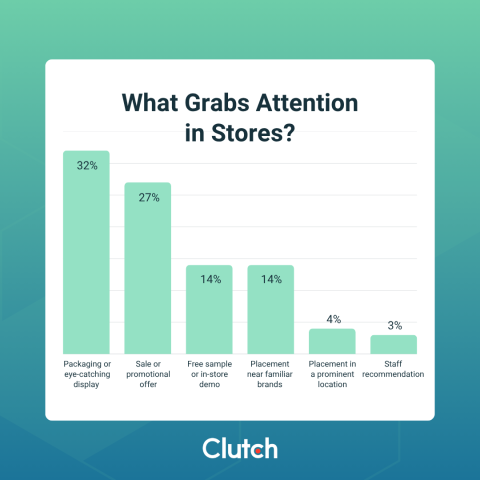
Packaging and display is the attention-grabbing factor by a wide margin at 32%, with sales or promotional offers coming in second at 27%. Free samples and in-store demos were tied with placement near familiar brands, both at 14%.
It stands out that the top three drivers account for 73% of in-store consumer attention, especially because those are the three factors your brand can likely influence.
Meanwhile, the two factors that matter least to consumers might surprise you. Only 4% of consumers surveyed cited prominent placement, such as an endcap or check-out line, while 3% cited staff recommendations. This means that nabbing a piece of expensive shelf real estate matters less than what you put on it.
The obvious takeaway is this: Even without premium shelf placement or staff endorsements, small brands that focus on packaging or display, promo offers, and samples or demos can effectively position themselves as competitors for the lion’s share of shopper attention.
The data shows us which areas need the most focus. We'll break down each strategy, ranked by consumer impact, and provide practical tactics your small business can implement immediately.
Packaging is the most influential in-store driver, and fortunately, it’s entirely within a small brand’s purview. Unlike shelf placement, packaging is 100% your brand’s decision, which makes it an incredibly powerful in-store display strategy and a golden opportunity to capture the consumer’s attention.
Multiple elements contribute to packaging’s effectiveness on the shelf. These include:
Most of these elements cost about the same to execute well as they do to flop. Before it becomes a budget line, strong packaging is, first and foremost, a design discipline.
The second-highest-rated in-store attention driver that consumers told us grabs their attention is a sale or promotional offer. How do these work so well? They reduce consumers' perceived risk of trying an unfamiliar brand, as they’re not paying full price to experiment with a product they may or may not like. This is a critical consideration for small businesses that don’t yet have the luxury of name recognition.
Certain types of promo offers are more effective on the shelf than others. The kinds of promotional in-store display strategies that actually catch the consumer’s eye are:
Exactly how you present your promo offers, however, is crucial. They must be part of the packaging design, not stickered on after the fact. A stick-on sale tag makes shoppers think your brand is trying to move dead inventory. When you visually integrate the promo into the packaging, it looks more like an intentional product introduction than an afterthought.
Our survey found that 14% of consumers consider free samples or in-store demos the attention lever that initially draws them in. Although this is only the third-highest driver on our list, it’s actually the one with the highest conversion-to-trial rate, making it just as consequential as packaging in the long run.
Put plainly, sampling works. It removes the single largest barrier to a consumer’s decision to purchase an unfamiliar brand: uncertainty about whether they’ll like the product. When a shopper has tasted, smelled, or felt a product, it answers the question that packaging alone can only imply.
Work with retailers to leverage the formats that small businesses can pull off with little trouble, such as:
There aren’t many in-store tactics in which your small business can outperform a national brand. Sampling is one of them. Well-known brands rarely bother with sample campaigns for established products. This leaves the format open for newer (and smaller) entrants to strut their stuff.
Product adjacency ranked fourth in our survey, with 14% of consumers saying their primary way to learn about new products is to find them on shelves near brands they already like. When a small brand gets shelf space next to a trusted brand, that trust tends to transfer, at least enough to earn the new product a second look.
As a small brand, you unfortunately have less control over your product’s shelf placement than you’d like, but you might have more control than you think. A few negotiation ideas are:
When weighing which retailers to enter, weigh product adjacency just as heavily as foot traffic. A spot on the shelf next to popular products can lead to better brand discovery than placement in a higher-traffic store with less-than-ideal placement.
The lowest-rated in-store attention drivers in our survey were prominent in-store placement (like at the register, on an endcap, or in a dedicated display) at 4% and staff recommendations at 3%. Premium shelf placement and staff advocacy are unquestionably valuable, but our data suggests they’re not as important as you might assume.
Here’s where they are important:
One of our study’s main takeaways is this: Rather than allocating much of their budget to premium placement, small businesses with limited promotional budgets should focus on packaging, promotions, and sampling. Those are the three in-store display strategies that create new attention rather than capturing existing demand, and for that reason, their ROI is significantly higher.
Although our survey didn’t measure this directly, it’s worth including here because it amplifies the attention drivers we just covered. And what is this attention multiplier? We’re talking about in-aisle signage and shelf-talkers.
We discussed how packaging design and baked-in promos capture the most consumer attention by a landslide. It stands to reason, then, that specific signage pointing directly to your product (with its brilliantly designed packaging and your promo offer visually integrated into the label) would draw even more attention to it.
When you use shelf-level signage among your in-store display strategies, it can do more work than the packaging alone. Here’s how:
Signage represents minimal cost and maximum impact. A well-designed, eye-catching shelf-talker can extend your packaging’s effective surface area by an order of magnitude.
For small businesses that lack dedicated retail marketing teams (and deep national-brand pockets), using these in-store display strategies is the smartest way to leverage your design expertise and your strategic brilliance.
If we had to condense our survey findings into a brief but realistic playbook for small businesses, these are the best practices we would recommend:
Broken down into a simple equation, we’d describe our study results as: design + strategy > marketing budget.
Most of these attention levers cost less than a single month of paid social spend. Making them an even larger boon for your budget, their value will compound over time as your packaging earns repeat recognition and adjacency with familiar products improves your brand’s category authority.
Because retailers don’t often share granular data, small businesses often struggle to measure their products’ in-store performance. There are, however, certain metrics you can feasibly track:
These may not be perfect measurements, but even imperfect metrics are better than none at all. Small businesses that track their in-store performance regularly and with basic discipline have a leg up on the competition: They can iterate faster than competitors that treat retail as a black box.
In-store discovery is one of the most powerful channels available to your small business. The main levers that drive in-store discovery — packaging, promotions, sampling, and adjacency — largely fall under your brand’s direct creative and strategic control.
When small brands fail on the shelf, it has far less to do with their inability to compete with national brands on budget and everything to do with failure to leverage the in-store discovery drivers they do control (and overspending on the ones they don’t).
If your brand invests in well-designed packaging, incorporates promos into the product itself, establishes even the most basic sampling programs, and negotiates thoughtful adjacency, you’ll be a contender for the 73% of attention that the top three in-store display strategies represent. That’s a winnable share, and you don’t even need a national marketing budget. All you need is a clearer read on what actually catches the shopper’s attention in the aisle.