
How to Define Brand Values That Guide Every Business Decision
Brand values are the principles that guide company decisions, define what a brand stands for, and shape how it treats customers, employees, and partners.
Updated February 26, 2026

Our 2026 survey shows that 96% of consumers read product or service reviews before purchasing from a new brand. So, even if your marketing efforts are exceptional, it's your online customer reviews that really drive customer decisions.
Online customer reviews have become one of the most important decision-making tools for buyers. To understand where reviews matter most and guide brands on how to generate reviews, Clutch surveyed 402 consumers in January 2026 about their online review preferences. Findings reveal:
If you don’t have reviews or are not generating them consistently, you’re likely to be filtered out early or become invisible during key purchasing moments.
Looking for a Public Relations agency?
Compare our list of top Public Relations companies near you
Yet, by nature, consumers do not readily take the extra time to write good reviews.
Use these seven tactics to get more reviews for your business and present authentic experiences to help your customers make confident decisions.
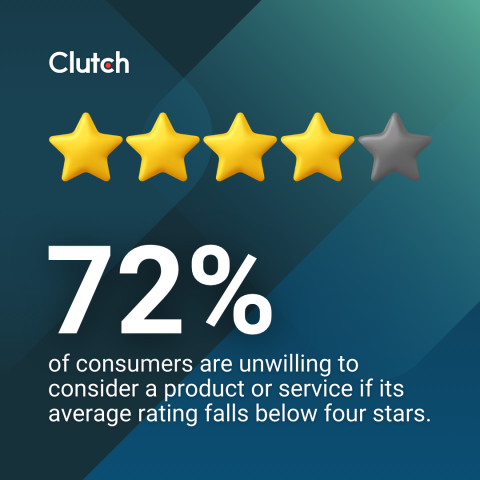
Experience quality comes first when you want to get more customer reviews. When 72% of consumers walk away if ratings fall below 4 stars, you can’t scale reviews without positive experiences.
While you can’t control how people talk about your brand online, you can control the experience you give each person.
Before you think about how to get more reviews for your business, verify that the product or service you’re asking customers to review can produce positive feedback. To evaluate your product quality:
A 2026 Upfirst.ai study shows that 20% of negative reviews are related to product/service quality. When you address quality issues, you can improve the customer experience to prevent avoidable public criticism in reviews.
Audit your average responses to customers' issues across channels and verify that they are helpful. In the Upfirst.ai study, over a third (37%) of negative reviews stem from poor communication, making it the top area for improvement.
Review your marketing claims and onboarding materials to confirm you’re not over-promising timelines or results. Clarify for your customers what they’ll receive and when, so you don’t create mismatched expectations.
Identify recurring complaints about your product or services in support tickets, reviews, surveys, or social media platforms. Then, prioritize issues that affect the most customers or have the biggest impact on customer experience to remove friction that leads to negative ratings.
Often, unless they have a negative experience to share, the average customer is not going to look for ways to leave an unsolicited review for your company. Fortunately, 83% of consumers are responsive to review requests, according to a 2024 GatherUp survey.
Used intentionally, automation can help with soliciting feedback. As Maxime Siebinga, Marketing Manager at Flowium, notes, "The brands that win use automation to ask for reviews at the right time and then let customers speak in their own voice."

To increase online reviews, create a scalable system for customer feedback collection:
The best practice for automated review requests is to keep them short and link directly to your review platform. Personalize the request to mention the customer’s recent purchase or interaction, making it relevant and increasing the likelihood they’ll leave a review.
Customers are more likely to leave a review when the purchase of a product or service is still fresh in their minds, but not so soon that they haven't had a chance to experience it. Here are some of the best moments to request reviews:
During these moments, your customers’ trust and satisfaction are at their highest, making them more willing to share positive experiences. More importantly, the details are still fresh, and your customer is likely to leave you more thorough feedback.
While star ratings provide an important first impression, consumers place the most trust in star ratings paired with written reviews. In fact, 43% of consumers say they trust reviews that describe using the product or service. Photos of products or services in action rank second (34%) in terms of trust and preference, followed by video (9%).
To collect rich reviews while making it easy for the customer, your request can include:
You can simplify the submission of rich reviews by including photo upload prompts for images of your product in use, thereby improving trust and influencing buyers.
Alternatively, add prompts for before/after photos or guided questions such as “What problem did this solve?” or “How are you using the product?” in your review request.
A common way to generate more reviews online is to offer incentives to give your customers a small extra reason to follow through on the feedback they intend to share. According to the PowerReviews 2023 survey, incentives are among the top reasons 65% of Gen Z and 76% of millennials leave ratings and reviews.
However, your incentives should always be ethical and in compliance with your review platform's policies to maintain trust and avoid penalties. The key principle is that your incentive should encourage customers to leave honest reviews, whether positive or negative.
Possible incentives you can offer include sweepstakes entries, loyalty points, and discounts on future purchases. Avoid paying for positive reviews or gating incentives based on rating, as this is disallowed on many platforms.
Implementing a strong user-generated content (UGC) strategy is a powerful way for your organization to get more reviews online. Because it’s created by your customers instead of your brand, it carries more weight as word-of-mouth promotion.
“Adding richer proof like photo or video reviews, customer-generated content, or short testimonial clips helps shoppers see real people behind the feedback,” said Siebinga. “This authenticity reduces hesitation in making the purchase decision.”
Good examples of UGC campaigns you can run include:
Based on our survey data, more than 80% of consumers say photo reviews are at least somewhat influential in their purchasing decisions, with 17% calling them essential. You can encourage your customers to produce more UGC to increase brand loyalty and online reviews.
One often-overlooked tactic in how to get more customer reviews is responding to reviews. In a Bright Local 2024 survey, 88% of consumers reported that they would do business with an organization that responds to both positive and negative reviews. Most people value authenticity and balanced feedback over perfection.
The best approach is to:
When you respond to people's existing online reviews, you signal brand engagement and encourage others to share their feedback. Plus, you’ll build transparency, making people more comfortable turning to you.
To generate reviews online, go where reviews matter most. Established marketplaces are practical options because they benefit from familiarity, scale, and the perception of stronger moderation, which reinforces confidence in the reviews they host.
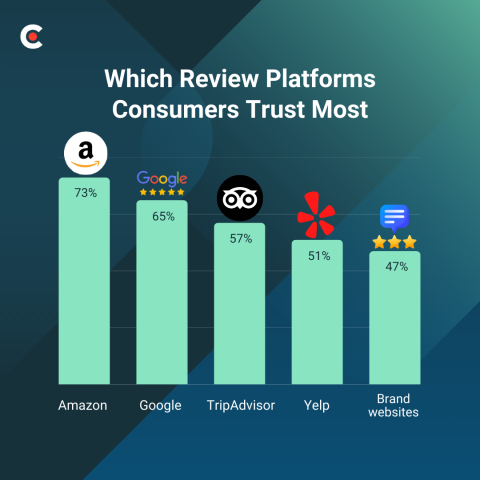
The data we collected in January 2026 shows that Amazon leads the way, with 73% of consumers saying they completely or somewhat trust customer reviews on the platform. On a highly trusted site like this, positive feedback can boost your ranking and buyer confidence while expanding discoverability.
Google follows closely with a 65% trust rating. More high-quality Google reviews can improve your local SEO and overall brand credibility to help you attract new customers.
If you want to collect reviews about travel or hospitality experiences, TripAdvisor earns the trust of 57% of consumers. Frequent, authentic reviews on TripAdvisor can set you apart from the competition.
Yelp is a great platform to show reliability if you’re a service-based B2B company. On this platform, you can collect and engage with reviews to show your target market you’re responsive and build local trust.
Your own website gives you full control of the presentation and context of the reviews. Use it to collect reviews from verified customers to help you build trust and keep potential customers engaged.
Specialized directories connect you with customers seeking niche services. Often, reviews from industry directories signal to your customers authority and trustworthiness within your industry.
Online reviews have become a powerful tool for consumers seeking purchase advice and info on a company’s reputation. If you let your guard down, however, certain mistakes can overshadow your good name.
A product with a high volume of exclusively five-star reviews, which was once a strong trust signal, now often triggers suspicion. Only 35% of the consumers we surveyed would fully trust a listing with only five-star reviews. Half would feel skeptical.
This skepticism pushes buyers to look beyond ratings and focus on reviews that reflect real experiences. You can take advantage of this. Siebinga explains, “The goal is to show real people explaining why they bought, what problem they were solving, and how the experience actually went. A small number of thoughtful, specific reviews builds far more credibility than a high volume of short, generic praise. When shoppers can see themselves in those early reviews, trust forms quickly.”
A selection of genuine, meaningful reviews from real customers can do more than a larger number of generic bought reviews.
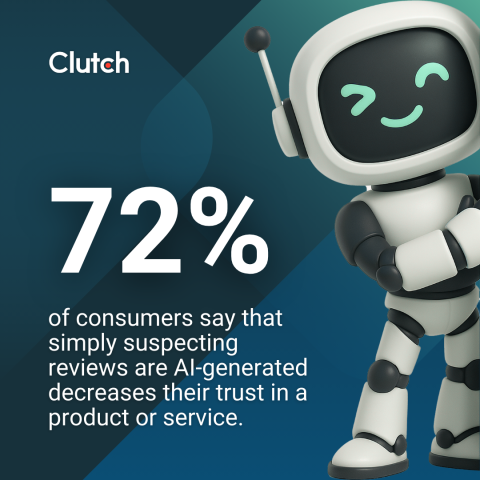
People are becoming sensitive to authenticity. Our report found that almost three-quarters (72%) of consumers say that simply suspecting reviews are AI-generated decreases their trust in a product or service.
Filtering customers before asking them to leave a public review can damage trust. Instead of asking all customers for a review, some companies gate the feedback process:
This kind of review manipulation violates many review platform policies.
Customers want to see you resolving issues professionally. If you ignore negative feedback or respond without accepting responsibility, your brand trust decreases.
You may be able to handle online reviews on your own. But when too much work starts pouring in, managing your reputation yourself can become a liability. Watch for these clear signs that your business needs support.
Low review volume can be as damaging as bad reviews. When your business profile looks inactive, your customers might assume your business is outdated, or worse, closed.
One poor rating won’t hurt you. However, when several negative reviews go unanswered or unresolved, potential customers might start thinking your business doesn’t care.
When your reviews come in sporadically, or only after negative experiences, your request strategy isn’t scalable. You need a structured approach to regularly collect reviews across the customer journey.
Depending on your business, you could be on multiple review platforms. Hiring expert assistance can ensure timely responses and consistent brand messaging across every platform.
Reputation management agencies will help you with:
By integrating strategy, a reputation management company can help you shape your online presence and influence customer decisions.
With effort, patience, and the right strategies, you can generate more positive reviews for your business. The best practice is to request reviews at the right time and make it effortless for customers to share their experiences. Incentivize participation, but don’t buy reviews or offer freebies for positive ratings only.
Once you get reviews, respond to both positive and negative comments to show potential buyers that your brand cares about everyone’s opinion. If you’re overwhelmed or want better control of your brand reputation, hire a reputation management agency to maintain an active, brand-building presence across review platforms.