
How to Define Brand Values That Guide Every Business Decision
Brand values are the principles that guide company decisions, define what a brand stands for, and shape how it treats customers, employees, and partners.
Updated August 19, 2026

Marketers often treat discovery as the end goal, but what really matters is what happens after customers find your brand. Clutch surveyed 408 consumers to understand how those post-discovery moments are changing.
Marketing often focuses on those magical moments of discovery. Every time someone comes across your Instagram profile or clicks your ad, it's celebrated as a win. Finding a new brand is actually the starting gun for customers, not the finish line.
The minutes or even days after a customer first encounters a brand are everything. People either like what they see enough to make a purchase, or they move on. And once that window closes, it's hard to entice them back.
Looking for a Public Relations agency?
Compare our list of top Public Relations companies near you
In May 2026, Clutch surveyed 408 consumers to better understand what shoppers do in those critical moments. We found that 72% of consumers buy within a month of discovering a brand, with most of those decisions made in the first few days.
This guide maps out what actually happens on the customer journey after discovery. Drawing on our data, it also recommends what brands should have in place at each step to keep that momentum going and turn browsers into buyers.
For many brands, lost sales don't happen at discovery. They happen in the verification window that follows. Either you build trust right away, or you don't.
Discovery used to happen at a leisurely pace. Someone might hear a friend praise a brand, then spot a magazine ad a few weeks later. Eventually, they might search for a website or request a product catalog. Months could pass by before they actually ordered anything.
Today, that timeline has sped up. Most consumers now make a purchase decision within 30 days of encountering a brand.
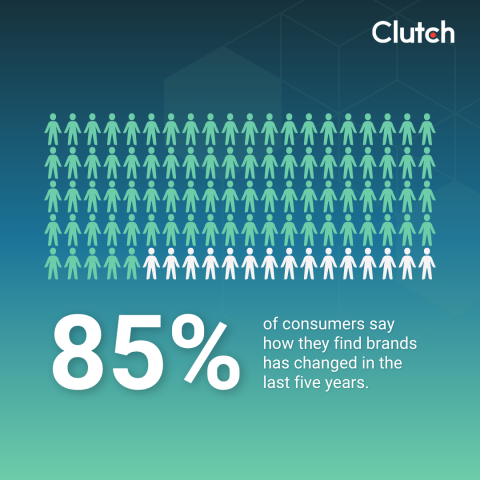
People aren't necessarily more impulsive or better at decision-making. Instead, this shift reflects a broader change in discovery. According to our data, 85% of consumers say how they find brands has changed in the last five years.
Faster discovery equals faster decisions. On the one hand, that can mean quicker sales. However, it also gives you a lot less time to build trust. If you don't show up credibly at every touchpoint, customers can lose interest.
It only takes a few minutes for that to happen. Monika Siwek, COO and Co-Founder at MOONSOON Digital Marketing, explains, "What happens in the next 10 minutes when customers open a second tab and look for evidence that you're real and trustworthy, that's where most brands quietly lose."
She continues, "Reviews, third-party mentions, credible press coverage, and product details that actually answer real objections — rather than reading like a brochure — are what close the gap between a first impression and a decision."
Customers aren't ignoring brands without these trust signals. They're doing their research and actively rejecting any company that doesn't pass the sniff test. For example, a pet owner may decide to try a new dog food after reading veterinarian testimonials and reviews. But if they can only find a few bare-bones product descriptions, they're probably not going to risk it.
Consumer post-discovery behavior is fairly predictable. After they come across a new brand, people tend to check these sources:
Customers usually don't move through this list one by one. They're hopping between multiple tabs or apps as they hunt for information. They might send a friend a quick text, asking, "Hey, have you ever heard of X?" Then they're reading a review or skimming your Instagram posts.
This multitasking means your brand needs to show up in all these places simultaneously, not in sequence. Here's where potential customers tend to go:
When customers discover a new brand, the last thing they want to do is buy. They don't even know if it's a real company yet.
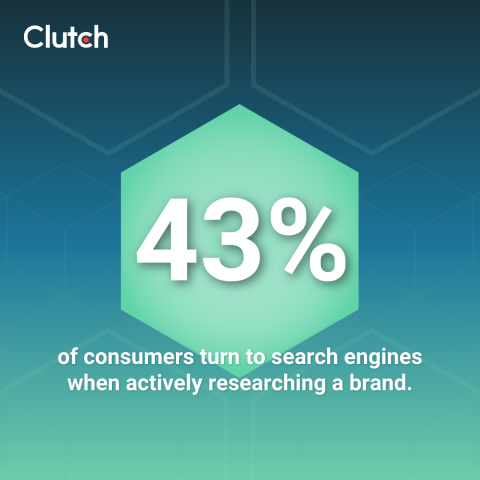
Instead of pulling out their credit card, they typically head to Google. Our data shows that 43% of consumers turn to search engines when actively researching a brand. They want to make sure the brand is legitimate and meets their expectations. They're also curious about what other people think. After all, internet strangers often feel more trustworthy than slick marketing.
The entire branded search engine results page (SERP) is fair game for verification. Ideally, your own site should show up first, but consumers don't stop there. They're scrolling through everything below it, too. That might include review sites, news mentions, a random Reddit thread from 2013, and Wikipedia-adjacent pages.
Focus on the pages under your brand's control. Iulia Vasciuc, CEO of ScaledOn, says, "Make absolutely sure your branded search and your Google Business Profile (or Amazon storefront) are bulletproof — because that's where every channel eventually sends traffic to verify you're real."
But it is important not to assume that Google is always the first stop. Nearly half (47%) of consumers expect AI tools to become the main way they discover brands in the future. Many already use ChatGPT and other assistants to verify brands first.
That doesn't mean you need to change tactics. These platforms still pull from the same third-party sources that Google uses. If someone raves about your products on Reddit, their thread could appear in branded SERPs or in a ChatGPT response. Either way, it builds trust.
When it comes to conversion factors, there's no real competition. Reviews win by a wide margin. Our data shows that 42% of consumers say positive reviews are the #1 factor in their decision to buy from a new brand.
It's not about star ratings. Reviews work because they come from people who have no financial relationship to your brand. Unlike salespeople, creators, or influencers, they have no incentive to lie about how great your products are. That makes their validation feel honest and pure in a way that no brand-made content can match.
As Fran Jakubowicz, CEO at Sunhouse Marketing, puts it: "Reviews sit at the intersection of search visibility, consumer trust, and AI-generated recommendations." In other words, a single glowing review could appear across multiple touchpoints.
Jakubowicz adds, "Third-party validation now directly determines how quickly a consumer moves from awareness to purchase, and increasingly, whether your brand even gets surfaced by an AI tool when someone asks for a recommendation."
That means reviews are no longer nice-to-haves. If you don't actively seek feedback, your brand will be invisible when the stakes are the highest.
It's normal to scope out a new acquaintance on social media. The same goes for freshly discovered brands, but people aren't looking at follower counts or likes. They're checking for coherence.
As they scroll, consumers see the dates of your last posts. If you haven't shared anything on Instagram since 2022, they might assume you've gone out of business. They're also looking for a consistent aesthetic. A jumble of seemingly random visuals is a major red flag.
Responses to comments matter, too. If a brand never replies, it may seem like there's not a real person behind it, or at least no one who cares. That's sketchy. Anything that doesn't line up with the consumer's initial expectations will also set off alarm bells.
That might seem like a lot of info to get from a quick scan, but consumers are savvy. About one in three (34%) encounter a new brand on social media every day, according to our modern discovery survey. That means they can tell when a profile feels active versus performative.
In other words, don't just focus on getting more eyes on your posts. Use your social profiles to keep sending those trust signals. If your profile looks sparse or abandoned, consumers will probably decide it's too risky, even if you made a great first impression.
Word-of-mouth recommendations often occur privately, making them easy to overlook. That's a mistake, though. A quick conversation with a trusted person can go a long way toward convincing a consumer to buy from a brand. Our data shows that 39% of consumers trust friends and family most when finding out about a new brand.
These discussions often happen in parallel with the other steps. For example, someone might text a friend while skimming Yelp reviews or share a product link in a group chat. If no one validates their find, or at least says something neutral about it, customers often won't buy.
A single recommendation can kick off a chain reaction. Our survey found that 71% of customers have recommended brands they found online to others. That means every buyer could become part of a friend's post-discovery sequence, creating a positive loop. And this marketing is completely free.
The post-discovery window isn't exactly a secret, yet brands still lose sales during it. Here are a few reasons why that happens:
It all comes down to trust. If you don't give customers a reason to believe in your brand, they'll go with someone else.
Brands that win over customers have a few things in common. Here's how to do it:
Staying visible without overwhelming people is key.
Discovery is only a fleeting moment at the beginning of the customer journey. Once someone stumbles across your brand, they typically take up to 30 days to decide whether to buy. Most of that decision-making happens outside your direct control.
Don't get caught up in raising awareness during this period. They've already seen your brand. Now, you're competing with other companies to hold up during verification. That takes an entirely different set of tactics.
As more people rely on AI to find and verify brands, the post-discovery research sequence will only get shorter. If you want to win over the 72% of consumers who make decisions within 30 days, you need to build your presence around this behavior. Otherwise, you're wasting your money on awareness that ends up costing someone else.
Get started by focusing on the verification quadrant: search, reviews, social, and recommendations.