Personal Branding vs. Company Branding on LinkedIn: Where Should Founders Focus Their Efforts?
Should founders build a personal brand or a company page on LinkedIn? Learn what each does best and how to run both without turning the platform into a...
Updated November 4, 2026

Most people who see an AI assistant ad won't click it, so the click-through rate only tells part of the story. Clutch explores the other measurement approaches that round out the narrative.
Advertisers can now purchase ads within ChatGPT through a self-serve Ads Manager. On October 5, 2026, OpenAI expanded its measurement tools and named its first third-party measurement partners.
Still, the program is in its early stages, and advertisers are still trying to determine how to evaluate whether AI assistant ads work.
Looking for a Public Relations agency?
Compare our list of top Public Relations companies near you
In September 2026, Clutch surveyed 747 consumers, including 628 regular users of AI assistants, about their experiences with and opinions about ads in AI assistants. A mere 15% said they would click through to the advertiser’s website. Almost a third (31%) said they’d ignore the ad altogether, while 12% said that seeing an ad mid-conversation would make them trust the assistant’s recommendation less.
Those figures explain why, if you judge ad performance based on clicks alone, AI assistant ads are likely to look weaker than they are. This immediate disillusionment could lead you to avoid both the upside and the risk of sponsored placements within AI assistant conversations.
Here, we’ll discuss why clicks don’t accurately reflect the value ofAI assistant ads, what brand lift measurement is, and how to use other metrics for a more effective picture of these placements, including brand lift, search lift, assisted conversions, and more.
Only 15% of AI assistant users,would click through to the advertiser’s site in the middle of a conversation, largely because of how people use AI assistants. People use AI assistants to work through decisions rather than make purchases, so clicking an ad often isn’t the logical next step.
Keenan Beavis, CEO of Longhouse, said, “Immediate click-through intent is weak on digital billboards inside conversational interfaces.”
OpenAI’s own Ads Blog makes this argument, acknowledging that they “already observe conversions following ad impressions without a qualifying click.” Even if users don’t click your ad specifically, they may return later through search, a direct visit, or a store.
Early partner results show how much a click-through rate (CTR) report can miss. According to OpenAI, a WorkMagic geo-lift study for wellness brand Dose estimated 2.3x more incremental orders than last-click attribution captured. Of course, that is a single-brand finding reported by a partner, so don’t take it as a benchmark. PPC Land noted that OpenAI gave no baseline order count, test dates, or confidence interval alongside that figure.
Our study details the share of users who would research a brand further after seeing an ad, which is the strongest evidence of delayed impact. A CTR report captures only one small part — the smallest part, in fact — of how AI assistant ads perform.
Missing clicks is only half the problem with measuring an ad’s effectiveness. Our survey found that 43% of users say ads improve their AI assistant experience, but another 37% say ads make it worse. On trust, 12% say they would trust the assistant’s recommendation less for displaying an ad.
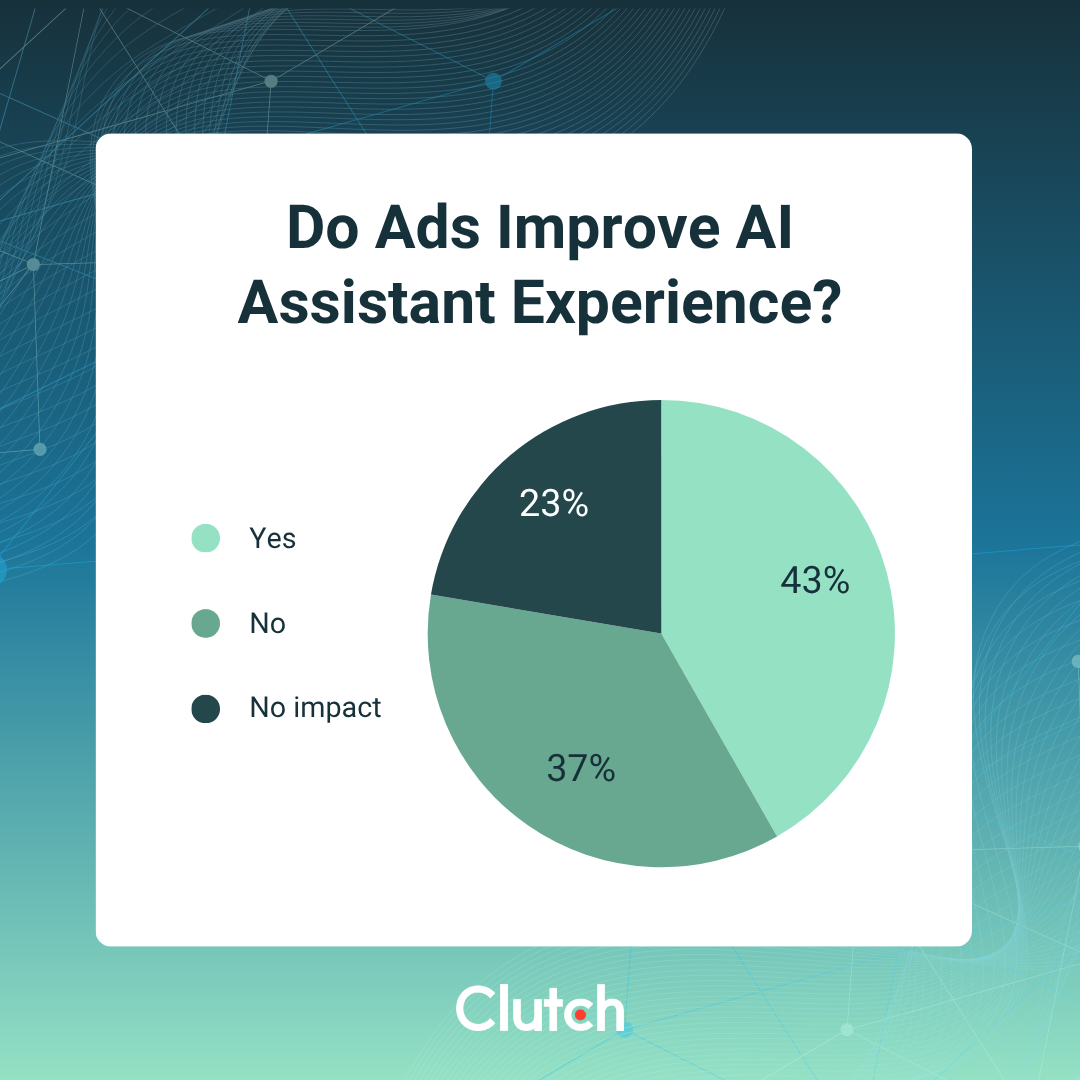
Those figures show that the effects you’ll miss if you only measure clicks aren’t just the positive ones. An ad can encourage consideration for one user but chip away at another user’s confidence in both the assistant and the brand that paid for the ad placement.
Brand lift can go down as well as up, which is why you need to measure it rather than avoid it. A campaign that quietly erodes consumer trust may show little sign of that erosion on a CTR report. To catch such issues, your ad measurements have to capture both ends of the spectrum.
Brand lift measurement tracks the change in how people perceive a brand after seeing its advertising. Marketing Week describes it as a way to quantify a campaign’s effect on the consideration stage in the middle of the sales funnel, where click data tells you little.
Standard KPIs include awareness, ad recall, consideration, favorability, and purchase intent. Google’s brand lift tool measures the same KPIs but adds brand interest, which it gleans from organic search activity.
The brand lift measurements come from controlled experiments. One group sees the ad, while a similar control group does not. Both groups then take the same short survey, and the difference between their positive responses is the brand lift. Google’s Display & Video 360 documentation calculates absolute lift by subtracting the control group’s positive response rate from the exposed group's.
This method also suits AI assistant ads. These placements reach people mid-decision, when consideration and preference are still forming. That is the exact funnel stage a brand lift study is designed to measure.
These five metrics cover the effects that click reports miss. Use the quick-reference table to match each method to the question you need answered.
| Method | What It Measures | Supporting Tools and Partners | When To Use It |
| Brand Lift Study | Change in awareness, consideration, and favorability between exposed and control groups | Survey panels; Kantar and Cint (early testing with OpenAI); Google Ads brand lift for YouTube | You need to know whether your ad changed user perception |
| Search Lift | Change in branded search activity | Google Search Console, Google Trends, paid search impression data | Impact shows up later through branded searches instead of immediate ad clicks |
| Assisted Conversions | Conversions where an AI assistant ad appeared earlier in the path | Analytics platforms with UTM tags; OpenAI pixel and Conversions API; AppsFlyer, Adjust, Triple Whale, Kochava | You want to judge ChatGPT ad performance next to your other channels |
| Incrementality Testing | Extra sales the ads caused | Haus, Measured, WorkMagic (early GEO experiments with OpenAI) | You need causal proof before increasing your marketing budget |
| Trust and Sentiment Tracking | Brand perception and how AI answers describe the brand | Brand sentiment and AI answer monitoring | You want to catch trust damage early |
A brand lift study uses an exposed-versus-control design to measure awareness, consideration, and favorability. Kantar and Cint are in early-stage testing with OpenAI to measure how ChatGPT ads affect brand resonance metrics, but the program isn’t broadly available yet. Until then, advertisers can run their own brand lift measurement through third-party survey panels such as Dynata, or compare surveys taken before and after a campaign.
As a best practice, keep the survey short, and collect only the specific data you need to judge the campaign. Marketing Week also advises using an outside partner rather than analyzing your own results.
Keep size in mind, too: According to Google’s documentation, smaller lifts of less than 2% require more survey responses for accurate reports. A modest campaign may never produce a readable result.
Search lift gauges increase in branded searches after people see your ad. Track branded search volume during and after a campaign in Google Search Console, Google Trends, and your paid search impression data. Then compare that volume with a baseline period or a region where the campaign didn’t run to separate the ad’s true effect from seasonality.
Google’s search lift tool for YouTube follows the same logic, comparing the organic searches of the exposed and control groups. A relative lift of 25% means exposed users were 25% more likely to search for the brand or product after seeing an AI assistant ad, according to our data.
Last-click reports attribute all the credit to the final touchpoint. Conversely, an assisted conversions report recognizes channels that appeared earlier in the path. Google Analytics counts a conversion as assisted for any channel that took part without getting the last interaction. Add UTM parameters to your AI assistant ads so they show up in those paths.
OpenAI supports this through its pixel and Conversions API, as well as through attribution partners including AppsFlyer, Adjust, Triple Whale, and Kochava. These tools allow you to evaluate ChatGPT ads using the same system as for every other channel.
Early partner data offers an example: DV Rockerbox measured WeightWatchers’ attributed cost per acquisition on ChatGPT at 15.3% below the brand’s blended paid search benchmark. OpenAI reported that figure, which PPC Land pointed out didn’t include spend or sample sizes.
Incrementality testing comes closest to establishing causal proof for emerging ad channels.
In a geo-holdout test, rather than relying on pure randomization, which often fails when physical markets vary so widely, platforms like Haus construct synthetic control groups. They compare target regions with a carefully modeled, weighted combination of control markets that show identical baseline trends.
OpenAI is running early-stage geo experiments using this design with measurement partners Haus, Measured, and WorkMagic.
Expect trade-offs, however. Turning off ads in a holdout market means sacrificing potential sales, and managing the experiment requires strict operational discipline.
According to SegmentStream, a major pitfall is algorithmic budget leakage. If you suppress spending in holdout regions without lowering your overall campaign caps, ad networks will automatically redirect the unspent budget to your control markets. This artificially inflates the control group's performance, reducing your apparent lift and undermining the test’s validity.
Brand lift surveys capture a snapshot, like a still frame. Sentiment tracking covers the time between snapshots, so you can watch brand sentiment and how organic AI answers describe your brand while a campaign runs. With 12% of our respondents saying an ad would lower their trust in the assistant’s recommendation, these metrics are critical.
Placement transparency can be another blind spot. eMarketer reports that advertisers still lack prompt-level visibility into why an ad appears. OpenAI is piloting brand suitability evaluations with DoubleVerify and Integral Ad Science, which provide external partners with insight into its safeguards without reading users’ private conversations.
Creating a strategy to measure the true impact of your AI assistant ad campaigns isn’t complicated. These actionable steps break it down into manageable chunks that you can start on immediately:
Setting the baseline is arguably the most important. Without a starting point, you have nothing to compare against your search lift or brand lift measurements.
AI assistant ads work differently from search ads, and click-based reporting can miss most of their effect. Our data shows that only 15% of users would click through after seeing a relevant ad. Another 31% would ignore it, and 12% would trust the assistant’s recommendation less. Meanwhile, 43% say ads improve their experience, while 37% say ads make it worse.
Those divides demonstrate why you must look beyond click data. Brand lift measurement, search lift, assisted conversions, and more go beyond traffic to show you how your AI assistant ads truly affect your brand.
A: Brand lift measurement tracks how advertising changes people’s perception of a brand. It covers metrics such as awareness, ad recall, consideration, favorability, and purchase intent. Most studies compare people who saw an ad with a control group who didn’t, using short surveys.
A: To measure brand lift, split an audience into an exposed group and a control group, then send both the same short survey. Subtract the control group’s positive response rate from the exposed group’s to determine absolute lift. Smaller lifts require more survey responses to read accurately.
A: Brand lift relies on survey responses from exposed and control groups to detect changes in awareness or consideration. Tracking search lift can determine whether exposure increased the number of people searching for the brand. Both use control groups, but they gauge different signals.
A: For now, there are limited ways to measure brand lift for ChatGPT ads. OpenAI is in early-stage testing with Kantar and Cint on brand resonance metrics, but it hasn’t yet made a brand lift measurement product broadly available. You can conduct your own studies using third-party survey panels or by comparing before-and-after surveys.