Lead Quality vs. Lead Quantity: Why B2B Teams Are Rethinking Their Funnel in 2026
Bigger buying committees and tighter budgets are forcing B2B teams to rethink lead quality vs. quantity. Here's how top teams rebalance the tradeoff in 2026.
Updated April 2, 2026

Brand scams are on the rise in the era of generative AI. Here’s what they look like and how to protect your business from reputational damage.
Online scams have evolved beyond the obvious, poorly written emails of the early internet. Today, they’re highly polished and designed to look indistinguishable from the real thing. This can be convincing enough to fool even the most cautious customers.
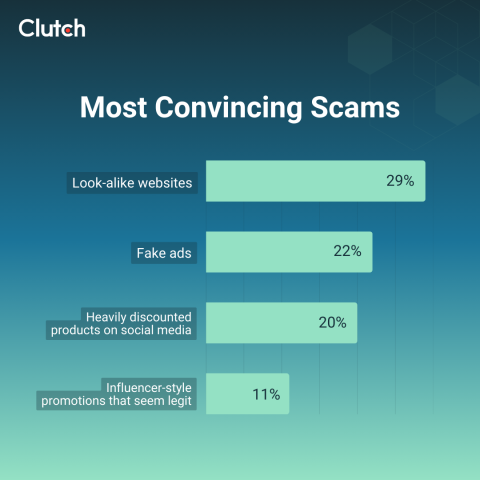
Clutch surveyed 401 consumers about their experiences with online scams, and the results revealed just how convincing fraudsters have become:
Looking for a Digital Marketing agency?
Compare our list of top Digital Marketing companies near you
For brands, the implications are significant. Brand impersonations are a direct threat to bottom-line revenue, consumer trust, and long-term reputation. This has made taking proactive steps to prevent impersonation more important and valuable than ever.
As Austin Mallar, CTO of Longhouse Branding + Marketing, puts it: “Agencies today should treat brand safety as part of performance strategy.” This guide covers what that means in practice.
Brand impersonations may not be your fault. But some research indicates that 63% of consumers today blame the authentic company when fooled by an impersonation scam. This can have many consequences:
Given the potential costs, it's important to monitor for brand scams and report and respond as you find them.
The short answer is that brand impersonations are so effective because they’re designed to be. Several psychological, technological, and behavioral factors come together to make modern scams especially difficult to detect.
First, fraudsters exploit the trust that consumers have already built with a trusted brand. They use your social proof and reviews to signal legitimacy and hope that consumers will accept them without double-checking the source. Many also use urgency tactics like limited-time discounts and low-stock warnings, leveraging the fear of missing out (FOMO) to incentivize people to act fast before thinking things through.
Technology has also made these scams easier to execute. AI-generated creative elements can mirror a legitimate brand's visual identity with minimal effort. Plus, scammers can target paid search and social ads with the same precision tools available to real marketers. This can make fake ads feel like legitimate advertising.
Consumer fatigue also plays a role. People encounter massive volumes of digital content every day, which makes vigilance difficult to maintain. Scammers design their operations with this environment in mind, creating content that looks legitimate at a quick glance and making it urgent enough that consumers won't give it a second look.
Fraudsters engineer exploits designed to abuse the channels customers trust most. Here’s what that looks like in practice today.
Look-alike websites are the most convincing scam format, according to 29% of consumers surveyed by Clutch. Scammers often register domains with subtle variations of your authentic URL — like “Walm.art.co” instead of “Walmart.com”.
Then they replicate everything from your actual website to make the scam site look indistinguishable from it. This includes the checkout page, branding elements, product listings, and layouts. AI has accelerated this process, as scammers can spin up fraudulent sites with less effort than ever.
Together, it can be enough to make some consumers complete purchases before they realize anything is wrong.
Another 22% of consumers say fake ads impersonating well-known brands are the most convincing scams they encounter. These efforts use stolen assets to run paid ads on search engines and social platforms that are hard to distinguish from legitimate marketing.
Once again, AI-generated content has made matching a brand’s aesthetic even easier. Plus, modern ad platforms allow scammers to put these fake ads in front of the most relevant audiences. Clicking on them typically directs consumers to a scam site that looks indistinguishable from your own.
An additional 29% of consumers fall for heavily discounted social media offers. These scams lean on unrealistic pricing, urgency messaging, and manufactured scarcity to incentivize fast action. For example, a flash sale offering 70% off a recognizable brand’s products "only while supplies last" can lead some consumers to complete a purchase without thinking.
Influencer-style promotions are also getting more common and have caught 11% of consumers off guard. Scammers create fake influencer accounts, repurpose stolen user-generated content, and build a following they hope to cash in on over time.
This problem is likely to get worse for two key reasons. First, influencer marketing is growing rapidly and training consumers to trust product recommendations from their favorite creators. Second, AI has enabled the creation of entirely fake people who look exactly like real humans. This continues to blur the line between authentic creators and sham accounts.
Brand impersonation scams may be on the rise, but there are steps you can take to combat them. Moving proactively and sharing updates with your audience could even help to build your brand’s reputation over time.
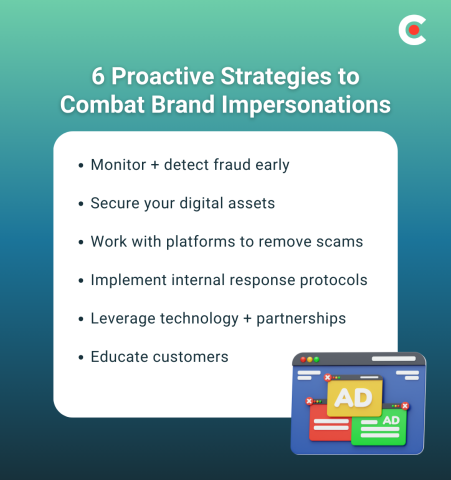
The faster you identify an impersonation attempt, the less damage it can do. Brand monitoring tools such as Mention, Brandwatch, and Google Alerts flag your brand name across the web in near real-time, so you can spot unauthorized use and take action quickly.
Social listening platforms add another layer of protection. They monitor social media channels to surface fake accounts that use your content or impersonate your business. They’re especially helpful if you do a lot of your marketing work on social channels.
The key is building monitoring into your operational routine. That means setting up alerts and reviewing flagged content at a consistent cadence. Daily is best for high-volume brands, but even small businesses should aim to review flags at least once a week.
Start by registering your trademark domestically and in key international markets to have legal standing to pursue takedown requests. Then claim verified accounts on every major social platform, even the ones you don’t use. Leaving handles unclaimed leaves the space open for fraudsters to impersonate you.
Beyond this, lock down your domain with reputable registrars that offer additional security layers such as registry locks and WHOIS privacy protection. You should also use two-factor authentication on all brand-owned accounts and conduct regular audits to safeguard credentials.
Some companies even register common variations of their domain names to proactively fight fraud. This could be especially useful if you operate under a few names or have a common shortening of your full brand name.
Every major digital platform has a reporting and takedown process for brand impersonators. But the quality and speed of these can vary significantly, so it’s worth doing research upfront to make sure you understand each process.
Building a working relationship with ad networks and platform representatives can considerably accelerate the takedown process. For example, you could ask for a point of contact on Instagram or X if you’re frequently impersonated. Companies like Meta and Amazon even have dedicated brand protection portals you can visit to streamline reporting and gain visibility into active takedown cases.
Setting up a response process in advance of when you need it is also worthwhile. That often starts with cross-functional training so customer service, marketing, legal, and operations teams can move quickly as fraud occurs. For example, you might create a process in which customer service staff notifies other departments of customer complaints about suspicious ads so they can act on them quickly.
Many companies have a dedicated point of contact for fraud response to prevent threats from falling through the cracks. Whether you have one or not, create documentation that clearly outlines an escalation path so employees and managers always know how to move forward.
Even as fraud increases, brand protection tools have also improved significantly. AI-powered platforms like Red Points, BrandShield, and Corsearch continuously scan the web for unauthorized use of your assets, automating a detection process that would otherwise require hours of manual monitoring. Many platforms can also automate the takedown request process.
If you’re especially exposed to brand impersonation, partnering with a cybersecurity firm could be a smart move. These firms have threat intelligence and incident response expertise to more comprehensively thwart bad actors.
For further protection, consider adding fraud detection software to your tech stack. This can help you find and stop unusual transaction patterns, suspicious login activity, and other signs that fraudsters are targeting your customers.
Communicating with your customers is a valuable tool in the fight against impersonation. Let them know about the risks of fraud and how to spot your company’s legitimate channels. For instance, clearly explain to your customers that you’ll never ask them for certain types of information, such as their login credentials or payment details, on social media.
Next, make it easy for customers to report suspicious activity with a dedicated channel on your site. When you get reports, let the person who submitted them know that you’ve taken action and the results of that action, where possible. Customers who feel heard are more likely to report again, making it easier for you to fight back against scammers.
Timely reporting is the best way to get impostor accounts and websites taken down. Here’s how to report a scam effectively:
Timelines for action can vary based on where you submit. Platform takedowns on Meta, Google, and similar sites can often address the fraud within 24 to 72 hours. But domain disputes and legal proceedings may take much longer, often weeks or months after an initial complaint.
Brand impersonation has grown from a fringe threat to a mainstream business risk, with 29% of consumers falling victim to look-alike websites, 22% responding to fake ads, and 29% being fooled by deep discounts on social media. AI has accelerated the speed and scale of fraud and made it significantly harder for consumers to distinguish between fake and real.
Today’s companies have a dual mission: protecting their businesses and their customers. A long-term brand protection strategy should combine:
None of these strategies can entirely eliminate the risk of impersonation. But together, they make it significantly harder for bad actors to target your brand. That can be the difference between dealing with frequent impersonation attempts and rarely experiencing them.