Lead Quality vs. Lead Quantity: Why B2B Teams Are Rethinking Their Funnel in 2026
Bigger buying committees and tighter budgets are forcing B2B teams to rethink lead quality vs. quantity. Here's how top teams rebalance the tradeoff in 2026.
Updated April 28, 2026

For years, backlinks were the currency of search visibility. If you earned enough of the right backlinks, Google rewarded you with rankings. That’s still true to a degree, but it’s no longer the full story...
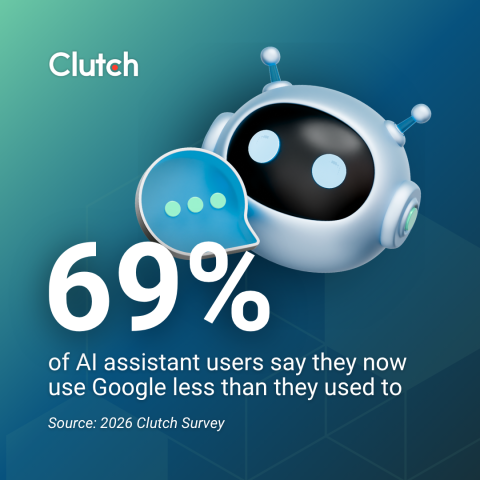
According to Clutch’s 2026 AI Adoption and Usage Survey, 32% of people who use AI assistants now turn to AI first before searching, edging out the 28% who still go straight to Google. Further, 69% of people who use AI assistants say they use Google less because of it.
Looking for a Digital Marketing agency?
Compare our list of top Digital Marketing companies near you
“The B2B buyer’s journey has shifted significantly,” says Ross Simmonds, Founder and CEO of Foundation Marketing. “Customers are starting with in-depth conversations in LLM [large language models] to better understand what is the right solution, who is the right service provider for their individual needs.”
AI doesn’t rank pages the same way Google does. Instead, it synthesizes information and decides whom to cite. Backlinks have transformed from ranking signals to harbingers of credibility and discoverability. This means your backlink strategy now has a new purpose beyond ranking highly on search results pages: to make your brand’s website the kind of source that AI tools consider credible enough to recommend.
Let’s talk about how to build backlinks so your brand shows up in AI-generated results.
Traditional SEO treated backlinks as ranking signals. The more authoritative links pointed to your site, the higher Google’s algorithm placed you in its search results. Although that logic still applies, AI search has raised the stakes considerably.
When ChatGPT, Perplexity, or Google’s AI Overviews generate a response to a user query, they aren’t simply providing a list of links. They’re synthesizing information from sources they’ve already deemed to be credible. Backlinks factor into that determination, but not just because of domain authority scores. They’re indicators of authority, pathways to discoverability, and context markers that help AI systems decide what to synthesize and recommend.
Backlinks haven’t become irrelevant. Along with AI technology, they, too, have evolved. They now inform AI tools whether you’re worth citing.
Volume alone is no longer enough. A thousand backlinks from low-relevance sites won’t convince AI to recommend you any more than it convinces a discerning human reader. To AI, it’s more important that your backlinks position you as a credible, frequently cited source within a specific category.
AI-friendly backlinks share a few characteristics:
The shift from organic web traffic to AI traffic has changed how smart brands approach backlink strategy.
“The ones who are responding are investing in channels beyond just their own website,” says Simmonds. “They’re recognizing that the idea that search engine optimization simply means 'Google and my website' is a broken philosophy. The better approach today is to embrace a multi-channel strategy where you’re on YouTube, you’re on Clutch, you’re on Reddit, you’re on LinkedIn, you’re on Medium, Quora, and more. The brands that are recognizing the necessity of diversifying their content mix are winning.”
Pure backlink volume, exact-match anchor text, and traditional domain authority metrics are far less important than they used to be. The backlinks that set you up for prime AI visibility are the ones that position your brand inside a web of trusted, contextually pertinent sources.
AI tools pull information from training data, real-time retrieval, and user behavior signals. While generating a response, they weigh sources in a loose citation hierarchy:
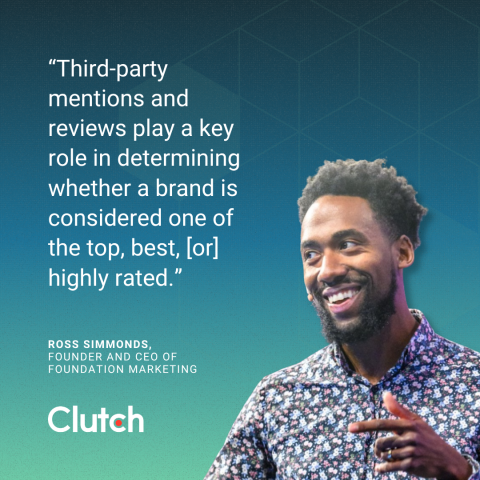
“Over the last few years, we’ve been measuring the impact across multiple platforms,” says Simmonds. “Third-party mentions and reviews play a key role in determining whether a brand is considered one of the top, best, [or] highly rated.”
Platforms like Clutch, where users find verified client reviews and third-party evaluations, carry the kind of credibility signal that AI systems weigh when deciding who’s citation-worthy. A strong profile on a trusted industry directory is good for human buyers doing research, but beyond that, it also feeds directly into how AI considers your brand.
Essentially, if you want AI to cite you, you need to be cited by the sources AI already trusts.
To get the most out of backlinks on the modern internet, it's important to win the trust of AI as well as human readers. Simmonds says, "We need to understand not only how to create content worth reading, worth linking to, worth referencing...but what stories are worth citing and what platforms are more likely to be cited."
The following framework can help you create a backlink strategy that earns you citation credibility with AI.
Start with the outlets that already carry weight in AI-generated responses, such as major trade publications, established industry directories, authoritative review platforms, and relevant .edu or .gov sources (where applicable). These are worth the effort it takes to get them, as one link from a source AI already relies on is worth considerably more than a dozen backlinks from sites it doesn’t know.
Prioritize earned media over link exchanges. Making guest contributions to respected publications, being quoted as an expert in industry roundups, and appearing in analyst reports are worthy pursuits.
On the other hand, stay aware of the risks of link exchanges. Over-reliance on exchanges, especially if they involve irrelevant or unnatural link patterns, can lead to lower-quality backlinks, reduced site credibility, and algorithmic penalties.
The most reliable way to get backlinks from both humans and AI is to publish legitimately referenceable content. Original research, comprehensive guides, and proprietary data tend to attract links naturally over time as they become the go-to resource for a specific topic.
Backlinko, for example, has built a backlink profile of over 1.5 million links, largely by publishing detailed, data-driven SEO studies that others in the industry cite repeatedly. Content like this compounds: The more others cite your work, the more AI recognizes you as an authority in your space, and the cycle continues to reinforce itself, pushing your credibility even higher.
When AI evaluates a backlink on a web page, it also reads the sentence, the paragraph, and even the surrounding section. It then uses that context to represent your brand when it cites you.
Pay attention to the verbiage that surrounds your link when you’re contributing guest content, securing a mention in an article, or getting listed in a directory. Does the wording reflect how you want to position yourself? Does it use the category language your buyers use to search?
A link that says “visit their website here” tells AI systems almost nothing. A link embedded in a sentence that explains what you do and why you were referenced is much more informative.
Different AI tools pull from varying sources. For example:
The common thread is that they all place greater weight on platforms with high domain authority, strong engagement signals, and frequent citations across the web.
Link building with AI-friendly backlinks requires identifying which platforms appear most frequently when your customers use AI assistants. Query those tools yourself, asking industry questions to find out who and what they cite. Then reverse-engineer your presence on those platforms. For instance, if LinkedIn articles, Reddit threads, or Quora answers consistently appear in AI responses for your category, devote more of your content energy to prioritizing backlinks from those sources.
Even without formal backlinks, AI synthesizes from brand mentions. A mention of your company name in a well-trafficked article, even without a link attached, still contributes to how AI understands your brand’s presence in a category.
That means you shouldn’t ignore unlinked mentions, but instead treat them as opportunities. Social listening tools like Mention, Ahrefs Alerts, or Brand24 can automatically surface mentions. Focus on third-party platforms over custom GPTs, and when you find mentions, you can:
Simmonds says, “You need to invest in these sources, create more content, [and] invest in optimizing your profiles.”
If a third-party platform is already mentioning your brand, you have credibility there. Don’t let it go to waste.
Inconsistent information throughout your backlink profile can confuse AI. If one platform describes your brand as an “SEO agency,” another calls it a “digital marketing firm,” and a third describes you as a “content strategy consultancy,” AI may be confused about what you actually do.
Audit your presence across the platforms where you’re cited to standardize your descriptions, category language, and positioning. When the collective picture of your brand across various sources tells a coherent story, AI can more accurately represent it.
Crucial to successfully implementing a new backlink strategy is measuring its effectiveness. The standard SEO metrics, such as domain authority, referring domains, and anchor text distribution, are still relevant. However, they don’t tell you whether you’re appearing in AI-generated answers, where an increasing number of users are starting.
Simmonds recommends a direct approach. “Get an audit of your visibility within the platforms,” he says. “Run an audit on how likely your brand is to show up for key category- and brand-related queries.”
You can test this manually by querying ChatGPT, Perplexity, and Google’s AI Overviews, asking category questions your buyers ask, and determining whether you appear in the results. If you aren't showing up, study the brands that are, in particular, their backlink profiles and content presence.
If AI tools do mention you, you want them to describe you accurately, favorably, and as part of the category you want to own. A few key metrics to track include:
Measuring success means expanding metrics beyond your SEO dashboard and proactively evaluating how AI represents your brand.
Backlinks are still essential, but with AI, the standards have changed, and your strategy needs to change alongside it. Rather than just targeting volume, aim instead for quality, context, and credibility.
Companies that ignore the evolution from traditional SEO to AI search, Simmonds says, “have their head in the sand and are just operating the way that they used to, and are allowing competitors to absolutely run circles around them by shifting their approach.”
Your brand has two choices: Adapt, or risk online invisibility.
It’s time to get ahead of the curve. If you’re ready to build an AI-ready backlink campaign, partner with an experienced SEO firm or branding agency that understands the importance of a modern backlink strategy.