Lead Quality vs. Lead Quantity: Why B2B Teams Are Rethinking Their Funnel in 2026
Bigger buying committees and tighter budgets are forcing B2B teams to rethink lead quality vs. quantity. Here's how top teams rebalance the tradeoff in 2026.
Updated April 14, 2026

Earned media brand mentions drive brand visibility in AI search engine responses. But for the LLMs to really take notice, those PR mentions need to appear in the right media properties, fit the right content types, and be formatted correctly.
As AI search grows in importance as a channel for learning about business solutions, marketers are expected to ensure that AI describes our brands accurately, positively, and prominently in responses to relevant questions. That, in turn, means making sure that your brand is mentioned accurately, positively, and prominently in the places where LLMs prefer to look for information.
PR hits, also known as earned media brand mentions, play a key part in this mission. Research from Edelman found that as much as 90% of AI-powered search citations come from earned media, with contextually relevant mentions in trusted media outlets and authoritative content carrying more weight than traditional keywords and backlinks.
Looking for a Digital Marketing agency?
Compare our list of top Digital Marketing companies near you
GEO (generative engine optimization) is the practice of optimizing your brand’s online presence so that AI-powered search engines accurately and prominently feature your brand in their responses to relevant queries. As we’ll see, generative engine optimization requires landing specific types of content, formatted in particular ways, on certain platforms and publications.
The rise of conversational AI and AI-powered search has changed the face of digital marketing. AI engines like ChatGPT, Perplexity, Google AI Overviews, and Bing Copilot have replaced the traditional SERP list with cogent, concise answers.
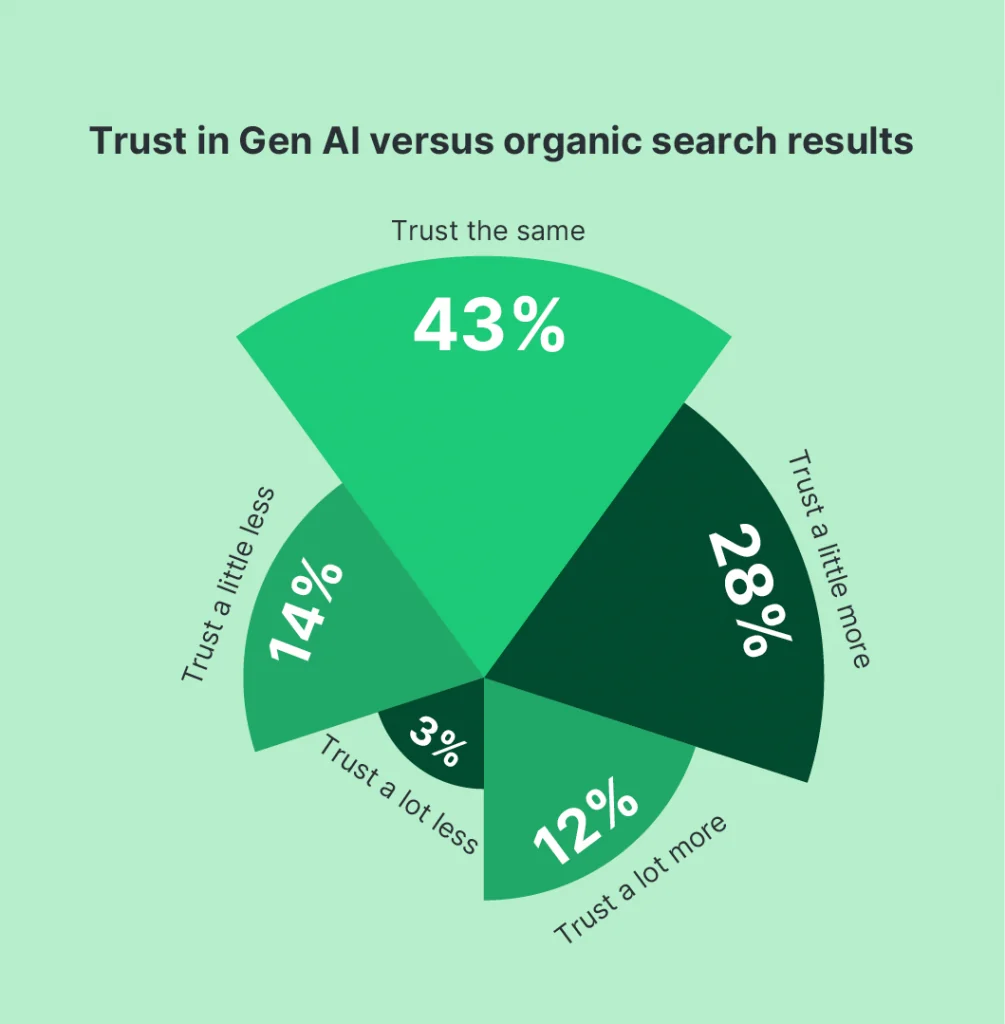
What’s more, users increasingly trust these replies as knowledgeable recommendations. Attest’s 2025 Consumer Adoption of AI Report found that only 17% of users trust AI answers less than those from traditional search engines, and 40% trust them more.
Source: Attest
Buyers rely on AI for brand recommendations, pre-purchase research, information about features and capabilities, and more. This is evident in the rise of zero-click searches.
When they’re learning about the various solutions offered by vendors, today’s prospects don’t necessarily encounter alternative views or check other sources. They’ll ask follow-up questions and eventually move from an AI-generated response straight to a brand website – could be yours or a competitor’s – giving AI answers a significant impact on customer decision-making.
Traditional search occupies a single point in a buyer journey, whereas people check out many channels and platforms. AI search, in contrast, is increasingly located in a single place: the AI search platform or answer engine. This is where prospects keep asking more questions, iterate on their prompts, peruse AI-generated comparison tables, or run deep research dives based on their pain points.
Note that AI searches tend to be ongoing conversations. Visitors are more engaged, with sessions lasting an average of 8 to 13 minutes, far longer than quick hit-and-run Google searches.
A buyer can move from the top to the bottom of the sales funnel in just one session in AI Mode, ChatGPT, or Perplexity, without the brand having had any direct voice or any opportunity to capture or nurture a lead. As a result, someone who ends up on your website after a conversation with an AI engine is likely already primed to journey further, because the AI has pre-qualified you as credible and relevant.
This is good news in many ways, but only if you, your marketing team, and your PR reps know how to optimize earned media activity for how AI search works. Some PR mentions are more impactful for GEO than others, and it’s all evolving extremely quickly.
Maximizing the impact of your PR campaign strategy requires tactics distinct from those for optimizing a PR campaign for human audiences, and it’s even more different from SEO link-building campaigns. Instead of trying to directly reach and convince your ideal customers that you’re an authority in your space, you’re trying to send signals to AI engines that inform how they answer questions related to your space.
This requires working with contributors, platforms, and publication-side editorial teams to produce the types of content assets that AI likes. If your agency knows how to land these assets in the right locations, while leveraging the right voice and formatting, then you’ll be primed to surface in the AI answers that matter most to your business.
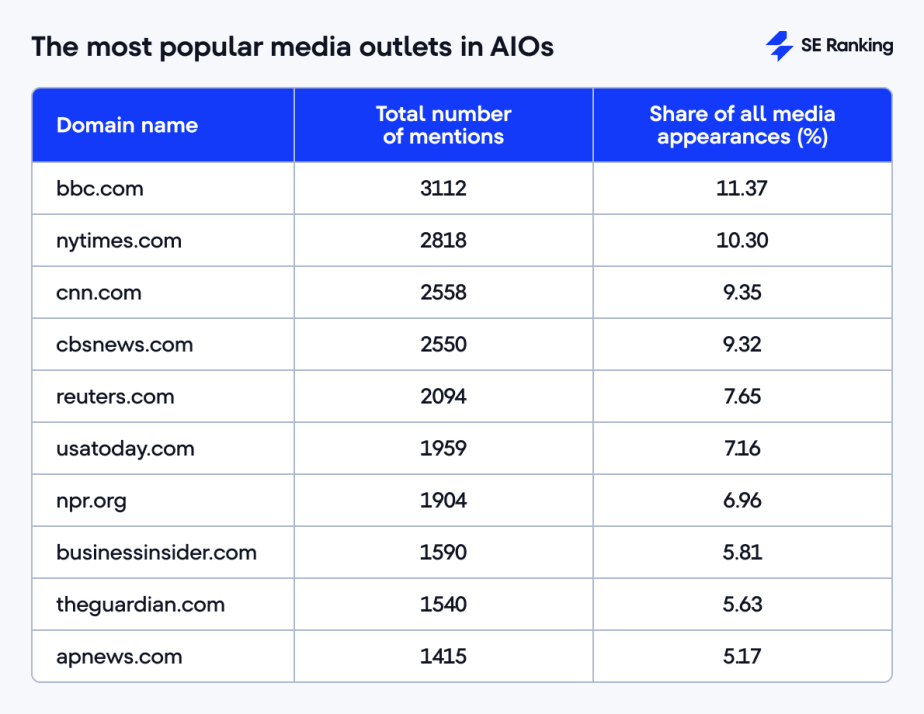
While owned media certainly shows up quite a bit in the sources cited in AI search answers, multiple studies have found that AI prefers authority publications, such as Forbes, Reuters, or The Guardian, over your brand’s product pages or blog posts. Depending on the company you’re promoting, these publications might be out of reach, but let’s remember that the clickstream data that informs these studies encompasses all types of AI prompts – not just those relating to business solutions.
Source: SE Ranking
In this sense, niche trade publications and local business journals can wield disproportionate influence, such as MarTech for marketing, Dark Reading for cybersecurity, or InfoWorld for data analytics. For example, if your expert commentary appears in SC Media, AI learns that your brand is authoritative in cybersecurity. It associates your brand with the topic, making the AI more likely to suggest it when someone asks for recommendations on a cybersecurity vendor.
This is why links don’t really matter in GEO. The web of mentions creates context that affects how AI interprets signals about your brand, whether those mentions are hyperlinked with keywords in the anchor text.
Just make sure that the publications your PR team targets are open to AI crawlers, that the content isn’t gated behind a lead capture form (although paywalled top-tier media is fine, apparently), and there are no disallow designations in the robots.txt.
AI also takes user reviews, opinions, and mentions on social media and knowledge platforms very seriously. One study that explored citations by the leading AI answer engines found that knowledge platforms reign supreme. Among the top ten most cited sources, Reddit comes up more frequently than Forbes or Gartner. Google’s AI Overviews, for example, cites Reddit, YouTube, Quora, and LinkedIn more often than Forbes and Business Insider.
These platforms have authority for GEO purposes, even though many of them aren’t traditionally considered “earned media.” According to Gini Dietrich’s PESO model of the marketing media mix, they are either paid (e.g., sponsored influencer videos on YouTube) or shared (e.g., brand-authored posts on Medium or customer community discussions on Reddit).
But there’s no arguing with AI answers, and GEO-ready digital PR firms know how to secure steady flows of contextually relevant mentions on all of these platforms as part of a holistic strategy.
If you want AI to recommend your brand based on your niche expertise or as a leader in its field, to accurately explain your product differentiation, and/or to showcase the love your customers have for it, then you have to bring those narratives to AI’s attention. And that requires packaging these narratives in content that AI can easily make sense of.
Setting aside thought leadership for a moment, when it comes to recommending what makes your product special, product-focused content rules the GEO roost. This encompasses product comparison articles, product-focused feature articles, and “top product” category lists wherever they are hosted, including authentic peer product review platforms.
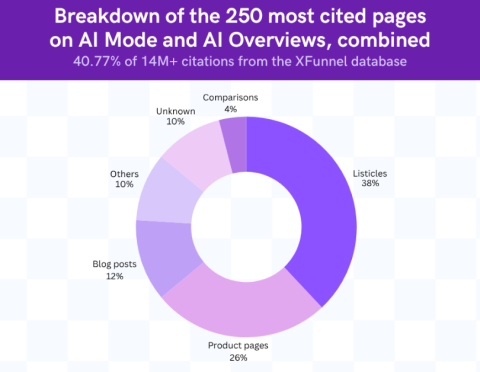
Listicles, which have been derided for years, are tops at influencing AI-generated answers. Research by xFunnel into over 14 million AI citations found that 250 pages make up more than 40% of total citations. Of those top 250 pages, 38% are listicles.
Source: XFunnel
Original research and data-led content are also valuable. Journalists particularly appreciate data-led content, so those types of assets are more likely to be published in authoritative third-party publications that AI favors as sources. Diverse publishers and writers will also cite your original research, which contributes to the web of mentions that convinces AI of your authority.
Bylined thought leadership op-eds and expert commentary interviews still play a significant role in driving prominence in AI search results. These types of pieces showcase your knowledge and depth of understanding, helping AI view you as experts in your niche.
Content written with definitive statements helps to show LLMs that your take is trustworthy, and this type of authoritative voice also helps the AI engines to summarise and repackage your words as factual answers. It’s generally best to format content so it's easy for AI search to quote. That means ordered lists with bullets, guides, glossaries and definitions, and FAQs, with section labels and schema markdown.
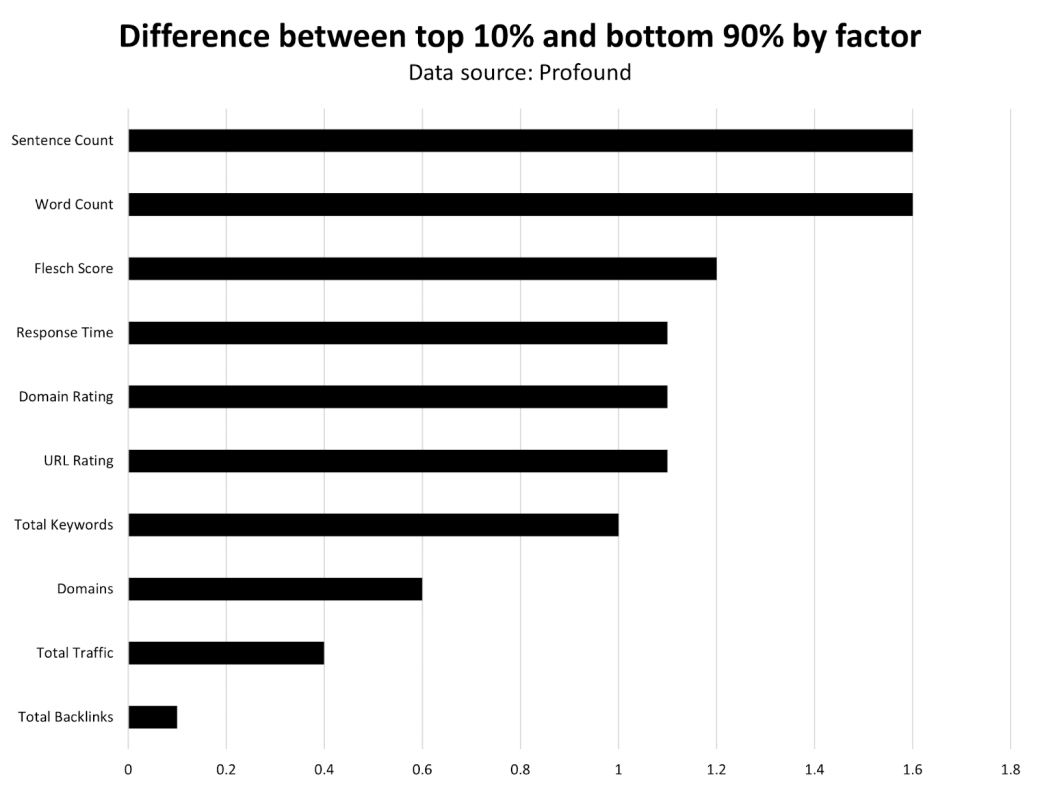
AI engines seek to answer the user’s question as closely as possible, so they favor content that closely matches people’s actual conversationally-phrased prompts. AI prompts are longer than yesterday’s longtail keywords, and they’re more likely to be part of an extended conversation. Kevin Indig’s research has found that the top 10% of content cited by LLMs is long-form, with high sentence and word counts.
As he explains it, that’s not because AI prefers longer content per se, but because the longer a piece is, the higher the chances that it meaningfully answers a specifically-worded prompt.
Source: Profound
AI engines also prefer readable, easy-to-understand content. Indig found that the content cited most by AI often has a high Flesch score, which indicates simple comprehensibility.
The relationship between earned media and AI visibility is only going to deepen. As AI search engines becomes the default way buyers research and evaluate solutions, the brands that show up in those answers will have a major advantage.
PR strategy is no longer just about reaching human audiences – it’s about sending the right signals to the AI engines that increasingly shape buying decisions. Brands that align their earned media efforts with GEO best practices now will be the ones best positioned as this landscape continues to evolve.