Lead Quality vs. Lead Quantity: Why B2B Teams Are Rethinking Their Funnel in 2026
Bigger buying committees and tighter budgets are forcing B2B teams to rethink lead quality vs. quantity. Here's how top teams rebalance the tradeoff in 2026.
Updated November 21, 2025

AI has raised standards for social commerce personalization. By delivering more relevant content and showing each customer what they need, AI personalization helps brands get more from their social spend.
Social commerce has transformed the online shopping experience. The process itself is relatively simple — brands create shoppable content on social media, allowing followers to transition directly from ad view to purchase with just a few clicks. The process is already robust, and artificial intelligence (AI) personalization has made it even more so.
To learn more, Clutch surveyed 483 typical consumers, asking about the impact of social media on their online shopping habits. More than three-quarters reported that brands' social content has influenced their purchasing decisions.
Looking for a Digital Marketing agency?
Compare our list of top Digital Marketing companies near you
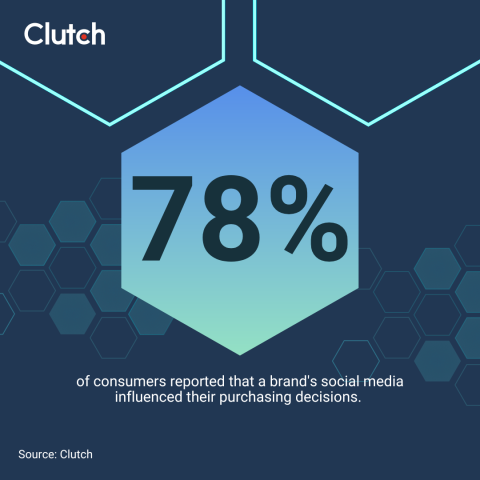
The takeaway is clear: To stay competitive, brands must find ways to drive conversions via their content. Personalized experiences are key to success, and AI takes personalization to the next level.
In this article, we explain how AI personalization works in social commerce. We'll examine what it is, how brands are already using it, and why it's so effective at driving conversions.
Personalization in marketing is nothing new. In 2021, a McKinsey report revealed that 71% of consumers expected personalized interactions, and 76% found generic communications frustrating. But as companies have responded to this demand and offered increasingly high-level personalizations, customers' expectations for promotional marketing have increased.
According to recent research by Attentive, an AI-powered mobile marketing provider, 96% of consumers are more likely to buy from brands that personalize their consumer experiences. Moreover, their expectations extend beyond basic personalization strategies, such as including customer names in messaging.
Today, 71% of customers want brands to learn from their shopping habits. Two-thirds want brands to remember their preferences, and 77% are more likely to buy from brands that offer relevant product recommendations.
AI enables brands to offer hyper-personalization more easily and efficiently. Using machine learning algorithms, brands can learn and effectively analyze consumers' browsing and purchase history. AI tools use these analyses to deliver personalized recommendations tailored to each user's unique needs.
To see the effect of AI personalization in action, look no further than social media marketing. Social platforms like Facebook, Instagram, and TikTok have consistently offered personalized experiences, with feeds featuring content that matches users' interests and preferences. Personalized social commerce is the next step.
On social media, brands can use AI algorithms to deliver customized product recommendations. Studies have shown that these algorithms are highly effective at learning about consumers' evolving needs, including their stage in the buyer journey. By delivering information that meets those needs, AI helps brands drive action on social media.
Social platforms have also embraced AI to power increasingly effective retargeting ads, which re-engage customers who have shown interest in a particular product or topic. While retargeting existed before AI, today's advanced algorithms can mine vast quantities of data to identify high-potential customers and optimize retargeting messages.
Meanwhile, AI personalization is transforming the role of influencer marketing. AI algorithms match users with influencer content based on each user's demographics and engagement patterns. Consumers view more relevant content, increasing the likelihood of interaction and purchase of shoppable content.
As AI and social commerce develop, brands can learn from the successes of innovators in the e-commerce space. One such success story comes from Ogee Beauty, which has leveraged Meta's Advantage+ shopping campaigns to drive conversions online.
Advantage+ is a social commerce tool that helps advertisers reach more shoppers. Using AI personalized content and targeting, Advantage+ matches brands with high-intent existing customers and potential customers whose shopping behaviors make them an ideal match.
Ogee Beauty used this tool to generate as many as 150 creative options per campaign, selecting the best-fit asset for each customer based on their behavior. The results were impressive: a 50% increase in return on ad spend, and a 45% reduction in cost per purchase. In the past year alone, Ogee's sales tripled.
E-commerce brands are also using AI personalization to create seamless experiences across multiple platforms. For example, clothing brand Lacoste partnered with Enhencer AI to generate personalized content for social and website visits.

Enhencer helped Lacoste analyze visitors' shopping behavior to create personalized Facebook ads for high-converting customers. The project resulted in a 90% higher ROAS and a 255% increase in conversion rate for the brand's Facebook campaign.
These are just two examples of how brands of all sizes are using AI to connect with shoppers on a personal level. By delivering the right message at the right time, these brands help customers feel seen and understood.
Hyper-personalization benefits the brand by making things easier for the consumer. It conveys the message that the brand truly knows the shopper and wants to relieve their frustration. Consumers respond, and the brand sees a lift in engagement.
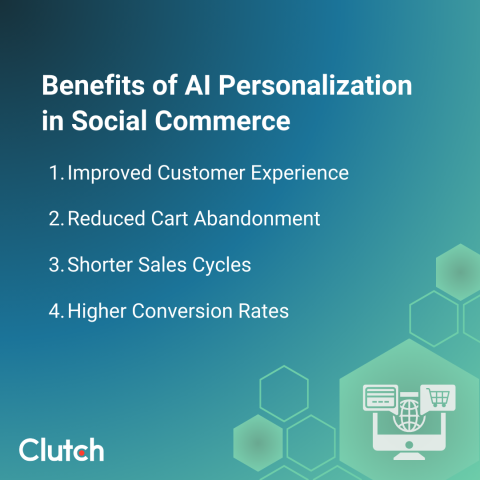
A recent PwC study has found that customers spend up to 16% more with businesses that offer a great customer experience. The key ingredients of those excellent experiences are simple: speed, convenience, friendly service, and knowledgeable help.
AI personalization helps brands meet all four touchpoints at scale. It recommends products or services that customers will love, providing a direct link to purchase. With the item they need at their fingertips, customers don't have to scroll through irrelevant content.
AI also helps brands provide higher-quality support on social platforms. The 2025 SproutSocial Index reveals that consumers want companies to prioritize personalized service on social platforms. AI enables brands to offer faster and more personalized support through social messaging, with the option to select human support if needed.
Analysts at Baymard Institute crunched the numbers and found that, on average, customers abandon more than 70% of digital shopping carts. The most common reason is that the customer was "just browsing" or "not ready to buy" — a problem that becomes more solvable when you present the shopper with the perfect product or service.
Picture a customer who sees an influencer post or ad featuring a product they have previously engaged with. They may have clicked on an ad, watched a video, or explored shoppable content. Their existing interest helps them follow through on the sale, rather than abandoning their cart.
AI personalization also helps you recapture customers who have already abandoned their purchases. This type of retargeting is already common but only partially effective, with less than half of cart abandoners responding to emails or ads. Personalization helps to increase your chances of success by speaking directly to the shopper's needs, limiting confusion and returns.
According to a recent analysis by Focus Digital, the typical consumer purchase happens after an average of 29 touchpoints. That number can be much lower on social media, where organic engagements can drive sales after 11 to 12 touchpoints.
Social media offers a more personal style of interaction. It has always been more individualized than other forms of commercial media, with users seeing content tailored to their preferences, whether it's live shopping events that generate interest or a simple ad. AI personalization targets the experience even more precisely to the individual user, constantly learning about a person's needs to deliver the right content.
This hyper-personalization can reduce the number of touchpoints necessary to spark interest. Instead of communicating benefits that are relevant to people like the shopper, AI algorithms target the specific user's requirements. Content overcomes objections more quickly and accelerates the purchasing cycle.
Social media already offers respectable conversion rates, with between 2.1% and 2.4% of all paid and organic clicks leading to action. AI has the potential to increase those numbers by matching users with more relevant content.
Consumer privacy research from the Interactive Advertising Bureau has found that 87% of consumers are more likely to click on ads for products they've been shopping for or shown interest in. More clicks mean a greater potential for more business, especially if the rest of the journey is equally personalized.
AI personalization has incredible potential, but brands must remember that it can be a controversial tool. As of 2025, just 32% of Americans inherently trust AI, compared to 72% in China. Older adults, women, and lower-income individuals in the U.S. are particularly likely to distrust AI.
While much of this skepticism is cultural, there are genuine risks that companies must be aware of when incorporating AI into their business processes.

According to the International Association of Privacy Professionals (IAPP), more than two-thirds of internet users are "somewhat" or "very" concerned about their privacy online. AI is a particular concern, with approximately 57% of respondents viewing AI involvement in data collection as a significant threat to privacy.
One issue for consumers is not knowing how companies use their data, but disclosure goes a long way. Nearly two-thirds of IAPP's surveyed consumers—64%—said they trust a company more when it provides clear information about its privacy policies.
Data from the IAPP reveals that if a company uses AI to personalize social commerce experiences, consumers want a clear explanation of how the process works.
AI algorithms "learn" by identifying patterns in data. If there is any bias in the algorithm's design, training data, or interpretation, the outcome can be inaccurate or unfair. The resulting content is likely to resonate poorly with consumers, generating unfavorable results at best and leading to brand reputation crises at worst.
For example, Pinterest came under fire a few years ago for primarily showing white faces in searches such as "women's hairstyles." The platform responded by adjusting its algorithm, which would then respond to individual users' past engagement and preferences. The change led to more engagement, proving the brand value of anti-bias design.
However, a proactive approach is best. By using inclusive algorithm training data and regularly reviewing the results, brands can identify and address biased outcomes before they become a problem.
AI algorithms depend on a steady stream of data to deliver reliable results. Brands must gather this data from consumers without violating privacy regulations or eroding consumer trust. The first place to mine is existing records and tracking data from consumers who have already provided their consent.
External data may also be available, but the ethics of using this data can be tricky, even if the purpose is "just" to train an algorithm. Brands should consider collaborating with data professionals when developing and training their own algorithms, rather than relying on those provided by a social platform.
AI can power highly personalized messaging and experiences, but people want relationships with people. Brands must ensure that a human oversees AI-driven marketing and sales initiatives, as well as data collection and processing. According to IAPP data, people feel more confident sharing their information when humans check computers' work.
As AI technology continues to advance, it shows signs of how it will drive the future of marketing. Expect to see features like:
Who knows what else is in store for the world of AI in e-commerce?
AI personalization is the future of e-commerce and social commerce worldwide. It allows brands to improve the customer experience, deliver more relevant messages, and reinforce customer relationships. Those benefits lead to more conversions and loyalty in the long term.
Although AI is still in its infancy, it's clear that brands that fail to adopt it will ultimately fall behind. Now is the time to invest in technologies and work with experts who can guide you forward.