Lead Quality vs. Lead Quantity: Why B2B Teams Are Rethinking Their Funnel in 2026
Bigger buying committees and tighter budgets are forcing B2B teams to rethink lead quality vs. quantity. Here's how top teams rebalance the tradeoff in 2026.
Updated November 21, 2025

It’s no secret that social media is influencing our shopping behavior, but you may be surprised to learn that it affects each gender differently. Here’s how you can use the latest social shopping research to connect with customers.
If you spend any time on social media, it’s almost certainly influenced your shopping habits — even if you don’t realize it. That trendy new outfit you can’t stop wearing? You may have seen content creators wearing something similar. And you probably checked out a product review or two before your last major purchase.
While these experiences are universal, gender also affects social media shopping habits.
Looking for a Digital Marketing agency?
Compare our list of top Digital Marketing companies near you
When Clutch asked 483 consumers about their thoughts on online shopping, we discovered that men and women gravitate toward different content and channels. The most significant overlap is YouTube, which both genders use the most: 58% of men and 43% of women. After that, though, their behaviors start to look very different.
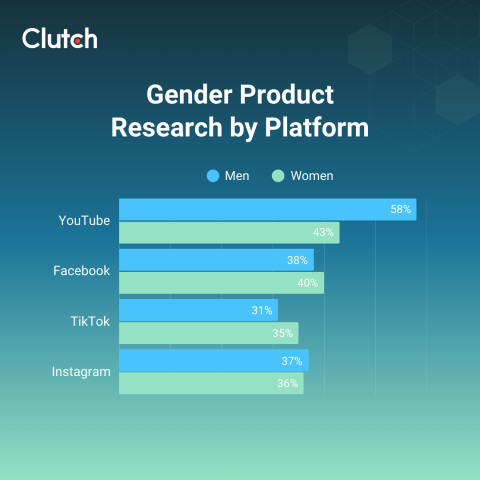
Other data seems to show that individuals who identify as women prefer more visually driven platforms, while male-identified individuals favor content-rich, but commentary-based platforms when it comes to hearing opinions on shopping research.
By understanding the connection between gender and social shopping trends, you can reach your audience even more effectively.
A decade ago, online shopping often involved a lot of Googling. You’d type in something like “hair straightener,” skim the results, and read a handful of reviews. Maybe you’d ask your friend with fabulous hair for a recommendation, too.
Traditional search still matters, but many customers are now turning to social media first for reviews and recommendations. Of course, not everyone spends time on the same platforms.
Understanding these patterns isn’t about pigeonholing your customers. But when you have a limited marketing budget (and who doesn’t these days?), trends can help you spend your money as strategically as possible.
It’s easy to see why YouTube appeals to both men and women. It allows creators to upload much longer videos than virtually any other platform, which makes it the perfect place to find lengthy product reviews and how-to content.
Doug DeMuro’s 2025 Ford Mustang review, for instance, is 27 minutes long, with 100,000 views and counting. You won’t find that sort of in-depth content in an Instagram Reel or TikTok video.
Plus, YouTube has a wealth of content on virtually any subject. Can’t figure out which mascara to buy? Watch beauty tutorials and see which products they use. If you need a new laptop for work, there’s almost certainly a tech review (or 30) for every model on your list. With so much content, YouTube makes it easy for men and women to research and compare products.
If you want to target both genders in the same place, YouTube is a logical starting point. Partnering with creators from diverse backgrounds can help your brand appeal to a wider audience. You can also experiment with different content formats, such as how-to videos, live shopping events, and tutorials, to see what speaks to each group.
Instagram and Pinterest attract millions of users of both genders, so don’t assume they’re men-free zones. But these platforms are especially impactful for female shoppers.
Our data shows that in the last six months, 37% of women have used Instagram to discover products, and 28% have turned to Pinterest to do the same. So what’s the appeal?
For Instagram, it’s the focus on lifestyle content. Fashion tips, travel photos, fitness videos — these are just a few types of content filling shoppers’ feeds. All those glamorous visuals can inspire female users to splurge, or at least discover new products.
“Instagram is great for proof and product fit,” shares Borislav Donchev, CEO of MAX Digital. “Use Reels for reach, Stories for quick answers, and product tags for easy checkout.”
The indie jewelry brand Little Rooms uses Reels and static posts to showcase its necklaces and rings. This content usually includes close-ups of the jewelry, so users can see how that cute UFO ring sparkles.
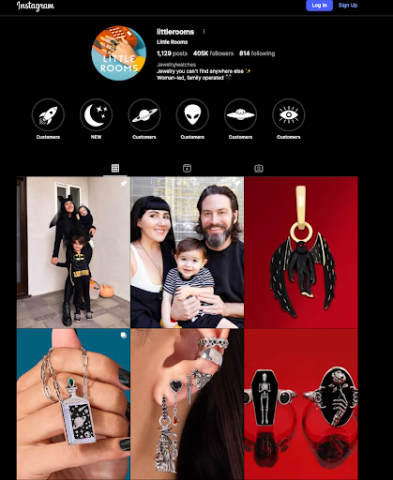
The brand also layers multiple products — like three earrings and a cuff — for that aesthetic look Instagram users love. For women (or men!) on the hunt for new jewelry, these posts can be incredibly enticing.
But Little Rooms’ own profile isn’t the only place you’ll find their jewelry on Instagram. Type #littlerooms into the search bar, and you’ll find over 21,000 posts, many with real customers wearing the iconic pieces.
These posts let curious shoppers see what the products look like outside of branded content, which may persuade them to buy. This effect can be even more powerful for clothing. Someone shopping for a dress, for instance, may prefer to see how it looks on Instagrammers with similar body types before adding it to their cart.
While Instagram is mostly used for sharing original content, Pinterest is more of a planning or idea-generation platform.
Users can still post, but they’re also curating other people’s “pins” (aka photos) in vision boards. For example, a woman may have a board for special fashion occasions — “Cocktail dress inspo” — and another for home decor — “Dream farmhouse kitchen w/ goat art.”

But Pinterest is not just about hoarding ideas like a magpie. The platform's online store lets shoppers buy products directly in the app. You can easily upload your entire product catalog and start advertising it in user feeds. But it’s your fans who can make the biggest difference in your marketing success. In fact, shoppers often love Instagram and Pinterest content because it’s shared by other women, not brands.
Tatiana Molenko, COO of UAWC Agency, explains, “User-generated content (UGC) remains the most powerful trust driver on social platforms. Native, non-intrusive ad formats consistently outperform traditional creatives in terms of conversions and long-term brand trust.”
Take advantage of this trend by encouraging shoppers to share UGC. When someone buys a product, send a follow-up email inviting them to post about it on Instagram and Pinterest: “Hey, bestie! We’d love to see how you’re styling that adorbs fall jacket. If you share it on Pinterest, please tag us!”
Inventing a hashtag for your brand can also help keep track of UGC across platforms. The makeup retailer Sephora, for instance, often uses #SephoraSquad to share UGC on Instagram.
LinkedIn and X probably aren't the first channels you think of when you're shopping for holiday gifts or a new razor. Unlike other social platforms, they don’t have built-in stores or checkout processes. And you probably won’t find many lengthy product reviews, especially on the famously concise X.
For male shoppers, though, these channels can be valuable research tools. According to Clutch’s survey, 18% of men have used LinkedIn to research products in the last six months, while 13% consulted X.
LinkedIn is a go-to resource for learning about professional tools and products. Curious about Affinity Designer? Plenty of creators share quick tutorials and even projects they’ve made with this graphics software. Plus, they may link to longer webinars or product comparisons that shoppers might not find otherwise.
This content is particularly appealing to shoppers in traditionally male-oriented fields, such as finance and tech. Business professionals will also find plenty of product recommendations for everything from men’s workwear to the best office chairs.
For small businesses, this platform offers many opportunities for sharing expertise with male shoppers.
Adam Yaeger, CEO at Llama Lead Gen, observes, “[LinkedIn is] an excellent space for credibility-building. Sponsored content, lead gen forms, and even thought leadership all contribute to mid- and bottom-funnel performance when the targeting is right.”
Dr. Squatch is one brand that uses LinkedIn for “manly” marketing. The company posts almost daily videos about its men's soaps, often featuring rugged-looking male actors. Hilarious phrases like “Welcome to Manlandia” and “I know bro smells good” leave no doubt about who the company is targeting.
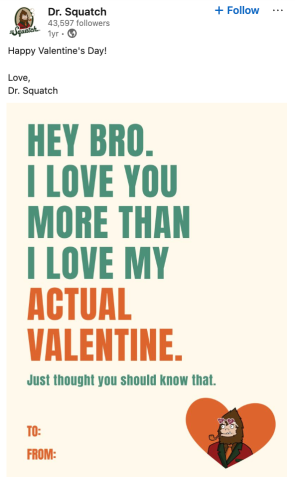
Of course, your posts don’t need to be so explicitly man-centric, especially if your products are pretty gender neutral. Focus on sharing quality content that flaunts your expertise, and you’ll soon attract both male and female LinkedIn users.
X is one of the best channels for real-time conversation and discourse with peers. Like LinkedIn, it also skews male.
“What I can tell you for Twitter (X) is that it’s about news and conversation, especially in B2B and tech,” remarks Donchev. “Try short threads explaining updates and links to deeper resources.”
Don’t bother with frills, like the highly filtered posts you see on Instagram. X users prefer straightforward commentary and information, which may be particularly appealing to men who want to get through their shopping list as fast as possible.
Like any aspect of marketing, gender preferences aren’t set in stone. Sure, women might love Instagram’s focus on visuals — but plenty of men scroll there, too. Use these statistics as general guidelines, and take time to research your specific audience.
Don’t forget about other demographics, too. Age has a huge impact on social media shopping habits. For instance, 40% of Gen Z look for reviews from online influencers before buying products, while only 31% of millennials do. An influencer collab could have a much higher return on investment with the younger generation.
Other factors to consider include education, ethnicity and race, and even occupation. For instance, if you’re marketing to blue-collar workers, you’ll probably have better luck on Facebook than on LinkedIn.
Flexibility is everything, especially when it comes to buying or returning products. By adapting your content for each platform and audience, you’ll have the best chance of winning over customers. A 20-minute product guide on YouTube could be split into informative snippets for LinkedIn. Or, to reach younger clients, you could add behind-the-scenes bloopers to TikTok.
There’s no such thing as an all-male or all-female social platform. You’ll find many people from both genders on every channel, but certain platforms naturally draw one group more than the other.
Pinterest is definitely more popular with women — just look at all the fashion and makeup boards. Meanwhile, LinkedIn and X are often the stomping grounds for men, especially in tech and business.
As social shopping keeps changing, understanding who shops where (and why) is key. By meeting your customers where they’re scrolling, you’ll boost engagement and conversions. Plus, your budget goes a long way when you’re searching for your audience in all the right places.