
Testimonial Advertising: How to Turn Customer Stories Into Sales
Testimonial advertising uses real customer stories and reviews to promote your brand. Discover popular types and how to put this content to work.
Updated June 30, 2026

Software now handles most of the bidding and targeting in Google Ads on its own. Here's what that shift actually changes for advertisers.
A few years back, running an account meant living in a spreadsheet, bid adjustments by device, hour, tier, hand-set, and constantly drifting. That job has changed.
Agentic commerce is the tidy name for it: software stopped waiting for instructions and started making the calls itself.
Looking for a Advertising agency?
Compare our list of top Advertising companies near you
You point at an outcome. The system drives toward it thousands of times a day.
On Google Ads, automated bidding and Performance Max already own most of the targeting.
Keywords alone can't carry a strategy anymore. The skills that matter have moved, mostly without anyone announcing it.
Early AdWords ran on two levers. Keywords and bids.
You picked exact phrases, wrote a tight rotation of ads, watched the search terms report it and nudged CPCs up or down by a few cents at a time.
It was fast. It was tactile. It was a little addictive, honestly. There's a satisfaction in turning a knob and watching a number move.
Then Smart Bidding showed up, and the job inverted.
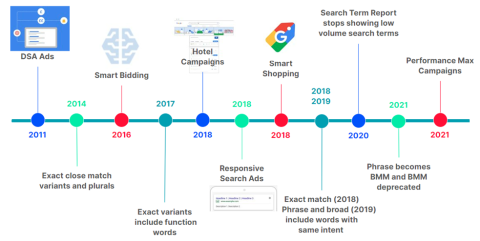
Instead of guessing the right bid for a specific phrase at 10:37 on a Tuesday, you told Google the outcome, like maximize conversions, hit a target CPA, chase a specific ROAS, and the system absorbed hundreds of signals per auction and decided in milliseconds what a human never could in real time.
Google's own overview of Smart Bidding lays out the mechanics in plain enough language that it's worth a re-read even for people who think they already know it.
Responsive search ads followed.
Then data-driven attribution. Then, Performance Max, which automates the boundary between settings.
The pattern across all of it is consistent: the machine absorbs the micro-moves, and the human gets pushed up a level by feeding it cleaner data, better goals, more flexible creatives. None of this has been frictionless. You give up granular control. What you get back is speed you were never going to match with a spreadsheet anyway.
Keyword-based advertising worked beautifully when searches were short and predictable.
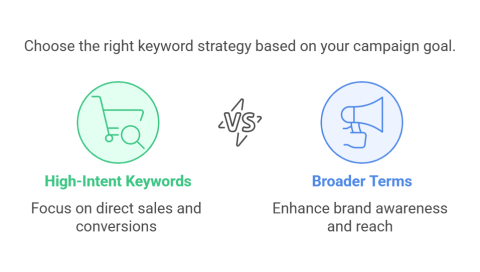
Build a list. Match it tightly. Capture intent as soon as it surfaces. The whole model made sense in a world where a query basically looked like a file name.
People don't search like that anymore.
They ask full questions. They describe a problem rather than name a product.
And every day adds a fresh wave of new ways to phrase the same need. Google has said that roughly 15% of the searches it handles daily have never been typed before, which is a hard number to use to build a static keyword list.
Layer AI Overviews on top of that, Google's generative summaries that answer a chunk of the query before a click even happens, and the straight line from search to click gets a lot more bent.
People no longer search in neat, predictable phrases. They describe a need and expect something tailored to it. Build a strategy purely around exact-match keywords, and you end up chasing a target that's already moved by the time you've locked in your list.
Keywords still matter. They're just not the whole map anymore. They're one input among several, and increasingly a smaller one.
Agentic commerce, in advertising terms, is the move from operating a tool to delegating to it.
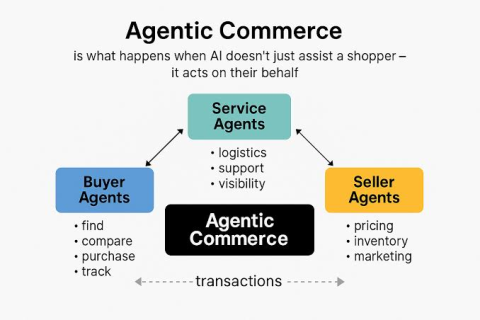
Instead of tuning two dozen settings and hoping they add up to the outcome you want, you:
It's the difference between giving turn-by-turn directions and handing someone the keys.
Specifically on Google Ads, this shows up in three places.
None of this is magic, even though it sometimes gets described that way in pitch decks. It's math plus data, applied at a scale and speed no manual process can sustain.
The lift comes from compressing thousands of tiny decisions into choices that more closely align with the outcome you actually wanted.
When the agent owns the knobs, the team stops babysitting bids and starts doing the work that was always supposed to matter: strategy, creative, positioning. That shift alone changes what a good paid media hire looks like.
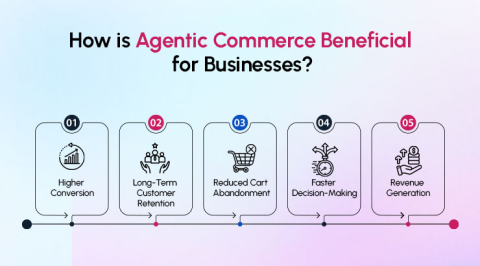
Agents pull from a far broader set of signals than a person can realistically track at once, like behavior patterns across an audience that no human is watching minute to minute. They find intent in places a rigid match-type strategy would have missed entirely.
The system reacts instantly to a shift in demand, to creative fatigue, to a competitor suddenly outbidding you, instead of waiting for someone to notice it in a Monday report.
Performance Max is the clearest example of this always-on recalibration, pulling budget across channels as conditions change in real time rather than on a reporting cadence.
The point was never to spend more. It's to waste less. A wholesale apparel account riding seasonal demand spikes feels this most directly. The system reallocates the budget before a person would even notice the trend.
Every dollar that used to get spent on an assumption now has a chance to get spent on something the system has actually learned to convert.
Agentic systems run on data, and that's exactly where things get uncomfortable.
Personalization that outruns consent is a trust problem waiting to surface. Anyone leaning into Google's privacy-safe measurement should actually sit with Consent Mode v2, because consent signals directly shape what the model can and can't learn.
Most teams already have tooling, workflows, and years of historical data they can't just abandon on a Monday morning because a new campaign type launched.
The smartest move is usually the least exciting one: start with one contained test, prove it works on a small scale, and only then expand. Rolling out agentic commerce account-wide on day one is how teams end up with a mess they're still untangling six months later.
Budget time for data hygiene, creative coverage, and to actually define the goal you're handing the system, because a vague goal produces a vaguely optimized account.
A land investing education platform and a B2B SaaS account will need very different versions of that groundwork.
You're teaching a system how to drive. It needs clear lanes and signals it can trust, and it will optimize toward whatever you give it, even if what you gave it was wrong.
Expect more secure ways to feed first-party data into the system, more weight on profitability over raw volume, and creative assembled on the fly to match intent rather than sitting fixed in a rotation.
Search itself keeps evolving alongside this, with AI Overviews and conversational interfaces acting less like a results page and more like a smart front desk for the entire web.
There's a version of this not too far out where agents are negotiating with other agents on behalf of brands and buyers alike, with very little of that exchange visible to either side's human team.
Whether that becomes the default mode of advertising is less a question of "if" than "how fast businesses adjust their thinking to it", and the ones experimenting now are the ones who'll shape what that default looks like, rather than scrambling to catch up once it's already standard.
Google's own role will likely continue to tilt toward goal-first inputs. Tell the platform the value you're after, the constraints you're working within, and the signals you're willing to share, and it mixes placement and creative accordingly, with less and less manual scaffolding required from the advertiser's side.
For marketers, the skill shift is already underway, and it's not subtle once you notice it. Less time stacking negative keywords. More time defining value correctly, fixing the data feeding the system, and telling better stories through modular creative that the machine can actually recombine.
Pick one campaign. Pick one outcome. Don't try to fix the whole account at once.
When it's time to go deeper than a single test, talk to people who've actually run these plays across different industries.
The lessons don't transfer cleanly from a SaaS account to a retail one, and pretending they do costs time.