
How to Measure SEO Success When Traffic Declines
Organic traffic is down, but is your SEO failing? Learn which metrics show real SEO success when AI Overviews and zero-click searches are reducing clicks.
Updated May 29, 2026

Striking-distance keywords are often overlooked or undervalued; but they can be valuable assets for your SEO efforts. Identifying and optimizing your website’s striking-distance keywords can be a game-changer for its visibility. This article will help you understand how to effectively find striking-distance keywords and discuss how you can leverage them for your website.
Search engine optimization often requires a deep data dive, competitor research, and thoughtfully planned execution to raise the bar on performance. Finding the time can be challenging, which is why striking-distance keywords are advantageous for time-strapped marketers.
Striking-distance keywords represent a great opportunity for improved visibility and traffic in organic search. They’re like a gold deposit buried within a mountain, awaiting an SEO to come along and mine them. When targeted and optimized effectively, striking-distance keywords can often produce quick results that elevate a site’s performance.
Looking for a SEO agency?
Compare our list of top SEO companies near you
Striking-distance keywords are terms your site is on the cusp of ranking in the top five positions. When you search for these terms, your site is currently showing up on the bottom of page one or on page two of search results, with rankings in positions anywhere from spots six to 20.
Often, the pages these keywords rank require a little extra TLC to nudge them up on the search results. The perceived “lower amount of effort” required to optimize for these terms makes them an attractive element to boost your SEO strategy.
It should be noted, however, that not all striking-distance keywords are created equally. As with all keywords, it’s worth comparing ranking position against average search volume and competition. Factoring these metrics in can help you evaluate whether or not a particular keyword is worth your time and effort, even if it is a lower amount of effort to target.
For example, let’s say a small, independently owned hardware store is looking to rank for “framing hammers,” which has a volume of 9,900 searches per month, according to Google Keyword Planner. The business has built out its landing page and has a great selection of products with helpful videos and useful content. With all that effort, they’re ranking at position 15 on page two.
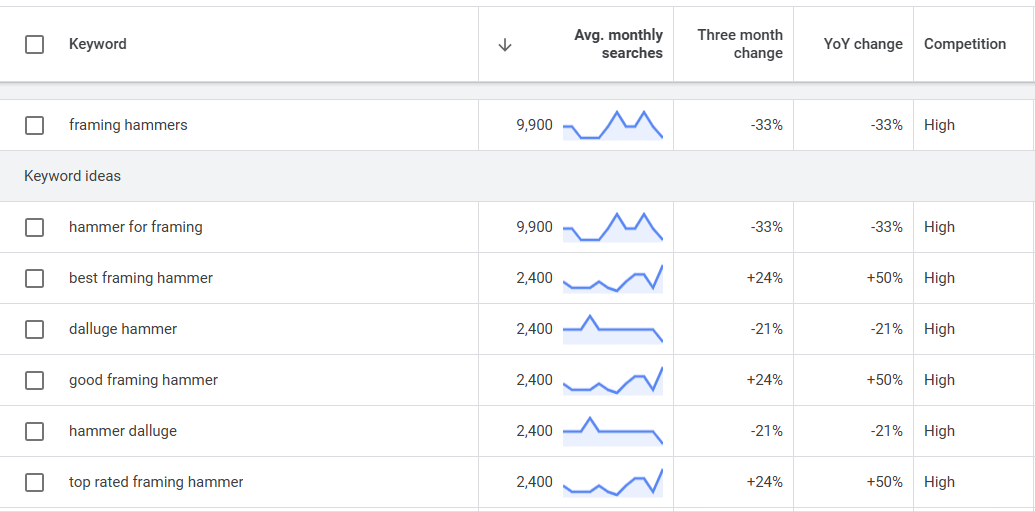
A quick search results show that page one is dominated by Home Depot, Lowes, brand-name framing hammer manufacturers, and a Reddit how-to thread. Because of the independent hardware store’s lower link authority, as well as the steep competition that big brands dominate, it’s likely not worth the time and energy to push further. In this case, focusing on more long-tail or niche keywords or other opportunities will yield better results.
This isn’t meant to discourage the opportunity that targeting striking-distance keywords offers. It just means that, as with most aspects of SEO, a discerning, surgical approach is best. Gather a list of striking-distance keywords and carefully whittle it down to search terms that offer the best intersection of volume, beatable competition, and alignment with your business or website.
There are three main methods of identifying striking-distance keywords, though their accuracy levels vary. Here are the three main methodologies:
Many SEO professionals and agencies like JumpFly recommend Method #3 for the most accurate results; but ultimately, it will depend on your goals and current SEO status.
The fact that you’re already ranking for these search terms means that much of the hard work has already been done. The next step involves adding or tweaking elements to better match what searchers are looking for and offer a more informative, concise, and user-friendly experience than competitors trying to rank for the same keyword.
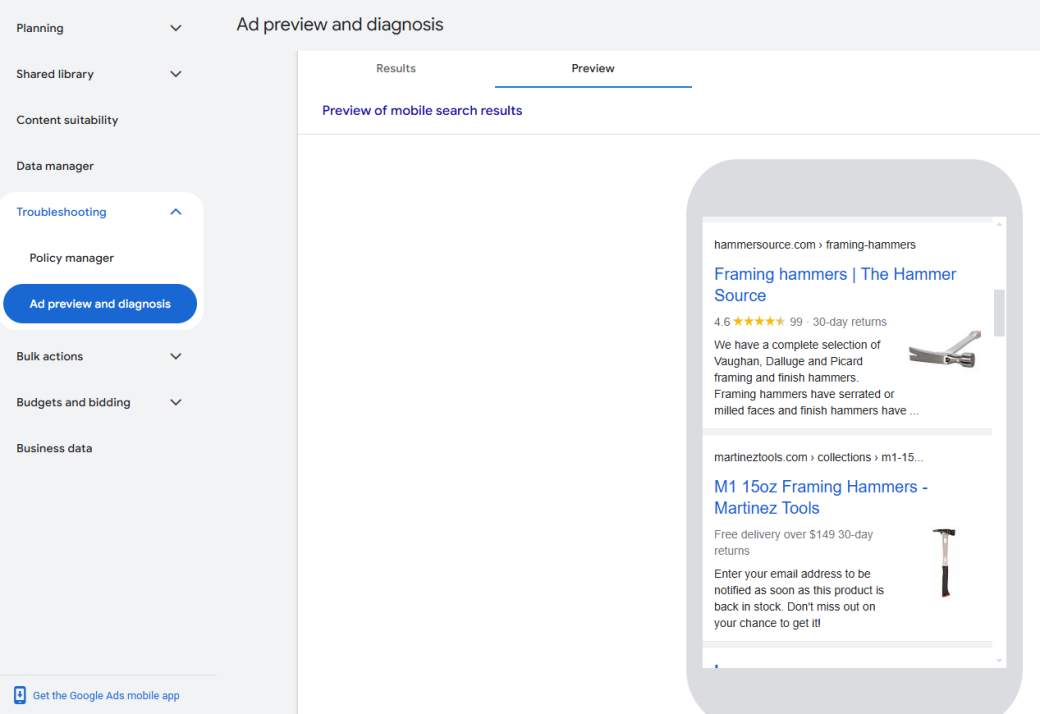
As a first step for optimization, it’s best to start with analyzing search results. Use Incognito mode or Google’s Ad Preview & Diagnosis tool to see what pages rank in the top three positions for your striking-distance keywords, and then ask yourself the following questions.
Once you understand what’s ranking, it’s time to see how it compares to your page. Start with looking at gaps in your page versus what’s on the top-ranking pages for the same keywords. Are there aspects that competitors discuss in-depth that are absent from your page?
Note: Optimizing for striking-distance keywords doesn’t always result in more copy. It’s not necessarily an arms race, with the winner earning the top spot because they had more words.
What matters is that you hit all the points searchers are looking for in clear, concise, and compelling ways. This could mean adding a related video to the top of your page or updating a layout to make it more user-friendly if the amount of information on your page is similar to competitors’ pages.
Google is smart enough to detect when sites create bland pages just for SEO. As part of E-E-A-T (Experience, Expertise, Authoritativeness, and Trustworthiness) and their commitment to elevating truly helpful content, Google looks for high-quality, authentic content designed for users. This means that SEOs can’t just duplicate the content on a competitor’s website. They have to tailor their content toward what the user is looking for while ensuring that it’s authentic, original, and fulfills a need.
Making content feel authentic sounds like a tall order, but there are plenty of ways to stand out. Exclusive images, photos, or visual data points highlight a distinct point of view. Proprietary data, such as a survey conducted by you or your website, could also separate your page from the competition. Your unique, creative voice (not AI-generated copy) is another way to impress upon Google that your page offers a fresh perspective.
The point is, when optimizing a page for striking-distance keywords, matching everyone else simply won’t cut it. You must prove that your page has the best user experience and the most helpful resources. Think to yourself, if I was someone looking for this page, what would I want to see?
SEO is a long game, and many tactics, whether technical or on-page, require a great deal of time, thought, and patience. This can be a disadvantage for marketers who need to produce measurable results.
Though they won’t help you rank for brand-new search terms, striking-distance keywords are a winnable solution that drives quicker growth while you balance a long-term SEO strategy.