7 Tips For Designing Web Forms
Clutch surveyed 502 web users about what they actually want from form design. Here are 7 data-backed UX principles that reduce abandonment and improve...
Updated May 12, 2026

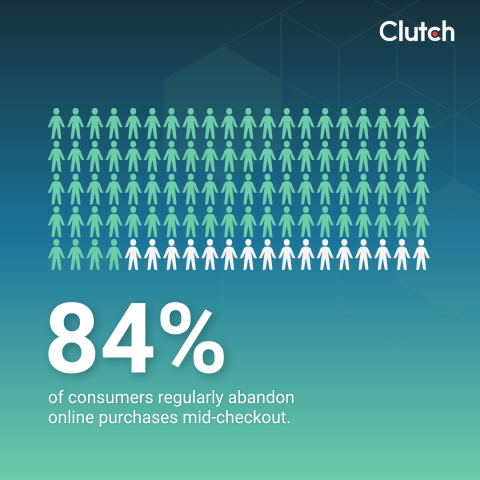
84% of shoppers regularly begin a checkout and walk away before completing it. Here’s what’s driving them away and what can make them follow through in 2026.
Most conversion problems aren’t really about the product. They’re about everything surrounding it: friction at checkout, missing trust signals, and unexpected costs that quietly push ready-to-buy customers out the door.
The numbers back it up. According to new Clutch survey data, 84% of shoppers regularly begin a checkout and walk away before completing it. And when shoppers leave, they rarely come back. In fact, only 14% return to complete the original purchase later. The other 25% head straight to Amazon to buy the same product somewhere else.
Looking for a Web Design agency?
Compare our list of top Web Design companies near you
Conversion rate optimization (CRO) closes that gap between abandonment and purchase by turning more of the traffic you already have into customers.
This report breaks down exactly why consumers abandon online purchases in 2026, what trust signals they rely on to decide whether to buy from an unfamiliar brand, and what businesses can do at each stage to convert more of the traffic they’re already getting.
Before unpacking the why, it’s worth establishing the scale. Purchase abandonment is the baseline behavior of online shoppers in 2026, and businesses that don’t pay attention to it are leaving real revenue on the table.
Over half of shoppers (51%) abandon a checkout at least half the time, and another 33% abandon occasionally. That leaves only 16% of consumers who almost always complete the purchases they start. For most businesses, that means roughly five out of every six shoppers entering a checkout flow are statistically likely to leave before finishing.
When shoppers do walk away, they rarely return to the original site:
The original site, in other words, gets one shot. And most of the time, it loses.
Here’s the good news: most causes of abandonment factors the business has direct control over: trust, friction, and transparency problems. Basically, the biggest leaks in the conversion funnel are also the easiest to fix.
When shoppers walk away, it’s usually because a specific moment of friction, opacity, or broken trust pushed them out of the funnel. Here are the top five reasons why shoppers abandon their carts.
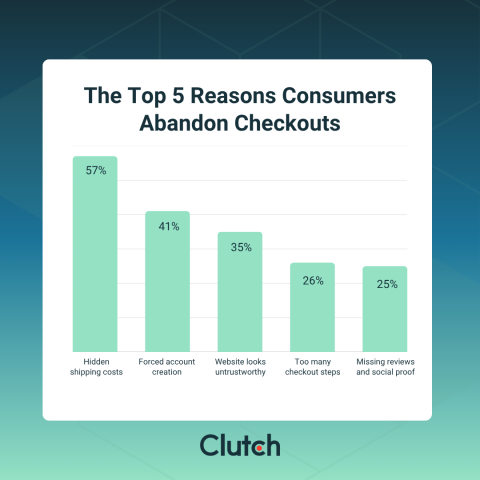
The single biggest abandonment trigger, causing 57% of consumers to abandon a checkout in the past six months, is that shipping costs were not revealed until the end of the checkout process.
The pattern also extends beyond shipping: 68% say unclear or hard-to-find pricing is an immediate deal-breaker on an unfamiliar website.
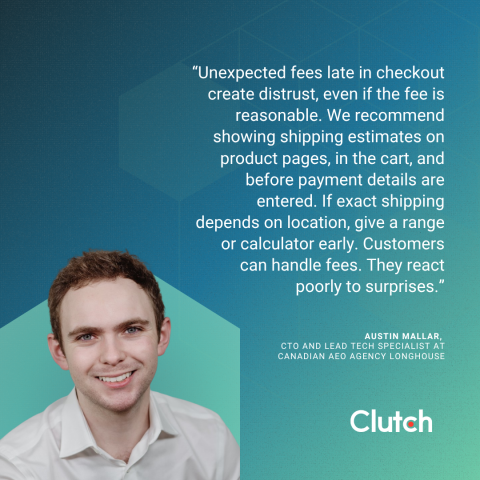
Austin Mallar, CTO and Lead Tech Specialist at Canadian AEO Agency Longhouse, suggests, “[Showing] the total as early as possible.” He continues, “Unexpected fees late in checkout create distrust, even if the fee is reasonable. We recommend showing shipping estimates on product pages, in the cart, and before payment details are entered. If exact shipping depends on location, give a range or calculator early. Customers can handle fees. They react poorly to surprises.”
Shoppers who feel blindsided at checkout don’t just leave. They lose trust in the brand. Transparency failures read as dishonesty, and once that signal lands, it’s hard to recover.
The takeaway: Price transparency is a conversion strategy. Shipping costs, taxes, fees, and any other add-ons need to be visible as early as possible. Shoppers aren’t asking for lower prices. They’re asking not to be surprised.
Just over two in five consumers (41%) have abandoned a checkout specifically because a site required them to create an account before buying. That’s a larger price to pay over a single design choice — one that’s almost always made in the name of capturing customer data.
The behavior breakdown shows just how strong the resistance is:
However, shoppers aren’t anti-account. They’re anti-friction without value.
The right incentive flips the script entirely: free shipping and returns (61%) and a first-order discount (57%) are the strongest motivators, with loyalty programs, easy order tracking, and faster future checkout also driving meaningful willingness to sign up. Only 7% say nothing would make them create an account on a site they’ve never bought from before.
Tim Katz, Co-Founder of Dyode, thinks that guest checkout should always be front and center. However, he also advises, “If you want to push account creation, do it on the order confirmation page after the purchase is done. Frame it around something the customer actually wants. Order tracking, easy reorder, or loyalty points if you have a program that's worth joining. By that point, you already have their email, and they have a reason to say yes.”
The willingness to create an account is there, but it has to be earned. Guest checkout should be the default, and account creation should be offered as a value exchange rather than a requirement.
Outdated or untrustworthy-looking website pages have caused 35% of shoppers to abandon a checkout. However, the decision to leave is often made before the checkout process even begins.
On an unfamiliar website:
Shoppers treat a site’s visual credibility as a proxy for the business itself. A page that looks untrustworthy raises doubts about the product, the company, and the risk of handing over payment information. Shoppers resolve that doubt the fastest way they can: by leaving.
For businesses, this means visual investment supports their conversion infrastructure. Professional photography, clear contact information, and current design make the difference between a shopper trusting you enough to keep going and clicking away.
Too many checkout steps have led to over one in four (26%) shoppers abandoning their checkout. But how many steps is too many?
No single step is catastrophic on its own. However, each one adds friction, and failure modes compound. For example, a shopper who completes email verification may not complete the password creation that follows.
Ali Hashmi, CTO of Tekglide, is very intentional about the steps on their clients’ websites. He shares, “We typically target a two to three step checkout at most: cart review, shipping and payment details, and order confirmation. For mobile-first audiences, we often push clients toward a single-page checkout where each section expands progressively.”
Basically, the real cost of a long checkout isn’t any one step, but the cumulative effort that gives a ready buyer a reason to bail.
Don’t worry about eliminating every step, but you should ruthlessly minimize them. Every step removed is a sale preserved.
When shoppers can’t find reviews or social proof of the product or service, 25% abandon their carts.
When shoppers can’t verify a brand through other buyers, they transfer that doubt to the product itself, and that doubt tips them out of the funnel.
Reviews and social proof reduce risk at every point in the funnel, including checkout, where shoppers are weighing whether they trust the site enough to hand over payment info one last time. Their absence creates exactly the kind of uncertainty that kills a sale.
Reducing friction only gets you halfway. The other half of conversion rate optimization is actively giving shoppers reasons to say yes.
When shoppers click into a product page from a brand they’ve never heard of, their eyes go to the same few places first:
With photos, discounts, and shipping information following further down the list of things consumers look for, the work of earning a sale truly starts with reviews and credibility.
Tamara Hofer, Copywriter and Marketing Assistant at The Branx, sees a lack of proof as one of the biggest conversion leaks on client websites. She explains, “Some companies pour everything into the hero and then drop the visitor into a generic contact form three clicks deeper. No proof in between. No specificity. No momentum and no real benefit or trust… It asks a stranger to go from ‘interesting’ to ‘meeting to close the deal’ in one move.” As a result, potential customers leave because the credibility just isn’t there.
The most striking finding sits at the intersection of brand-controlled and user-generated content (UGC). When asked what’s more likely to win them over when they’re on the fence about an unfamiliar brand, 37% pointed to what customers say (reviews, testimonials), while only 17% said brand copy (mission, story, case studies). That’s more than two-to-one in favor of customer voice.
Plus, when it comes to visual content, 49% want a mix of real customer photos and professional brand photography — the highest single response — meaning the most persuasive visual strategy combines both rather than picking one.
For businesses, this means trust is built across every page of your website, from the landing page to their online cart. By the time a shopper reaches checkout, the decision on whether they trust you has already been made.
Consumers aren’t abandoning purchases because they changed their minds about the product. They’re abandoning because something about the experience — a hidden fee, a forced account, an outdated page, too many steps, a missing review — gave them a reason to walk away. Every abandonment is a signal, and every signal points to a business decision that can be made differently.
Here’s what the data signals most clearly for businesses navigating the conversion landscape in 2026:
Most online businesses have spent years optimizing acquisition by driving traffic, refining ads, and improving SEO. However, the biggest conversion gains in 2026 aren’t at the top of the funnel. They’re at the bottom: the checkout, the product page, the trust signals shoppers see before deciding whether your brand is worth their time and credit card.
Consumers aren’t unpredictable. They told us exactly what makes them leave and exactly what makes them stay. The brands that listen — and fix the leaks — will convert more of the traffic they already have without spending another dollar to get it.
For businesses looking to optimize their conversion funnel end-to-end, partnering with a top web design agency can help identify where your site is losing revenue and close the gaps before more sales walk away.
This report is based on a survey conducted in 2026 using the online polling platform SurveyMonkey. We surveyed 401 adults in the United States across all income levels who confirmed they have made at least one online purchase in the past six months. The respondents were 48% male and 52% female, aged 18 to 99.
Participants were asked a series of multiple-choice and single-selection questions about their online checkout behavior, abandonment patterns, trust signals, and purchase decision-making. Quotas were applied to ensure a balanced distribution across demographic segments. All respondents were required to complete the survey in full to be included in the final analysis.