
How to Define Brand Values That Guide Every Business Decision
Brand values are the principles that guide company decisions, define what a brand stands for, and shape how it treats customers, employees, and partners.
Updated September 3, 2026

Everyone remembers an ad, but far fewer love one. New consumer data shows what separates the two, and how you can make people love an ad by building brand affinity long before the campaign runs.
Plenty of ads stick in people’s minds. Some for their catchy tunes or clever catchphrases, others for being repetitive, annoying, or just plain confusing. But only a few are genuinely liked, and those aren’t always the same ones that are most memorable.
What separates the two often comes down to brand affinity, the relationship a consumer already has with a brand before an ad plays. It's built from past purchases, product experience, and a general sense that the brand shares its values.
Looking for a Public Relations agency?
Compare our list of top Public Relations companies near you
Unlike brand awareness, which just means people recognize the logo, brand affinity means they prefer it. That preference is ultimately what allows an ad to earn genuine liking rather than just recognition.
In July 2026, Clutch surveyed 552 consumers about their thoughts on World Cup advertising. When asked why their favorite campaign stuck, star power (35.5%) and already liking the brand (35.2%) came out neck-and-neck. Humor (32%) and visuals (29%) were close behind.
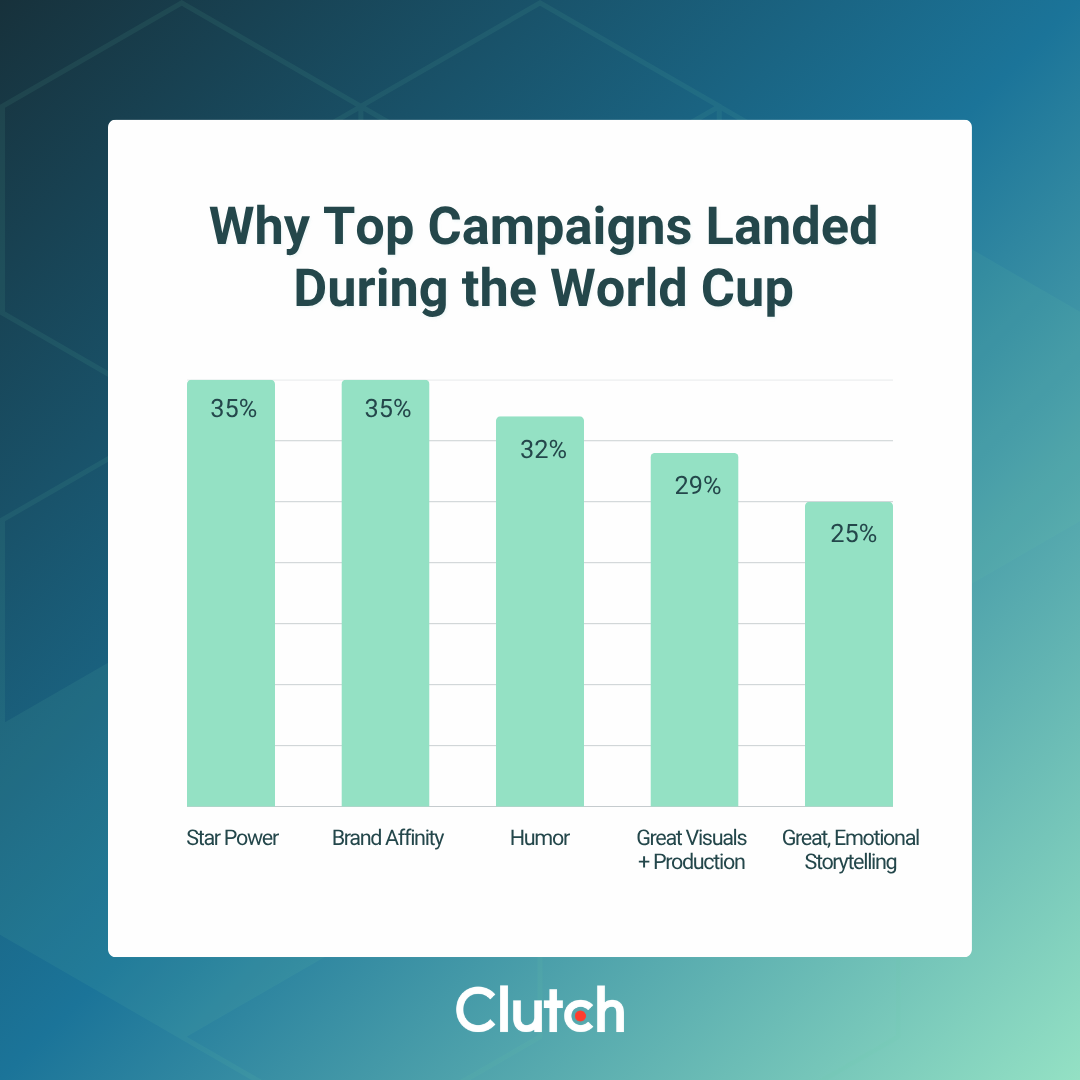
These statistics suggest that while celebrities and production value rent attention for the length of an ad spot, the affinity a brand built before the tournament is what makes a campaign land. This is the multiplier you can't buy in a single event; you must develop it over the years.
Read to learn what separates ads people remember from ads people love, what makes an ad memorable, and why brand affinity is the multiplier.
Ads that are remembered aren't necessarily loved. According to our survey, Adidas won recall (42%) and best campaign (33%), but ranked near the bottom on brand lift, with just 15% saying it made them feel more positive. LEGO, in contrast, ranked modestly in recall (24%) but led lift at 37%.
That's because Adidas and LEGO won two different prizes. Attention or recall is bought with spectacle, stars, and frequency, while affection or lift is earned through affinity, tone, and resonance. In other words, awareness means people know you, while affinity means they like you.
What can brands learn from this? Decide which outcome you're actually buying, because the metrics diverge. A campaign can dominate recall and still move no one.
Our survey found that top campaigns resonate for a variety of reasons: featuring athletes or celebrities (35.5%), customers already being fans of the brand (35.2%), humor (32%), striking visuals (29%), an emotional or storytelling angle (25%), capturing the World Cup vibe (25%), and, in last place, giveaways (11%).
It’s clear that celebrity and production, two of the most attention-grabbing drivers, are the flashy, overused ones every brand chases, while humor, story, and affinity focus more on the craft and the connection. Prizes or giveaways barely make a dent, which might be surprising.
External findings back up our data. HubSpot's research on memorable ads found that only 2% of consumers cited a celebrity or expert as the reason they recalled an ad, suggesting celebrity casting is often a weaker recall driver than marketers assume.
According to Ipsos Market Research's meta-analysis of over 2,000 pieces of video creative, brand-owned assets, such as characters and sonic cues, are more effective at driving recall than assets borrowed from wider culture, such as celebrities. Marketing Week columnist Mark Ritson has made a related point in commenting on this research: most advertisers assume logos and slogans matter most for memorability, when they are actually the weakest elements.
The takeaway for brands is that spectacle gets you seen, but craft and affinity get you remembered fondly and survive the final whistle.
Brand affinity is the emotional connection and liking that exists before a campaign even begins and that outlasts it. It's distinct from brand awareness, the concept of people knowing your brand, and loyalty, where people keep on buying from you.
Our data puts a number on exactly how much brand affinity is worth. “I already like the brand” (35.2%) did nearly as much work as A-list talent (35.5%) in making a campaign land. This notable result suggests that an emotional starting point built long before the tournament performed on par with the single biggest, most expensive lever available during it. It's also the one input a competitor can't rent for a single event.
This is why brand affinity acts as a multiplier for everything else the campaign does. Give an affinity-rich brand a big-name spot and a large budget, and the campaign produces lift on top of recall. Give an affinity-poor brand the identical inputs, and attention evaporates instead, the way it did for Adidas, which experienced high recall, but low lift during the World Cup.
The lesson for brands is that affinity isn't a line item you add to a media plan. It's an asset every campaign either draws down or builds.
Lego is the clearest proof. Although it had no connection to soccer at all, the brand won on lift (37%) and on being seen as a “natural fit” (31%) for the tournament, ahead of brands with an actual link to the sport. It got there through a likable, endlessly remixable creative idea and a consistent brand character. Affinity did what category logic couldn't: it made a non-endemic brand feel like it belonged in the moment.
That points to a few practical levers for brands planning their next tentpole campaign:
The same logic our data suggests about pre-tournament affinity shows up again and again in brand marketing outside of sports.
According to Wistia's Brand Affinity Marketing Playbook, users have become skilled at mentally tuning out things they don't want to see, including what marketers traditionally saw as elements of a successful ad campaign. This means that exposing them to a 10-second video multiple times or to a compelling tagline won't necessarily drive purchases. Instead, businesses should play the long game by building brand affinity with consumers and demonstrating that they share common values.
They can do this by creating and distributing long-form, binge-worthy content, so viewers will spend more time with your brand, giving you the chance to make more personal connections with them.
Chris Savage, Co-Founder and CEO of Wistia, has similar sentiments. In Recur 2019, he said that having a great brand means building affinity to stand out from the flooded marketplace, and you can do this easily through videos. Key examples of companies building affinity, according to Savage, include Netflix, which started as a DVD service but has also invested billions in Netflix originals that have been nominated for awards. Similarly, Peloton doesn't only sell exercise equipment with sensors that provide feedback, but also live and on-demand workout classes.
MailChimp took a similar approach after a different kind of viral moment. An ad that ran on the podcast Serial, featuring people in different languages struggling to pronounce "MailChimp," took off and became a cultural touchpoint, even showing up it ran on the podcast Serial, featuring people in different languages struggling to pronounce "MailChimp," took off and became a cultural touchpoint, even appearing in Saturday Night Live sketches.
MailChimp later put its full brand advertising budget behind an original video series instead of traditional ads.
The common thread across all three is that they all invested in original, ongoing content to build brand affinity.
The takeaway for brands? The affinity a brand brings to a tentpole event is the result of all the goodwill and connections built through past campaigns. You can’t create that with a single media buy or within a single tournament window. It has to be cultivated over time, just like LEGO and Netflix did.
Star power and production attract attention. According to the July 2026 Clutch World Cup survey, 35.5% of consumers cited an athlete or celebrity as the reason their favorite campaign stuck with them. Meanwhile, affinity earns the landing, with 35.2% saying that already liking the brand was the reason their favorite campaign stuck. A giveaway, cited by just 11%, buys neither attention nor affinity.
In the end, the kind of brand affinity that can't be bought in a single tournament decides whether a campaign is merely noticed or genuinely loved. That's the gap between Adidas's high recall and LEGO's leading lift.
Brands chasing their next big moment are better served by focusing on being memorable and loved. The ones who manage this are the ones who built affinity long before the first whistle, just as LEGO did, without a clear connection to soccer.