
How to Define Brand Values That Guide Every Business Decision
Brand values are the principles that guide company decisions, define what a brand stands for, and shape how it treats customers, employees, and partners.
Updated September 3, 2026

Though marketers often plan budgets around the engagement metrics they can measure, new World Cup data shows that signals such as likes and shares don't necessarily show who actually buys. Learn the difference between brand awareness and conversion, and which signals matter more.
Digital marketers often treat engagement — likes, shares, comments — as proof that a campaign is working. However, data regarding a 2026 global event suggests it may be the wrong signal to lean on.
A July 2026 Clutch survey found that 54% of World Cup viewers didn't engage with any online campaign. Yet the same survey found a matching 54% said a campaign drove them to buy: 40% bought outright, and another 14% mentioned they wanted to.
Looking for a Public Relations agency?
Compare our list of top Public Relations companies near you
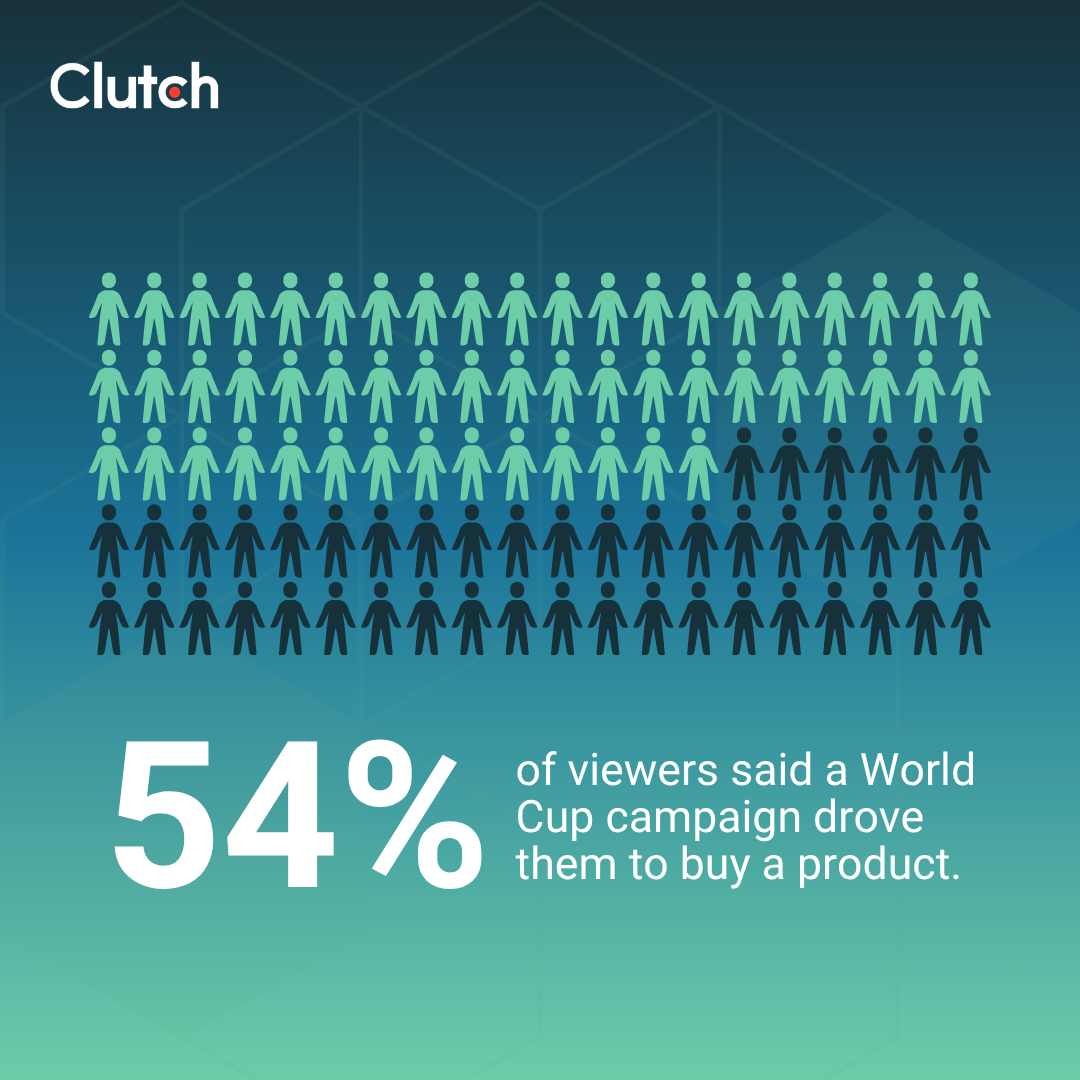
While it’s not the same 54% of people, the fact that the numbers align is worth noting. It suggests that engaging with a campaign and making a purchase are two different matters.
What does that mean for how you spend? Engagement and conversion happen at different points in the funnel, not in the same place. Getting noticed doesn't mean getting paid, and if your budget is only chasing likes and comments, you're optimizing for visibility instead of sales.
Learn more about brand awareness vs. conversion, and engagement vs. conversion. Explore why awareness needs an actual path to payout, and where the money should go instead.
Most marketers have heard the industry's usual warning about vanity metrics. High engagement doesn't guarantee sales.
Our 2026 World Cup data makes a sharper point: The majority of the audience never engaged at all. 54% were unengaged, while 46% liked, shared, or commented. Yet a separate 40% said a campaign drove them to buy.
These two categories aren't just different metrics. They're built differently from the start.
Engagement campaigns are designed to spark a reaction. Think about contests, prompts to comment or share, trending audio — anything meant to be picked up and passed along. On the other hand, awareness campaigns are designed to be remembered more than reacted to. Examples include high-frequency video, sponsorships, and placements built for reach over interaction.
That distinction matters. If you judge a campaign by engagement, you're only hearing from the
loud minority who reacted. Meanwhile, a separate, but comparably sized, share of the audience may have quietly opened their wallets.
Engagement and conversion aren't measuring the same thing. Engagement tracks interaction and amplification, and lives at the top or middle of the funnel. Conversion tracks purchase and intent, a bottom-funnel outcome. Their metrics answer different questions, so a stronger score on one tells you little about the other.
The takeaway for brands? A campaign that scores well on engagement has only proven it can reach the people (46% in the survey) who respond visibly. It doesn't necessarily tell you much about the 40% who bought. Ultimately, optimizing for the loud minority may mean optimizing for the wrong audience.
If engagement oversells itself as a proxy for sales, awareness has the opposite problem. It's necessary, but not sufficient. That's because being seen and remembered doesn't guarantee anyone buys.
Our survey numbers make this concrete: Adidas dominated recall, but that lead didn't translate into brand lift or purchase intent at the same rate.
Awareness spending pays off in certain scenarios, like when a brand is entering a new market, competing as a low-recognition challenger, or operating in a long-decision category like automotive or B2B, where no single ad is expected to seal the deal instantly. In these cases, the aim isn’t immediate sales but establishing a presence through frequent videos, sponsorships, and placements focused on reach rather than interaction — laying the groundwork for future conversions.
Adidas' campaign shows what that looks like when done well. Besides winning recall in the survey (42%, the highest of any brand), its "Backyard Legends" campaign was also the tournament's stickiest campaign by a wide margin (33%, more than triple the next brand). Recall and stickiness usually split across different brands, but Adidas captured both, which is closer to what awareness spend is actually supposed to buy.
That doesn’t mean awareness spending is a waste, even when it doesn't sweep the board as Adidas did. In fact, cutting it can be costly in ways that surface later. BCG’s research shows it takes brands $1.85 to recover for every $1 cut in brand spend, and the bottom quarter of spenders saw 13% lower sales growth than the top quarter.
Clearly, awareness has a real payout. It pays along a path from consideration to purchase, not on its own.
The lesson for brands is that awareness earns the right to convert, but doesn't convert on its own. You must build the path from seen to sold. While recall can get someone into consideration, something else has to carry them from consideration to purchase.
If engagement and conversion are different things, why does so much marketing budget still go into chasing engagement?
That's because engagement is easy to measure. Likes and shares appear instantly on the dashboard, the same day a campaign launches. In contrast, conversion takes longer to attribute and often requires stitching together data from multiple sources. Faced with such challenges, teams tend to invest in measuring engagement rather than the metrics that more accurately reflect revenue.
This pattern of the visible metrics winning the budget over the signals that actually measure revenue isn't unique to World Cup campaigns. Marketing teams tend to skew toward short-term, easily measured performance, with an estimated 69% of the budget allocated to short-term tactics rather than long-term brand building.
This bias comes with consequences. Take the World Cup. Suppose a marketing team launches a campaign optimized purely for likes. It would target the 46% who engaged but could miss some or most of the 40% who said ads actually influenced their purchase. A campaign built this way might rack up visibility while barely moving the needle on sales if the two groups have little overlap.
That possible gap gets wider when you factor in age. According to our survey, 65% of Gen X and 48% of millennials said World Cup ads drove them to buy, against just 6% of baby boomers.
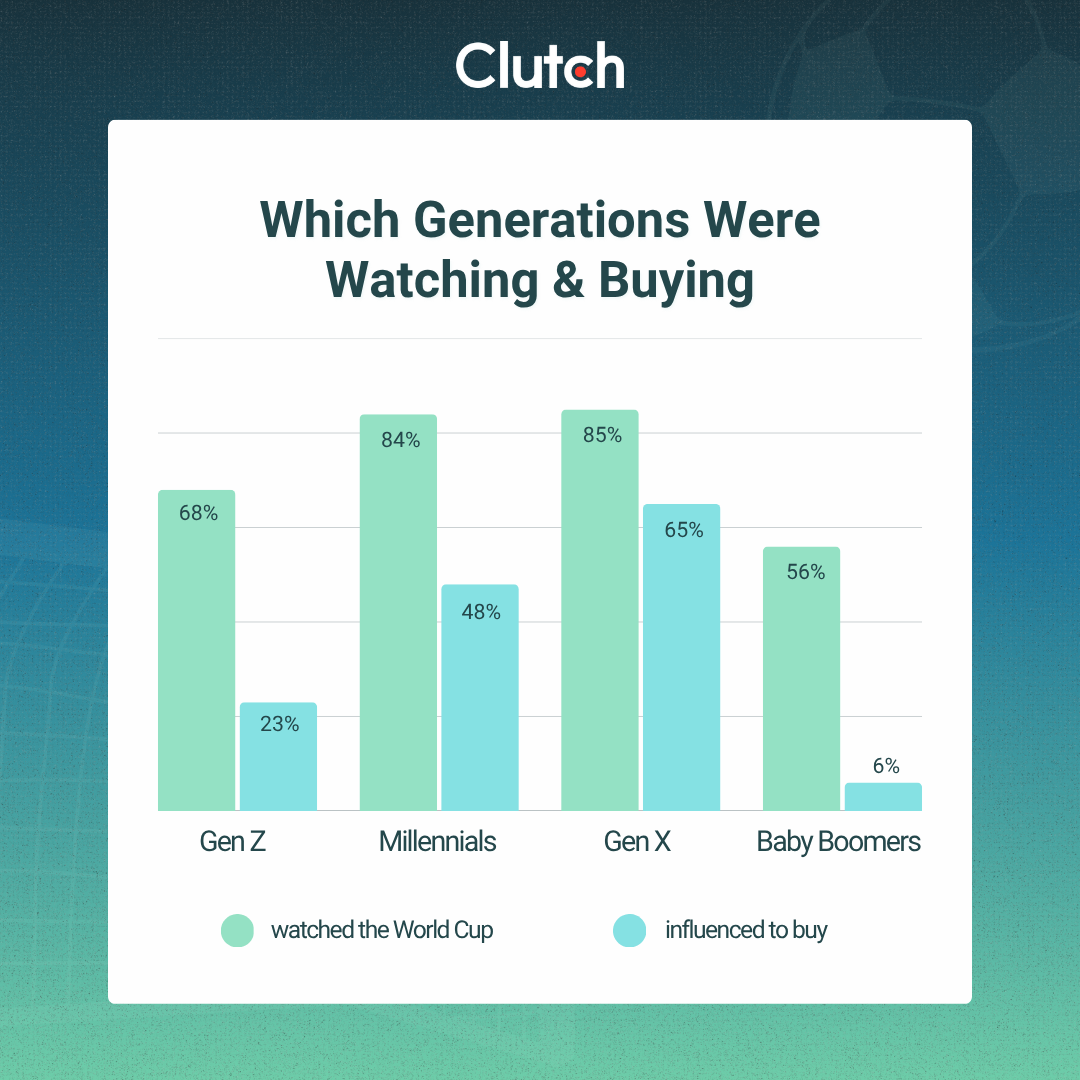
A budget built solely around broad engagement isn't merely chasing the wrong behavior. It's sometimes chasing the wrong audience entirely, one that may be unlikely to convert regardless of how much it engages.
The takeaway is that the metric you see isn't necessarily the metric that pays. Before allocating budget, measure conversions directly through surveys, brand lift studies, or attribution modeling, rather than assuming engagement alone will achieve your goals.
To maximize effectiveness, your budget shouldn't go entirely toward either awareness or conversion.
Remember, awareness fills the funnel, while conversion harvests it. Starve either one, and the machine will slow down. Research suggests a 60/40 split favoring brand over performance, though the ratio shifts with brand maturity, market, and audience.
For marketing teams, the World Cup data isn’t saying “spend less on awareness.” It’s saying “stop treating engagement as a stand-in for conversion in your budget planning.” Invest in awareness for what it really delivers — real but delayed return. Also, put money directly into the conversion path instead of assuming engagement will naturally lead there. And stop overpaying for flashy engagement that never translates into actual sales.
In practice, a 60/40 split may not mean two separate phases but two campaigns running simultaneously. A brand might run a broad video or sponsorship push that builds recall with one audience, while a retargeting or search campaign runs alongside it, converting the demand that same recall is creating. The team shouldn't pause the awareness campaign while the conversion campaign runs, since it's what keeps feeding it.
Running awareness and conversion together, rather than picking one, comes down to three things:
At the end of the day, don't pay for the signal that's easiest to see. Pay for what pays you back: conversion, plus the return awareness gives you later, even if it takes its time getting there.
According to the July 2026 Clutch World Cup survey, 54% of viewers never engaged with a single ad campaign, yet a separate 40% said ads drove them to buy. These statistics aren't contradictory, because engagement is a minority signal that doesn't necessarily track purchases. In practice, awareness pays off throughout the path from consideration to purchase, a process that takes time.
It's tempting for marketing teams to find the visible signals. Engagement is easy to watch on a dashboard, but it may say almost nothing about who's buying. Fortunately, the fix is straightforward: Measure and budget for conversion directly.