
Why Salesforce Staff Augmentation Is Becoming a Strategic Choice
Salesforce staff augmentation is no longer a stop-gap. Learn why more businesses now use external specialists to access expertise, move faster, and scale...
Updated November 4, 2026

Cyberattacks have hit 68% of small businesses, and most believed they were well protected beforehand. We’ll detail seven benefits of outsourcing cybersecurity, potential drawbacks to consider, and how to pick the right partner.
Cyberattacks aren’t just a big-company problem. Small businesses are frequent targets, often with fewer resources and less robust security defenses.
In October 2026, Clutch surveyed small business owners whose companies had been affected by cyber threats. The findings reveal a troubling gap between perceived security and reality: Nearly seven in 10 small businesses (68%) have experienced a cyberattack or security breach. Yet before these incidents occurred, 95% of owners believed their security measures were adequate, and 64% considered their cybersecurity posture strong.
Looking for a IT Services agency?
Compare our list of top IT Services companies near you
For many businesses, the threat doesn’t stop after a single incident. In fact, 84% of affected businesses reported that their cybersecurity incident wasn’t their first.
The takeaway? Confidence alone isn’t enough to protect a business. And for small-to-midsize businesses (SMBs) that can’t afford a full in-house security team, outsourcing cybersecurity offers a practical way to access specialized expertise and strengthen their defenses.
In this guide, we’ll explore why businesses turn to outsourced cybersecurity, what it means to outsource your company’s cybersecurity, the benefits and potential drawbacks of this approach, and how to choose the right cybersecurity partner.
SMB owners often outsource cybersecurity only after a cyberattack demonstrates the company’s security vulnerabilities.
After their most recent cyberattack, 91% of SMB owners hired an external cybersecurity provider to manage the response. This is probably because many small businesses don’t have an internal IT team or the resources to effectively contain the cyberattack and minimize damages. By outsourcing, they’re able to respond quickly and even prevent future attacks.
An additional 71% hired an incident response firm, while 47% partnered with managed security services providers (MSSPs) for ongoing monitoring and 45% retained legal counsel.
The surprisingly high cost of a security breach or cyberattack is the problem with waiting until after one occurs to tighten up your network protection. Among the SMB owners in our survey, 31% said they lost between $50,000 and $249,000, and 26% estimated losing even more: between $250,000 and $999,000.
Recovering from a cyberattack is especially challenging for small businesses. While 55% of SMB owners said they were able to make the necessary changes within days of the attack, 41% said those essential security changes took longer.
Outsourcing cybersecurity can help protect both your finances and your reputation by enabling faster incident response and reducing the risk of future attacks. With the right security measures in place, you may also be able to limit the damage of an attack or prevent one altogether.
Outsourcing cybersecurity involves partnering with an external provider to manage some or all of your organization’s digital security, including threat monitoring, defense, and risk management, rather than relying solely on an in-house team.
SMBs generally choose from these five primary types of cybersecurity partners:
Most SMBs choose a co-managed (hybrid) setup, where internal IT or security staff handle core strategy and internal governance, and the external security provider manages 24/7 monitoring, overflow support, or specialized testing.
Full outsourcing exists, in which the third-party provider manages nearly all digital security operations, but outsourcing cybersecurity doesn’t have to be all-or-nothing. Many small businesses start by outsourcing a single service and build from there.
Outsourcing cybersecurity offers several advantages, from lowering costs to saving time for other essential work.
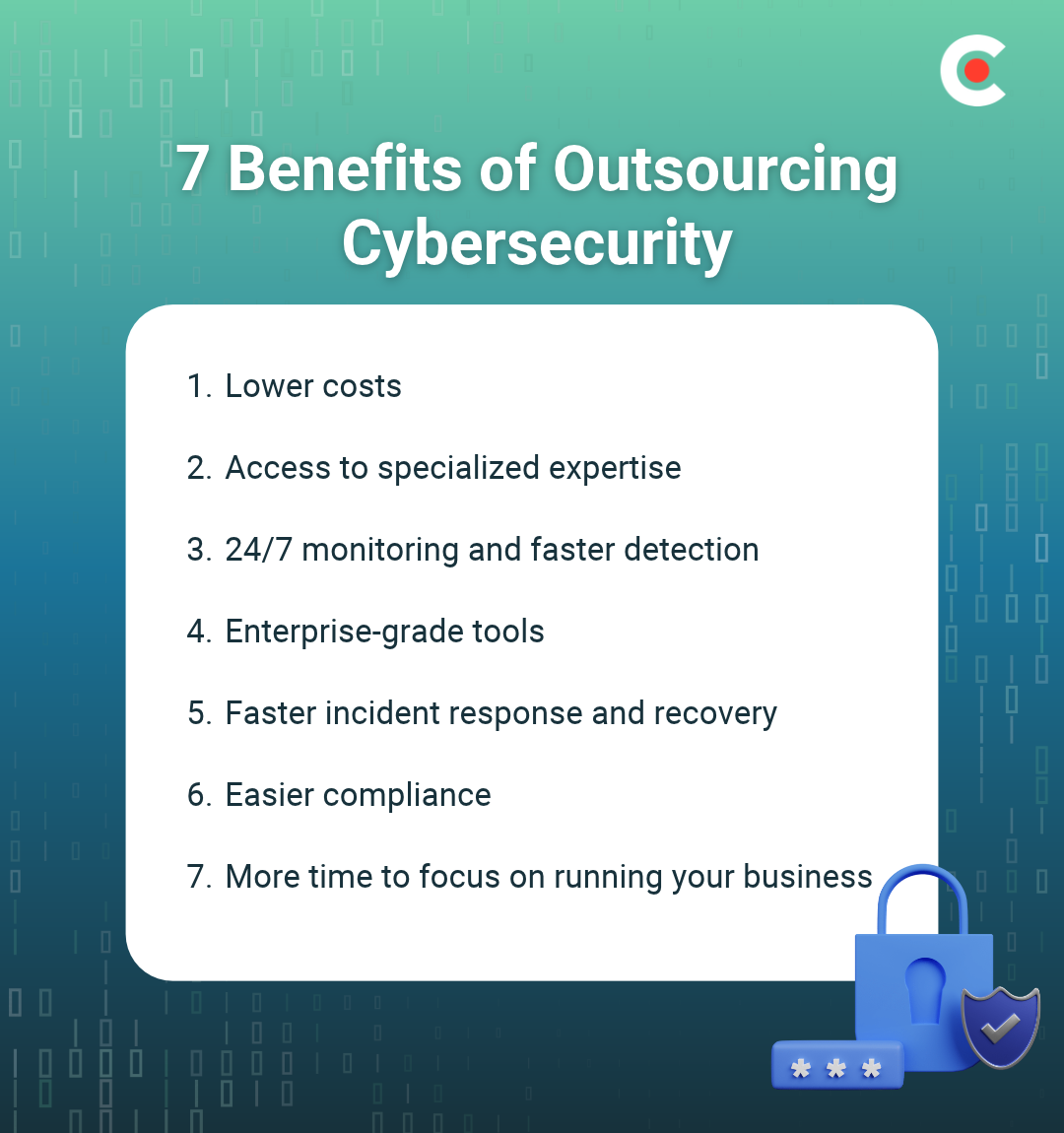
Outsourcing is often more affordable than hiring an internal IT team. In May 2025, the Bureau of Labor Statistics (BLS) reported a median annual pay of $129,180 for information security analysts, not counting benefits, tools, and training. That figure is per individual, and no one person can provide 24/7 coverage. Hiring a provider turns security into a fixed, predictable operating cost instead of a hiring project.
Demand for cybersecurity professionals is high, and finding qualified candidates can be challenging. BLS projects 21% job growth for information security analysts from 2025 to 2035.
If you’re considering hiring the talent directly, you’ll be competing with everyone and likely paying more for the same candidates.
Additionally, cybersecurity providers monitor threats for many clients at once, so they recognize attack patterns that a lone generalist IT person would likely miss, helping them bridge the divide between feeling secure and actually being secure.
Attackers don’t keep normal office hours, and a small team can’t staff both day and night shifts. Round-the-clock monitoring detects suspicious activity at 3 a.m. on a holiday weekend rather than waiting until Monday morning.
Speed makes the difference in these situations. IBM’s 2026 Cost of a Data Breach Report found that, on average worldwide, breaches cost $4.99 million — a record high, up 12% from 2025’s $4.44 million — and took 247 days to identify and contain. IBM ties faster detection to lower costs. SMB owners who have experienced attacks tend to agree; 47% of small businesses hired MSSPs for ongoing monitoring following a cyberattack.
Providers license endpoint detection, Security Information and Event Management (SIEM) platforms, and threat intelligence feeds that a small business could never afford or run on its own. They spread the cost across their client base, and you reap the rewards.
“Cybersecurity is a layered strategy, not a product,” says Rebecca Lamanna, business development manager at Parachute Technology. In other words, a provider’s value comes from combining cybersecurity tools with the people who tune and monitor them. That’s how outsourcing cybersecurity provides a multi-pronged approach that no single license could deliver.
When it comes to cyberattacks, having a response plan and a team ready to deploy it is essential. Seven in ten (70%) affected SMBs experienced downtime or service disruption, 52% reported financial losses, and 46% lost customer data. Recovery took up to three months for a staggering 86% of respondents.
But experienced cybersecurity companies can quickly identify threats and help resolve them. Ultimately, having a provider on retainer dramatically shortens the time between “we’ve been hit” and “we’re back online.”
Cybersecurity providers can also help you choose can help you meet the requirements for your industry regulations, like Health Insurance Portability and Accountability Act (HIPAA), the Payment Card Industry Data Security Standard (PCI DSS), or state privacy laws, and keep the documentation auditors require.
The stakes rise after a breach. Data loss, which 46% of our survey respondents experienced, can often trigger legal and compliance obligations. That explains why 45% hired legal counsel.
When they outsource cybersecurity, SMB owners and small IT teams can stop moonlighting as part-time security analysts. Services scale with your company, so adding locations, employees, or systems doesn’t mean searching for security talent all over again. Many providers even cover employee training, so you can worry less about how your employees engage with company cybersecurity policies.
Outsourcing cybersecurity also carries possible disadvantages, although you can avoid each of these with practical measures:
These easily preventable issues shouldn’t stop you cold, but you should include them in any conversation with your provider before you sign.
Once you’ve decided what type of provider you need, five simple checks will help you determine the strongest candidates before you select one.
Work through these, and you’ll find a partner that best suits your company size, risks, and budget.
A: Outsourcing cybersecurity is a good idea for most SMBs. Few can afford a full in-house team, and 91% of owners we surveyed ended up obtaining outside help after an incident anyway. Hiring that help proactively prevents scrambling after the fact and wasting valuable days recovering from an attack.
A: Pricing for outsourcing cybersecurity varies widely with your company size, the type of partner you select, and the services you choose to outsource. Most providers charge a recurring monthly fee. Request quotes from several providers, and compare the services each covers.
A: Most SMBs begin outsourcing cybersecurity with 24/7 monitoring, because attackers strike at all hours and early detection limits the damage. An incident response retainer makes a sensible second step, so that provider’s team already knows your systems when an attack occurs. A risk assessment can help you determine which services to outsource first.
A: Although an MSP and an MSSP sound similar, there are nuances between the two. An MSP functions as a fractional IT department, managing uptime, helpdesk tickets, backups, and baseline security. An MSSP focuses exclusively on security, running monitoring tools and compliance reporting. If you have no IT staff, start with an MSP. If you have IT staff but need specialized coverage, choose an MSSP.
Cyber threats aren’t going away. Our survey found that 68% of SMBs have faced a cyberattack, and 91% of owners surveyed brought in an outside provider to respond. The real question about outsourcing cybersecurity isn’t whether you need outside help. It’s about whether you should obtain it before or after an attack.
Considering more than half of the owners we surveyed lost $50,000 or more, they likely have an opinion on the best time to pull the trigger.
For more expert advice, read our article on Cybersecurity Trends for Small Businesses.