
Cyberattacks Are Common. Here’s How Small Businesses Recover
68% of small businesses have faced a cyberattack. Learn how most recover within 3 months and the steps to strengthen security after an incident.
Updated October 16, 2026

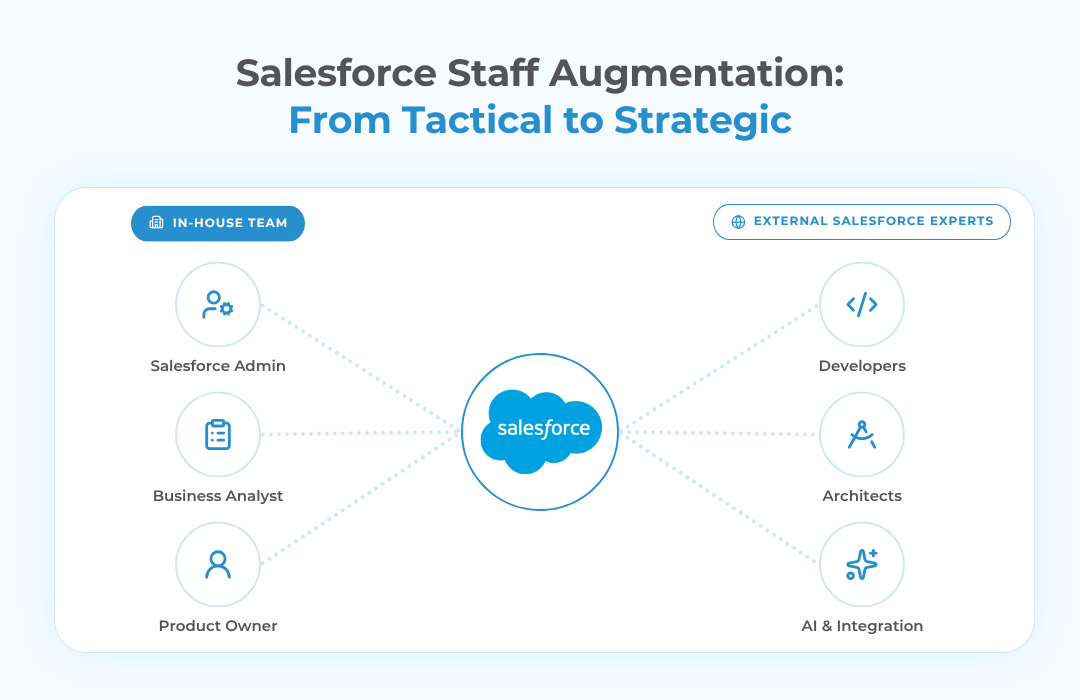
Salesforce staff augmentation is no longer just a way to fill critical gaps in a team. For many businesses, it’s becoming a long-term strategy for accessing particular expertise, keeping projects on track, and scaling without constantly expanding their in-house workforce.
Companies are no longer asking whether they should implement the platform; they’re interested in getting the most out of it. Internal resources are almost never sufficient for this.
Looking for a IT Services agency?
Compare our list of top IT Services companies near you
Source: Original visual by Peeklogic.
Bringing in external specialists is no longer a sign of a weak team. This trend has become a way to keep pace with the market. Today, the labor market cannot keep up with technological changes. By the time a vacancy is filled, the requirements have often moved on. Speed in acquiring the right professional creates a true edge over rivals today.
Companies are struggling to find qualified experts across specific, narrow domains. A certified technical architect is not just someone with a certificate. They are specialists with many years of project experience and a set of prerequisite certifications. Very few people pass their board review on the first try. It takes five or more years to train such a specialist.
The market is physically incapable of producing them any faster. This is not a temporary market anomaly that can simply be waited out. The structural nature of a mature platform requires deep expertise.
The shortage isn’t limited to architects. Apex developers, integration engineers, Data Cloud specialists, and CPQ specialists – in each of these niches, supply lags behind demand. A company may spend years searching in vain for someone with the right set of certifications and experience.
As a result, projects are delayed or carried out by people with inadequate qualifications. Either way, it costs money – it’s just that the losses aren’t always visible in the financial statements.
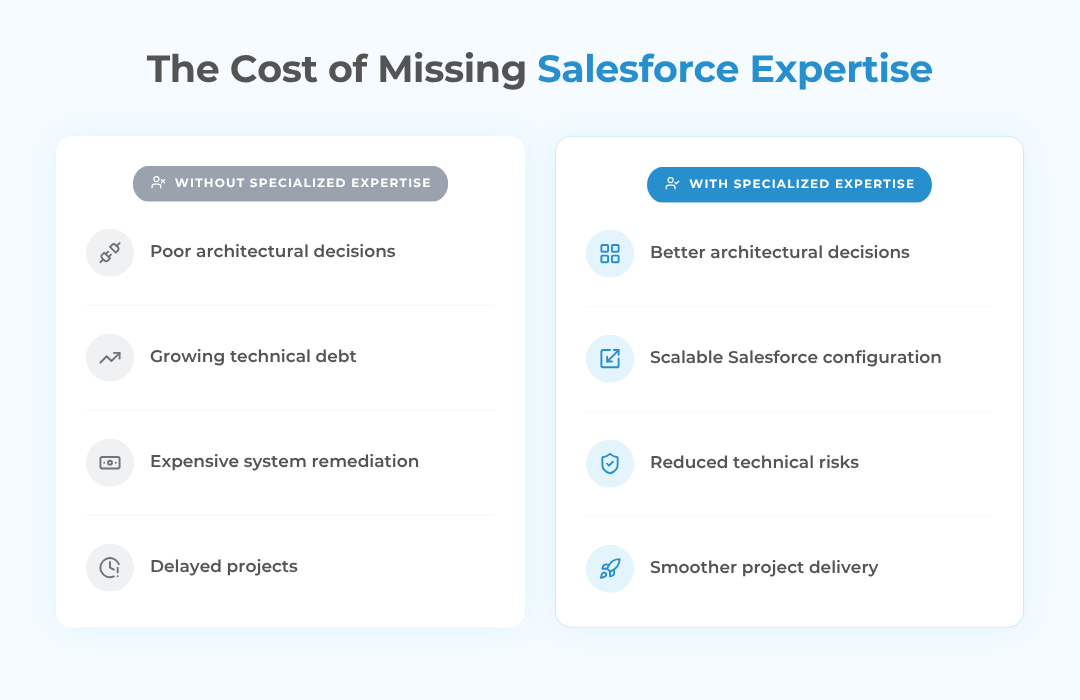
Peeklogic experts regularly encounter the consequences of decisions made by people without the necessary expertise. When Salesforce work is performed by a generalist rather than a platform specialist, workarounds emerge:
Such mistakes remain hidden initially, building up gradually over time. After three to five years, the organization discovers that its Salesforce org requires significant remediation before it can move forward. This raises the question of whether it’s even possible to continue developing the system. Each such remediation cycle costs more than bringing in the right specialist in a timely manner. The business loses time that it could have used to grow.
Then there's technical debt. It builds up when decisions are made without thinking through what they'll mean later. An organization may operate for years with a working configuration that is not scalable.
Source: Original visual by Peeklogic.
When the time comes to add a new sales channel or integrate AI capabilities, it becomes clear that the current architecture simply cannot handle the load.
Companies pay for Salesforce but don’t fully utilize the platform’s capabilities.
License costs are fixed. Their value is directly proportional to the expertise available to implement them. It’s hard to ignore this math when we’re talking about annual contracts worth tens of thousands of dollars. Underutilized functionality isn’t a cost savings – it’s a direct loss that’s difficult to justify to management when defending the budget.
At the same time, many companies don’t even realize the extent of their unused functionality. Reports, dashboards, automation, connections to outside systems – someone has to set all of that up. Without that someone, the company keeps paying for a full package while using a small slice of it. That gap is what missing expertise actually costs.
Bringing in certified specialists on a contract basis solves the immediate delivery problem. A CPQ developer, Health Cloud architect, or Marketing Cloud engineer can be brought onto a project within days through a qualified partner.
This isn’t a solution to a structural shortage – it’s a way to prevent current projects from suffering due to market conditions. The client gains access to the expertise they need, rather than trying to hire someone from a market where supply can’t keep up with demand.
You pay for the skill you need, on the project where you need it. Not for a person you'll then have to keep busy and keep around. The task is completed without any ongoing recruitment obligations. If the project ends or priorities change, the company isn’t left with an underutilized specialist on the payroll. This is especially important for businesses operating under uncertain conditions and unable to plan their staffing needs years in advance.
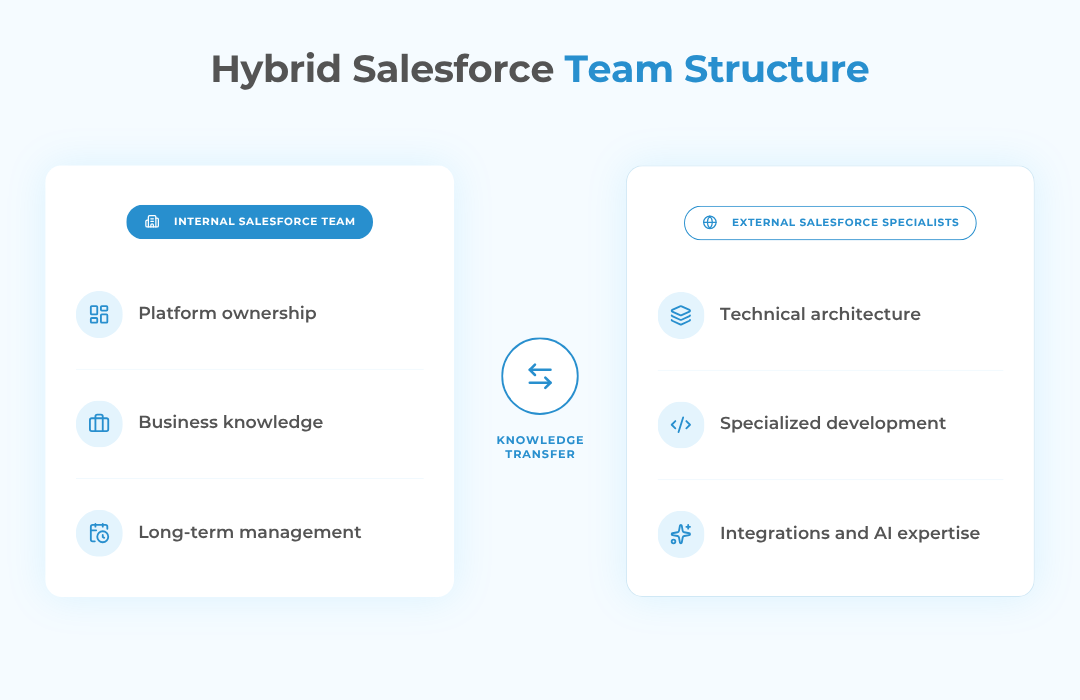
At first glance, augmentation looks like a tactical move. But organizations that use it correctly integrate external specialists into a hybrid team structure. The core consists of internal employees responsible for organizational ownership and institutional knowledge. The layer of brought-in experts is necessary for project depth.
This configuration scales better than hiring in-house staff exclusively or outsourcing entirely. The internal team manages the platform and builds up contextual knowledge. External specialists fill in competency gaps as needed. Over time, some of that knowledge is transferred internally – but without the illusion that it’s possible to hire all the necessary architects and developers at once.
A hybrid approach allows for more predictable budget planning than constantly expanding the staff for each new project. Choosing the right balance also means understanding the trade-offs between a Salesforce partner and an in-house team, particularly regarding costs, flexibility, and long-term ownership.
Source: Original visual by Peeklogic.
Strategic and tactical augmentation primarily differ in that the former is planned in advance. The company understands which projects will be launched in the next quarter, what competencies will be required, and who needs to be brought on board. This is not a reaction to a crisis. This approach represents sound resource management.
The shortage is particularly acute in niche cloud areas and products. CPQ, Revenue Cloud, Data Cloud, and AI integration – these competencies require highly specialized expertise. Even if a company is willing to pay market-rate salaries, the right specialist may simply not be available on the market at that particular moment.
Frank Della Rosa, Research Vice President at IDC, notes a broader shift in the Salesforce market: “Salesforce Agentforce 360 underscores a seismic shift in the software market, where expertise becomes the primary driver of innovation.”
This explains precisely why premier Salesforce partners center their operations on these specific domains. Peeklogic, for example, has a team holding more than 250 Salesforce certifications and covers the entire Salesforce stack – from Sales and Service Cloud to Revenue Cloud and Agentforce. When all that expertise is in one place, you get the right person for the task without months of searching. One partner covering several areas also cuts the paperwork on your side.
There's a second thing you get: pattern recognition. Someone who works in their niche daily has already seen the mistakes other teams make and knows where the traps are. A generalist developer won’t have this experience, even if they’re very familiar with the platform. In specialized fields, depth is more important than breadth, and that’s precisely what’s hardest to achieve within a single company.
Bringing in an outside specialist used to be seen as an admission that something was missing within the team. Now, it’s an acknowledgment that no single team can house all the specialists that might be needed over the next three to five years.
The difference between tactical and strategic use of augmentation lies in the attitude toward it. Tactical: “The project is burning down – get us an extra pair of hands for thirty days.” Strategic: “We already foresee next year's skill gaps, so we are crafting a blended structure: outside pros handle peak workloads, enabling our core staff to master essential expertise”.
One more thing, strategic augmentation fixes: dependence on one person. If all the platform knowledge lives in one architect's head, that person's leaving is a serious problem. Spread the expertise across several people and a partner, and staff changes stop being a crisis. This isn’t bureaucracy for bureaucracy’s sake, but a way to ensure project continuity.
Different engagement frameworks for partnering with external Salesforce experts have surfaced across the industry, with each model tailored to specific project needs:
The choice of format depends on whether the company has in-house personnel capable of managing external specialists and making decisions. If so, augmentation offers maximum flexibility. If not, a dedicated team or project handles the task entirely but requires closer collaboration with the partner at the outset.
In practice, companies rarely use just one format. Most often, it’s a combination: a dedicated team leads the main project, an architect is brought in to review key decisions, and a separate specialist handles a specific integration task. This approach requires more complex management but allows you to get the most out of each format and avoid overpaying for resources that aren’t used consistently.

![How to Create a Budget for BI & Analytics Services [With Template]](https://img.shgstatic.com/clutch-static-prod/image/resize/715x400/s3fs-public/article/f07e9d6bd89e7f70df9c94301acdd847.png)