Lead Quality vs. Lead Quantity: Why B2B Teams Are Rethinking Their Funnel in 2026
Bigger buying committees and tighter budgets are forcing B2B teams to rethink lead quality vs. quantity. Here's how top teams rebalance the tradeoff in 2026.
Updated June 1, 2026

Attribution is no longer the reliable growth compass it once was. As privacy changes, AI-driven discovery, and fragmented customer journeys reshape digital marketing, brands are learning to operate with far less visibility into what truly drives conversions. The companies winning in 2026 are not the ones with perfect data, they’re the ones adapting fastest to uncertainty.
Five years ago, performance teams lived inside clean click paths and tidy conversion funnels.
Today, the dashboards still glow, but the story behind the numbers feels thinner.
Looking for a Digital Marketing agency?
Compare our list of top Digital Marketing companies near you
Privacy regulation, browser limits, walled gardens, AI-driven search, and wildly fragmented journeys have reshaped what we can actually see.
IAB’s 2026 State of Data shows advanced measurement is everywhere, yet buyers still question rigor, speed, trust, and efficiency.
So brands compare platform reports that rarely align, triangulate partial signals, and place bets with 40-60% less observable attribution data than they once had.
In this article, you’ll see how smart teams adapt, what replaces user-level certainty, and why this shift creates an advantage for those who lean into it.
PS: Some channels still outperform the rest. See which ones brands double down on in our latest ROI breakdown.
For a start, let’s unpack in more detail why attribution data feels harder to trust and use this year.
The first major shift came from changes to privacy.
Apple’s App Tracking Transparency across platforms, and a large share of people simply opted out.
As a result, deterministic user-level tracking became much weaker, especially across iOS devices.
At the same time, privacy-first attribution frameworks began prioritizing aggregated, anonymized reporting.
That approach protects consumers, which absolutely matters, yet marketers lost a large portion of the granular visibility they once relied on for optimization and targeting decisions.
Then the browser landscape became messy.
For years, the industry prepared for a fully cookieless future, yet reality turned out to be far more fragmented.
Chrome, Safari, Firefox, regional privacy laws, consent banners, and custom cookie settings all handle tracking differently.
So, brands now work across multiple environments with different levels of visibility.
One campaign may look highly effective in one browser and far weaker in another, even when the actual customer behavior remains similar.
Google’s 2025 decision to keep its current Chrome cookie-choice approach shows that the cookie story is not a clean “on/off” transition.
Large platforms started keeping more measurements inside their own ecosystems.
Meta, Google, Amazon, TikTok, and others increasingly rely on modeled or aggregated conversions rather than direct user-level attribution.
That creates a strange situation in which every platform claims strong performance, yet the numbers rarely align with external analytics tools.
Marketing teams spend more time comparing dashboards and validating signals than simply reading results at face value.
More buyers now get answers directly from AI tools, search summaries, social recommendations, and curated feeds without ever visiting a website.
Gartner even predicted a 25% decline in traditional search volume by 2026, driven by AI chatbots and virtual agents.
And this trend already shows up in real behavior.
SparkToro’s zero click studies reveal that a massive share of searches already end without a click to the open web.
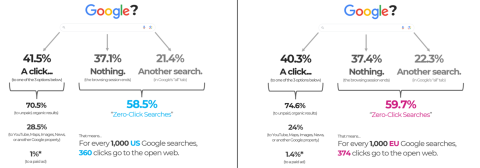
Source: SparkToro
So influence still happens, awareness still grows, yet attribution systems lose visibility into those early decision-making moments.
As these shifts overlap, customer journeys become almost impossible to map cleanly from start to finish.
A single buyer may discover a B2B vendor through LinkedIn content, hear about them on a podcast, ask ChatGPT for alternatives, compare vendors in Reddit threads, join a webinar weeks later, and finally convert after multiple sales conversations.
Every platform captures only a small piece of that path.
Which means marketers in 2026 rarely operate with perfect attribution certainty anymore.
Instead, they learn to work with partial evidence, directional trends, and blended measurement models that piece together the bigger picture.
Still, messy data does not make familiar metrics irrelevant.
And that leads us to the next section:
At this point, attribution almost sounds broken beyond repair.
Yet that would be the wrong conclusion.
Although only 22% of organizations still rely primarily on last-click attribution, that alone shows these models are far from obsolete.
The real issue comes from expecting tactical measurement tools to explain total business growth on their own.
They remain extremely useful for things like:
Each system simply measures different parts of the customer journey:
| Measurement type | Best for | Bad for |
| Platform attribution | In platform optimization | Proving total incremental revenue |
| GA4 / web analytics | Site behavior and conversion paths | Cross device, cross platform truth |
| CRM / ecommerce data | Actual customers and revenue | Explaining what caused demand |
| Finance reporting | Business truth | Channel level optimization |
The teams pulling ahead in 2026 have already moved beyond one-dimensional attribution thinking.
Now let’s unpack the measurement stack they rely on instead.
So what replaces the old “single source of truth” mindset?
In most cases, smart brands stop searching for one perfect measurement model and start triangulating.
“The time for a single-channel fix or a one-off framework has passed.” - David Cohen, CEO, IAB.
Interestingly, IAB’s 2026 State of Data report shows that 67% to 76% of U.S. buy-side decision makers already use attribution analysis, incrementality testing, or MMM in some form.
Yet only 39% use all three together.
That gap matters because the real advantage comes from the combination itself.
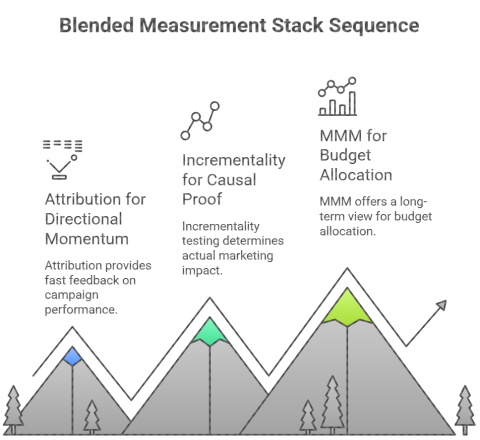
Inside this blended stack, attribution still serves as the fast feedback layer.
Brands use it to spot momentum shifts across campaigns, audiences, creatives, and customer behavior while performance evolves in real time.
It helps teams quickly identify patterns and emerging opportunities.
As we mentioned before, the key difference lies in treating attribution as directional guidance rather than an absolute business truth.
Then comes incrementality testing, which answers a much harder question: would this revenue have happened anyway?
This is where brands run geo tests, holdout groups, conversion lift studies, and audience split experiments to isolate actual marketing impact from background demand.
While correlation measures association, incrementality focuses on causation.
Finally, media mix modeling (MMM) provides a long-term business perspective.
MMM helps brands understand channel contribution over longer timeframes while accounting for seasonality, economic shifts, pricing changes, and diminishing returns.
This layer gives leadership teams a clearer picture of where future budget allocation actually makes sense.
And this shift changes more than reporting models. It changes the KPIs that teams prioritize every day:
Once attribution becomes patchier, smart teams stop obsessing over one perfect conversion path.
They move toward signal clusters: a mix of business, behavioral, customer, and demand indicators that help them understand whether marketing is actually working.
| Signal | What it answers | How it helps decisions |
| Incremental lift | Did sales rise in exposed markets versus holdout markets? | Shows whether campaigns created extra revenue or captured demand already in motion. |
| Branded search lift | Are more people searching for the brand after campaigns run? | Reveals whether awareness activity is turning into active buyer interest. |
| Direct and organic traffic quality | Are more high intent visitors arriving when paid attribution looks unclear? | Helps identify demand that paid platforms may influence but fail to capture cleanly. |
| First party customer behavior | Are email signups, account creations, quiz completions, repeat purchases, or wishlist actions improving? | Shows whether audiences are moving closer to purchase, even before final conversion. |
| New customer revenue | Are campaigns bringing in fresh demand or mostly reaching existing buyers? | Helps separate real growth from retargeting-heavy performance. |
| MER / blended ROAS | Is total revenue rising efficiently compared with total media spend? | Gives a business-level view when channel reports disagree. |
| CAC payback and contribution margin | Are customers profitable after discounts, refunds, COGS, shipping, and retention? | Keeps teams focused on profitable growth rather than surface-level ROAS. |
| Qualitative demand signals | What are people saying in surveys, reviews, Reddit, TikTok comments, sales calls, and support tickets? | Captures influence that dashboards often miss, especially in messy discovery journeys. |
| AI search visibility | Is the brand appearing in AI answers, category comparisons, and buyer research moments? | Helps brands understand visibility in discovery environments where clicks may never happen. |
But once brands track more signals, they also face a new problem: those signals rarely agree perfectly.
Now let’s see how experienced marketers navigate that uncertainty.
The key shift here feels surprisingly simple: leading teams decide in advance which measurement source guides which business decision.
That structure removes panic, reduces reactive optimization, and creates far more consistent decision making when the data inevitably gets messy.
| Situation | Likely explanation | Smart response |
| Platform ROAS rises while blended revenue stays flat | Platforms over credit conversions that likely would have happened anyway. This issue becomes even harder in B2B environments. | Run incrementality tests, reduce retargeting bias, review new customer mix |
| GA4 traffic or conversions decline while revenue grows | Tracking gaps, dark social, AI discovery, offline influence, or cross device behavior distort visibility | Prioritize revenue trends, inspect branded search growth and direct traffic quality |
| MMM shows a channel performs well while attribution underreports it | Upper funnel influence or delayed conversion effect | Evaluate the channel at portfolio level across longer timeframes |
| Attribution shows strong performance while incrementality tests look weak | Demand capture, over crediting, or aggressive retargeting inflate results | Cap spend, shift budget toward prospecting, test holdout markets |
| Customers frequently mention channels dashboards barely track | Influence happens without a measurable click path | Expand post purchase surveys, monitor assisted demand signals, test spend adjustments |
And this is exactly why media budgeting looks very different from the playbooks marketers used a few years ago.
As attribution visibility weakens, budget allocation starts becoming far less reactive.
A few years ago, many teams adjusted spending almost daily based on platform ROAS swings.
In 2026, that approach creates more noise than clarity.
Solid brands manage media budgets more like investment portfolios, where each channel plays a different role inside the growth system.
That shift is already showing up in the data: companies moving from single-touch attribution to multi-touch models report an average 22% increase in budget efficiency.
This bucket covers channels that harvest existing intent: paid search, shopping, retargeting, affiliates, email, and SMS.
These channels usually sit closer to conversion, so tighter attribution can still guide decisions here.
The goal is efficiency.
Brands watch conversion rate, CAC, MER, repeat purchase behavior, and revenue quality to make sure they capture demand without overpaying for buyers who are already ready.
Second bucket builds future demand through channels like Meta prospecting, TikTok, YouTube, CTV, creator-led UGC campaigns, podcasts, OOH (Out-of-Home), and partnerships.
These channels often influence people long before they convert, so last-click reporting usually undervalues them.
Here, smart teams look beyond immediate ROAS.
They track branded search lift, direct traffic quality, new customer revenue, lift studies, creative resonance, and MMM contribution over time.
The final bucket exists to improve the entire measurement system.
It funds geo tests, creative experiments, new channel pilots, incrementality studies, and audience tests.
This spend may look inefficient inside a platform dashboard, but its job is knowledge.
It helps teams understand what truly drives growth, where diminishing returns begin, and which channels deserve scale later.
Once budgeting becomes less reactive, reporting starts changing too.
As budget allocation becomes more strategic, reporting has to evolve too.
The strongest reports spend less energy fighting over which channel “deserves” a conversion and more energy helping teams decide the next move.
A useful reporting setup usually has four views:
| Reporting view | What it should show |
| Executive view | Revenue, margin, total media spend, MER, CAC payback, and forecasted ARR impact |
| Growth view | Channel spend, platform ROAS, CAC, new customer revenue, creative winners, funnel conversion |
| Measurement view | Incrementality tests, MMM readouts, confidence levels, attribution gaps, assumptions |
| Customer view | Survey responses, reviews, search trends, AI visibility, sales and support themes |
The real upgrade comes from adding confidence scoring.
Every major recommendation should carry a high, medium, or low confidence label based on the number of signals pointing in the same direction.
For example: “We recommend increasing YouTube spend by 15%. Confidence: medium. MMM shows positive contribution, branded search rose in test markets, but platform attribution underreports direct conversions.”
Next, let’s look at the operating rhythm strong marketing teams use to keep decisions aligned with reality.
Once reporting becomes decision focused, the real advantage comes from rhythm.
Measurement works less like a dashboard setup and more like a management system.
The teams that move fastest have a clear cadence for what gets reviewed, when it gets reviewed, and which decisions each review should unlock.
A solid cadence usually looks like this:
This rhythm matters because advanced measurement tools alone rarely fix the real problem.
IAB’s 2026 State of Data points to a familiar gap: measurement may be widely adopted, yet still underperform on rigor, coverage, timeliness, trust, and efficiency.
In fact, between 60% and 75% of marketers say their current measurement approaches still fall short across those core areas, despite widespread adoption of attribution, incrementality testing, and MMM.
That tells us the challenge goes beyond buying better tools.
Teams also need cleaner ownership, stronger review habits, and a shared way to turn mixed signals into action.
Which brings us to the practical side of all this theory.
The stack only works when the company rebuilds the operating model around it.
Use this checklist as a practical starting point:
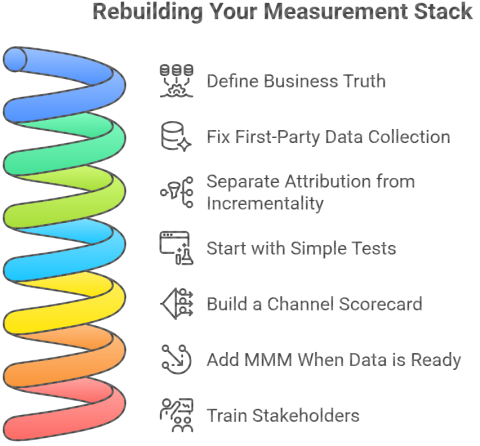
Choose the source of truth for revenue, margin, refunds, customer status, and repeat purchase behavior.
Usually, this comes from e-commerce, CRM, finance, or a clean data warehouse.
Strengthen the basics first: server-side events, CRM hygiene, consent capture, UTMs, customer IDs, email and SMS capture, and offline conversion uploads.
Better measurement starts with cleaner owned data.
Make the distinction clear across the team. Attribution shows observed paths. Incrementality shows causal lift.
One explains visible behavior, the other answers whether marketing created extra demand.
Run geo holdouts, campaign holdouts, audience splits, or pre/post tests before investing in complex tooling.
Remember: Simple experiments often reveal the biggest gaps fastest.
Evaluate every channel by revenue impact, incrementality, scalability, margin quality, confidence level, and strategic role.
This keeps budget decisions grounded in more than platform ROAS.
MMM needs clean spend, revenue, seasonality, promo, pricing, and external factor data.
Treat it as a strategic planning layer, rather than a magic answer machine.
Finance, leadership, and channel owners need a shared language for modeled, directional, and causal signals.
Otherwise, every meeting turns into a debate about whose dashboard wins.
So before wrapping up, let’s summarize the mistakes that quietly weaken modern measurement strategies.
Here are the traps that show up most often:
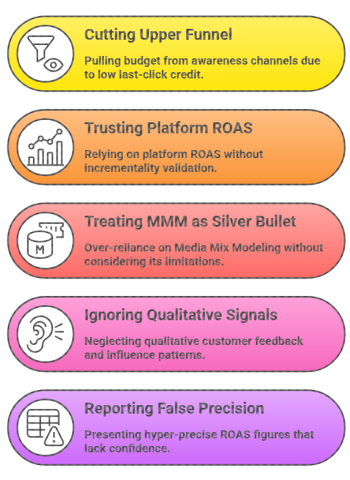
When awareness channels receive little direct conversion credit, teams sometimes pull the budget too quickly.
That move may improve short-term efficiency, yet it slowly reduces future demand and brand momentum.
High platform ROAS can look comforting.
Yet without lift tests or holdouts, a large share of those conversions may come from demand that already existed.
This often leads to overfunding retargeting and underfunding growth.
Media mix modeling supports smarter channel allocation.
Still, MMM depends on data quality, assumptions, and time horizons.
It works best as a planning layer rather than a daily decision engine.
Customers frequently mention creators, podcasts, TikTok videos, or conversations that dashboards barely capture.
Reviews, surveys, sales calls, and support chats often reveal influence patterns long before attribution tools do.
A dashboard showing $4.37 ROAS may feel impressively exact.
But in low visibility environments, confidence ranges often communicate reality more honestly than hyper-precise decimals.
The real danger comes less from having fewer data points and far more from pretending the remaining data offers perfect clarity.
Marketing teams in 2026 operate in a world with less visibility, weaker attribution paths, and far more fragmented customer behavior than they had just a few years ago.
Yet the brands pulling ahead rarely wait for perfect tracking to return.
The biggest shift happening right now goes beyond technology.
It is a mindset change.
Brands stop treating attribution as a flawless truth machine.
They start using it as one signal inside a broader decision system built around incrementality, MMM, first-party data, qualitative feedback, and business outcomes.
The companies winning with 40% to 60% less observable attribution data usually share the same advantage: they make calmer, more disciplined decisions while competitors still chase perfect certainty inside conflicting dashboards.
That may become the most valuable measurement skill of the next decade.
Privacy regulations, browser restrictions, AI search, zero-click discovery, and fragmented customer journeys have reduced the amount of observable user-level data available to marketers.
Yes. Last-click attribution still helps with tactical optimization, such as creative testing, campaign pacing, landing page analysis, and keyword management. The issue comes from using it as the only measurement model.
A blended measurement stack combines attribution, incrementality testing, and media mix modeling (MMM) to provide a broader, more reliable view of marketing performance.
Strong teams track signal clusters such as incremental lift, branded search growth, direct traffic quality, first-party behavior, new customer revenue, MER, contribution margin, and qualitative customer feedback.
They define decision rules in advance. Different measurement systems answer different questions, so teams assign specific roles to attribution, incrementality, MMM, CRM, and finance data, rather than expecting a single dashboard to explain everything.