Testimonial Advertising: How to Turn Customer Stories Into Sales
Testimonial advertising uses real customer stories and reviews to promote your brand. Discover popular types and how to put this content to work.
Updated November 21, 2025

Outdoor advertising is seeing a revival. And the right approach can turn OOH advertising into a high-impact, connected channel, without wasting cash.
If you judge OOH (Out-of-Home) advertising by the average highway billboard, you might think it's obsolete. But in reality, OOH advertising isn't dying out. It's evolving.
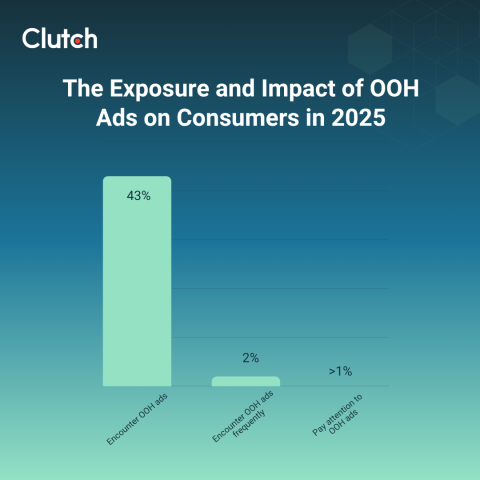
In fact, a Clutch survey of 453 consumers about advertising found that 43% still encounter OOH ads.
Looking for a Advertising agency?
Compare our list of top Advertising companies near you
However, only 2% encounter them frequently, and less than 1% actually pay attention when they come across them.
The takeaway isn't "abandon outdoor advertising." It's "rethink what belongs in these ads, where they live, and how they connect to the rest of your campaign." Bold creative, smart site selection, and tight digital integration now separate forgettable OOH ad spend from genuine impact.
OOH advertising covers any ad media you place in public spaces. It could be on billboards, street furniture, bus and subway stations, or place-based screens.
The data suggests that this ad space is growing quietly but steadily. OAAA (OOH Advertising Association of America) reported U.S. OOH revenue hit a record $9.1B in 2024. It has kept growing into 2025, with Q1 2025 setting a new quarterly high.
Digital OOH (DOOH) accounted for more than a third of OOH spending, growing faster than static formats. These impressive figures imply that OOH is not a dying channel but one that's being repositioned. Consumer behavior has shifted, and that shift has changed where OOH works.
Hybrid schedules reduce five-day commuting and flatten the weekday rush. Moreover, a study by MIT researchers documented durable changes in trip patterns post-2020, with significant regional variance. Some corridors rebounded, but others never returned to their pre-pandemic peaks.
In this environment, if you still plan purely around the "AM/PM drive," you may miss the noon gym crowd, the early school pickups, or weekend stadium surges that carry more weight than they used to.
So why do some brands still write off outdoor advertising as outdated? Because much of what the public notices (and shrugs at) is static, low-concept ads repeating brand names at 70 mph. That perception is only half true.
Tired or poor billboard placements are indeed background noise. OOH designed for context and digital connection, however, can still earn attention, recall, and incremental performance.
OOH remains valuable for mental availability and local presence. It reaches people in shared spaces where brand signals feel public, not personal. And it's a valuable counterweight to closed-feed media. What's changed is how and where brands deploy it and how often you refresh it.
OOH works better when well-situated. It tends to underperform in low-density, low-relevance settings or where the idea can't punch through at a glance. Transit hubs, dense urban corridors, and live events are where OOH still has reach, because these locations concentrate public attention:
A few recent implementations show why context wins. FX used a massive Times Square 3D board to promote Alien Earth in September 2025. The OOH stopped foot traffic and spilled across social media. It's proof that premium sites can command attention when the ad creative earns it.
The biggest shift with OOH is DOOH. Connected screens serve dynamic content based on time, weather, or audience triggers and can be bought programmatically.
The data is already encouraging. OAAA's 2024 figures show DOOH already accounts for roughly a third of U.S. OOH spend, with programmatic DOOH (pDOOH) now capturing 24% of the DOOH market. And the deal flow backs it up. The acquisition of Vistar Media signaled how cross-industry data and the pDOOH space are converging.
For OOH, scale does the work that small screens can't. A single, high-contrast visual at 50 feet tall is likely to force a "pause" in crowded environments. That's why 3D anamorphic boards keep going viral.
When the creative uses scale to stage a moment without clutter, it generates memories and conversations that are often shared online. BMW's 3D Times Square reveal for the XM is a prime example. It was a physical moment that went viral on social media feeds and automotive forums, and even earned press mentions.
There are still a few key issues plaguing OOH advertising:
Clutch's consumer survey data underlines this gap between exposure and impact. Only 2% of survey respondents said they encounter outdoor advertising frequently anyway, and less than 1% even pay attention when they see the ads. That's a creative problem, not an OOH format issue.
The key is to treat OOH like a high-impact touchpoint that integrates into a connected customer journey. Try these best practices for outdoor advertising, which work across categories and budgets.
Don't get too complicated. Strip your message down to a single promise or punchline. Win with minimal copy, high-contrast art direction, and one clear action. The most shared OOH in the last few years follows this rule: big, clean visuals, strong color, and almost no words.
A coordinated 3D DOOH rollout put Citizen and its sister brands on Fifth Avenue with forced-perspective product animations. The ad showed watches "emerging" from their cases, running across the flagship's LED façade and JCDecaux BoldVu® street furniture. Minimal copy, product-as-hero visuals, and placement in one of the world's highest-intent retail corridors made the creative feel premium and instantly legible at street level.
Placement strategy still makes or breaks outdoor advertising. Focus on intersections and corridors where your target audience actually clusters. Layer your placement real-world timing for optimal results. Marathons, concerts, playoffs, trade shows, and city festivals change flows and increase dwell time.
Spotify Wrapped's OOH advertising proves the value of strategic placement. This campaign took over the streets of NYC and LA with OOH ads that turned neighborhoods into Spotify playlists.
OOH works best as the top of a connected funnel. A few practical moves here are to:
For instance, Boehringer Ingelheim ran a programmatic DOOH campaign in Spain for its Frontpro line that used dynamic QR codes. The screens blended static and digital placements and used triggers to turn a public canvas into an interactive prompt. The result was an impressive 254% boost in brand perception.
With the path forward in OOH indicating a deeper merge between data, creativity, and sustainability, look for more of the following in the coming years:
In plain terms, OOH is moving from static placements to a living channel that adapts to audiences.
Outdoor advertising isn't dead — lazy OOH is. The channel still promotes brand presence in public spaces, but only when teams bring a creative idea, place it where attention actually occurs, and link it to digital to turn a moment into a customer journey across devices and social media.
Static wallpaper with vague copy won't cut it anymore, so modernize your approach. This could be the use of new AI tools for ad creatives or sustainable billboards as a DOOH strategy. And if anyone doubts the medium, point to the money moving into it and the viral ad campaigns lighting up city blocks this year.
By thinking of OOH advertising as part of a connected experience, your brand can meet your audience wherever they go.