Testimonial Advertising: How to Turn Customer Stories Into Sales
Testimonial advertising uses real customer stories and reviews to promote your brand. Discover popular types and how to put this content to work.
Updated November 21, 2025

Audio ads are gaining serious traction across audio streaming and podcast advertising, and the playbook has matured. This article maps the strategies that drive outcomes, so you can scale with clarity and confidence.
Online audio listening hit an all-time high this year, with 79% of Americans over the age of 12 listening monthly, according to Edison Research's The Infinite Dial 2025. Podcasts continue to gain share as part of daily routines, and streaming platforms now provide precise ad targeting and measurement that performance teams recognize and trust.
Clutch surveyed 453 consumers about their thoughts on advertising. Our data found that 33% of consumers encounter ads through audio and podcasts. This meaningful slice of attention has outpaced many expectations and validates a budget shift that brand and demand leaders have debated for years.
Looking for a Advertising agency?
Compare our list of top Advertising companies near you
If you're allocating a budget for the next planning cycle, audio ads deserve a hard look. Below, you'll find what's driving this audio growth, why it matters for sophisticated teams, and how to operationalize audio ads for measurable return.
Audio streaming and podcast advertising aren't side quests anymore.
"The best ads feel like someone looked you dead in the eye and said, 'You need this. And I’m willing to stand behind it,'" said Chad de Lisle, VP of Marketing at Disruptive Advertising.
Audio streaming now operates with scale and reliable cadence. Three dynamics of this medium stand out the most:
So, why does audio advertising work at scale?
It's time to pay attention to this shift because the audio medium now checks boxes that kept it "experimental" for far too long: reach, precise targeting, brand safety, and clear measurement (brand lift plus real-time attribution).
NPR's National Public Media, for example, documents consistent lifts in awareness, favorability, and purchase intent for sponsors, and provides attribution tools that connect audio exposure to on-site actions.
The upside of audio ads isn't just reach. It's the way audio shows up in a person's day and the relative strength of the ad experience. Let's set the stage before we get tactical.
Audio streams don't stack banners, pop-ups, or mid-scroll interstitials (full-screen ads that appear between content). The unit is singular and focused. On podcasts, a mid-roll might be the only message at that moment, no competing visuals, and no five other placements fighting for cognition.
That scarcity amplifies the message and can provide a better ROI for the ad spend. It also helps brands avoid creative arms races that add cost without moving the needle.
Voice-led formats resonate differently. When a trusted host delivers your story, aided recall and consideration lift tend to pop. Nielsen reports an average aided recall for podcast ads of 71%.
IAB's 2024 guidance, outlined in the creator-economy playbook, reinforces the point. According to the report, more than 85% of podcast listeners say they "enjoy" host-read ads. This enjoyment factor underpins the permission that makes brand messages in audio ads feel additive, not interruptive.
Be it on a treadmill, during school drop-off, or a warehouse shift, audio fits into routines where screens can't go. That context gives performance teams new reach at efficient prices while letting brand teams tell a story without visual baggage.
That utility boosts completion rates, as you aren't competing with "skip" muscle memory developed on video platforms.
A single, consistent voice can carry brand memory better than a carousel of visuals. Voice communicates tone, values, and intent quickly.
It's also easily reusable across platforms. For instance, you can reuse voiceovers for podcast ads, streaming audio, program-intro sponsorships, and even call-center hold experiences.
Spotify's Streaming Ad Insertion (SAI) made this even more attractive by bringing digital-grade planning, reporting, and targeting to podcast ads, turning voice-led creative into an addressable asset.
Targeting, formats, and alignment are the operational levers that matter for experienced teams, and your analysts, media buyers, and brand partners can pull them week to week.
Platform data and dynamic insertion make audio as programmable as display or video, without inheriting their worst habits. Here are a few of the best strategies to use audio ads to the fullest:
A case study of "Heart Starts Pounding" from Spotify spotlights that targeted campaigns increase awareness and traffic by aligning audience signals with creative variants.
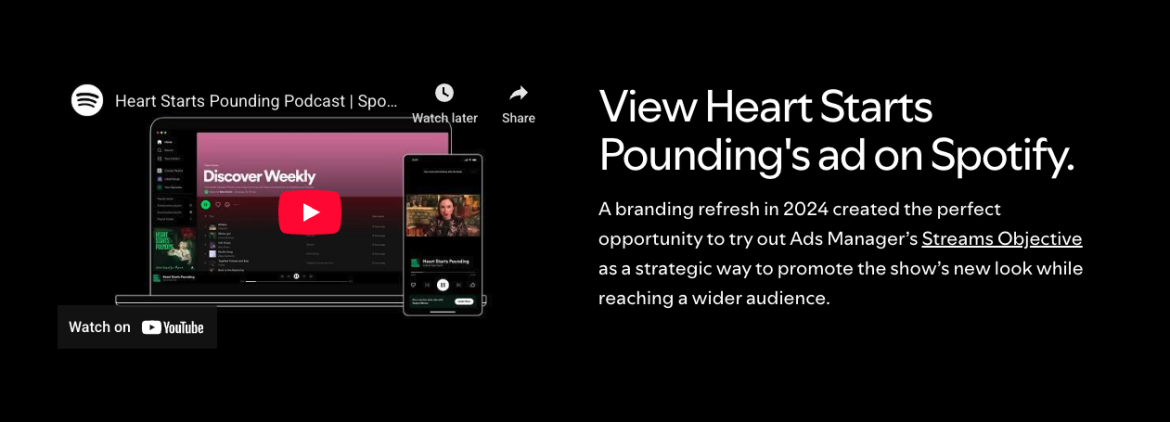
Heart Starts Pounding Case Study - Spotify Advertising
Using this insight in reverse for B2B could be advantageous. For instance, make audio your always-on ad channel. Then, layer social media, connected TV, or retargeting display ads only when each adds net-new reach you can measure.
Native ad strategy wins when it respects the show's voice. Here are a few points worth considering:
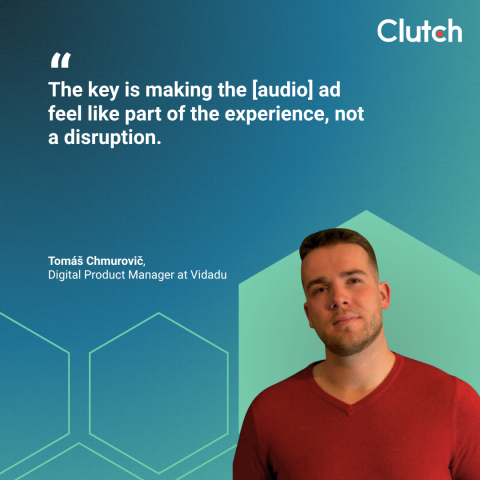
As Tomáš Chmurovič, Digital Product Manager at Vidadu, puts it: "The key is making the [audio] ad feel like part of the experience, not a disruption." To do so, treat the host as a co-writer, not just a voice. Provide a tight message map (benefit, proof, offer, URL) and let them translate it for their audience. That's where authenticity lives.
Context lands the message, and the audio's context is surprisingly rich. A great approach is thus to align the narrative to the content theme and audience mindset:
You can mix and match a few of these contextual segments to get measurable outcomes.
Audio ads have moved from "interesting test" to a proven channel with scale, addressability, and credible measurement. Listening continues to rise. Podcasts in particular now hold a larger share of ad-supported minutes and outperform on recall when creatives respect the medium.
The macro ad market will ebb and flow, but audio continues to post consistent revenue and attention growth, as cross-validated by IAB/PwC, Spotify, and Edison reports.
In short, if you're setting the audio ad strategy:
This is a good time to consider audio ads. While video screens become noisier, audio offers a quieter path to attention and travels with your audience throughout the day. Clutch's consumer survey also signals that the format is woven into everyday media habits.
Why not use that reality to your advantage and build your audio ad strategy now, as it keeps expanding?