
How To Advertise on ChatGPT Without Losing User Trust
New Clutch data shows 65% of AI assistant users find ads hard to distinguish from real answers. Learn how to advertise on ChatGPT without losing user trust.
Updated May 28, 2026

Media buying can help brands drive the most impressions and gain competitive footing. For those who are inexperienced, starting a media buying project can be daunting especially when calculating costs and preparing a budget. Keep reading this detailed guide and let's take a deep dive into everything you need to know for media buying — from cost factors to components and steps.
Media buying is not new but many small business or startup owners feel intimidated by it.
Essentially, media buying is a form of paid marketing that requires thorough research and planning to buy ad space on relevant channels and platforms. Brands can choose between or even combine traditional and digital platforms to reach their target audience with media buying.
Looking for a Advertising agency?
Compare our list of top Advertising companies near you
At first glance, it is easy to assume that it's not as cost-effective as other marketing channels such as content marketing and SEO.
However, that's not the case because if you have an optimal strategy and a practical budget, you can generate the best results to give your brand the leverage it needs. In this step-by-step article, we’ll help you create a budget by breaking down all the steps, components, and factors you need to look out for when planning.
Once you finish this piece, the next thing to do is to search and match with the best partner on Clutch. Scroll through our rankings for the best media buying and planning agencies.
Media buying is a huge investment that provides exponential returns when done successfully. However, you don't need to spend tons and tons of dollars to reap its benefits.
To get the best results, you must know how to spend your resources responsibly and understand what goes into it all. These are the critical components you need to consider when budgeting for your media buying and planning project:
Now that you know all of the components and processes that go into a campaign, you can understand where your budget goes. Of course, other marketers or professionals have their own breakdown of the process but these are the general steps for media buying.
Before you sit down and work on your Excel sheets, the first step when planning your media buying budget is to define and analyze your business goals carefully. To make sure priorities are aligned properly, some marketers define their goals into three categories — purpose, audience, and reach.
Purpose refers to the main mission that ties the media buying campaign to the brand’s overall marketing goals. Some examples include generating brand awareness, driving sales, or introducing new products or services.
Audience is straightforward — it refers to the demographics you’re trying to reach depending on the form of media you’re using for your campaign. Knowing the type of audience that will read, click on, and consume your content will help you maximize your media buying budget.
Reach is the last category and it typically depends on the first two mentioned. Understanding your target audience and the purpose of your media buying campaign will allow you to determine the ideal reach and frequency of your ads.
The goals you’ve set will help you with the next step of the budgeting process. Staying aligned with your objectives will allow you to save costs and figure out how to get the most out of your investment.
The key to maximizing your resources wisely is to choose the best media mediums to focus on.
See, different media have their own pros and cons. They can work differently depending on your funnel and audience segments.
Generally speaking, there are two common types of media buying approaches — direct and programmatic. The success of your project will depend on knowing which is the right approach for your brand depending on its goal, budget, and message.
Direct media buying refers to the process where ad buyers and publishers negotiate personally. It’s typically done on traditional media like television, print, and radio.
Moreover, programmatic media buying is more popularized by digital media and it is an automated form of buying and selling digital ad space, relying on real-time bidding (RTB).
Your brand can combine both traditional and digital mediums or focus on them separately. Ultimately, your strategy and the type of media buying approach you go with are influential to your budget.
Data is the name of the game when it comes to media buying in this modern age. The best way to determine how much you spend on your next campaign is by leveraging the data you’ve gathered from your previous media buying and digital marketing activities.
Keeping track of the results of your previous campaigns is a great practice that will not only help you with your current projects but also your future endeavors.
Take your time to assess your previous marketing expenses, the results of past marketing tactics, and the challenges faced. The information you gain will be invaluable to you as you plan your budget.
If your brand hasn’t done a media buying campaign before, the next best way to get data is by conducting thorough media research.
Unclear key performance indicators (KPIs) can be the downfall of any media buying campaign. From the get-go, any form of advertising or marketing is initiated with specific objectives in mind. Not knowing what KPIs to track is just like splurging your resources.
Aside from Return on Ad Spend (ROAS), the most common KPIs tracked by marketers include cost per click (CPC), click-through rate (CTR), and cost per acquisition (CPA).
The good thing about digital media buying is that marketers can access these KPIs in real time. The immediate results can allow you to adjust your strategy and budget quickly.
Media buying isn’t just about knowing the right timing and placement for your ads, it’s also about creating compelling ad content that will attract new customers.
Your ads can’t be plain and boring. What’s the point of spending money bidding for ad placements if your consumers ignore your content?
The type and amount of content you produce for your media buying campaign will directly influence your budget allocation. For example, if you’re launching a seasonal or limited edition promo via ad placements, you’ll need to produce new content — that includes graphics, copies, and if needed, product photographs or videos.
Remember, content creation isn’t free but it also doesn’t require you to break the bank. You don’t need to overspend to produce quality content if you have a highly skilled marketing team and a great understanding of your audience.
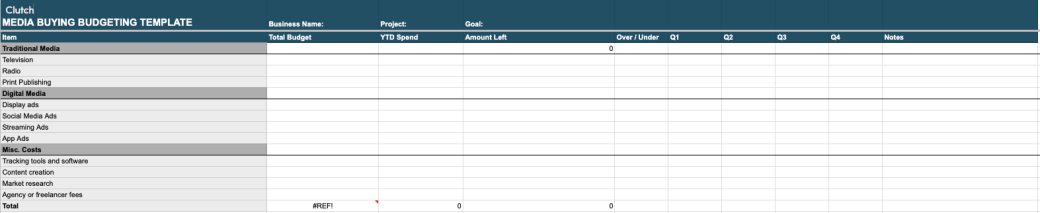
Download Clutch’s free media buying budget template.
Media buying costs aren’t straightforward. You can search the internet all you want but you won’t find a specific answer as to how much you should spend for your project.
Consider these factors carefully when budgeting for your media buying needs:
Additional reading: “Media Buying and Planning Services Pricing Guide”
Media buying is key to many marketing plans, and it shouldn’t be underestimated. Time and time again that proved itself to be one of the best ways to reach consumers. With rife competition across different industries globally, keep in mind that you don’t compete and one-up them on how big you spend on your ads.
Thoughtfully planning your budget is one of many components that make a successful project. Don’t rush it. Take your time consulting your team and experienced professionals.
Once you’ve prepared your budget, you’ll need a team to help you execute your project. Connect with the leading media buying and planning agencies on Clutch.