
How to Define Brand Values That Guide Every Business Decision
Brand values are the principles that guide company decisions, define what a brand stands for, and shape how it treats customers, employees, and partners.
Updated February 24, 2026

Your business needs something new, but should you perform a brand refresh or a full rebrand? The wrong decision could not only hurt your budget but also your reputation.
A recent Clutch survey found 98% of consumers notice brand changes, which makes executing a brand refresh vs. a complete rebrand one of the most high-stakes decisions in your brand's life cycle. And the key to making the best decision possible comes down to understanding your underlying business needs.
Keep reading to learn the strategic triggers that separate the need for a visual tune-up vs. a full identity transformation so you can choose the right move to evolve your business.
Looking for a Public Relations agency?
Compare our list of top Public Relations companies near you
A brand refresh is an update to a brand's visual execution that still keeps its overall architecture intact. These small-scale brand updates could include changes to typography, color refinements, adjusted design systems, and updated packaging.
A brand refresh strategy works when:
When it comes to deciding on a brand refresh, Mo Dhaliwal, CEO of Skyrocket Digital, advises: “Small changes are fine when your core promise is strong, and it’s just the execution that feels a bit dated.”
Think about your core value proposition, the things consumers love about your branding, and the problem you solve for your audience. If the big picture hasn't changed, a brand refresh could be all you need to realign and keep moving.
A rebrand is a fundamental transformation of a brand's identity, positioning, messaging, and visual system. As some branding experts like to put it, a brand refresh is a new shade of lipstick; rebranding is changing your name.
A rebranding campaign is typically a response to a deep strategic shift. Dhaliwal advises, “Bold rebrands make sense when there’s a fundamental business shift like opening new markets, mergers or acquisitions, directional shifts, or repositioned offerings.” He explains, “If the business model changed but your identity hasn't, you might be creating cognitive dissonance. Your audiences need visual signals that match the new reality you’re inviting them to experience.”
A rebrand is the right move when:
If your audience's perception of your brand no longer matches the reality of your business, a larger-scale rebrand might be necessary.
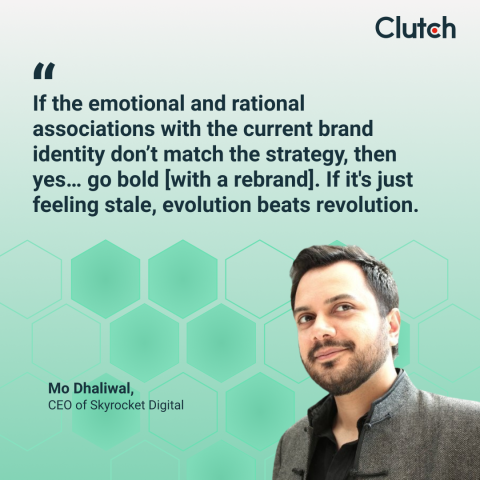
For Dhaliwal, the decision to rebrand or refresh comes down to a clear set of circumstances: “If the emotional and rational associations with the current brand identity don’t match the strategy, then yes… go bold. If it's just feeling stale, evolution beats revolution.”
Deciding on a brand refresh or rebrand (or neither) starts with asking the right questions.
Does your brand still communicate your core promise? If yes, a rebrand might be unnecessary.
Are you trying to solve a cosmetic issue or a strategic problem? Fixing a cosmetic issue warrants no more than a refresh, but a low-level strategic problem requires a bigger solution.
Are your customers confused by your current branding, or is it that you are simply bored with your brand? Making changes just to hop on trends or satisfy a passing whim is probably a bad idea — one that could risk alienating your target audience. “Maybe customers chose your brand precisely because you weren't chasing every trend,” warns Dhaliwal.
And changes for frivolous reasons without strategic backing may need to be followed by changes for more significant or practical reasons. That can lead to a quickfire succession of brand changes — and Clutch survey data found 44% of consumers say frequent updates (one or more within a year) reduce their trust in a brand.
Let's dig into three examples of rebrands and refreshes done by well-known brands within relatively recent memory to see what worked and why.
Brand Refresh (2018)
In 2018, Dunkin' Donuts rolled out a brand refresh: updating store design and producing new packaging to showcase brighter colors and modern typography.
This was a refresh because the brand personality stayed the same — still fun, fast, approachable Dunkin' Donuts. The visual updates simply gave the brand a cleaner, more current feel.
Full Rebrand (2019)
The 2019 rebrand saw Dunkin' Donuts officially change to Dunkin' — reflecting the transition from a chain of donut shops to a "beverage-led, on-the-go brand." Dunkin' fully leaned into a new identity to rival Starbucks rather than Krispy Kreme and the baked goods aisle of the supermarket.
The name-change signified a shift to a sharper emphasis on beverages and prompted an all-around shift in customer expectations, brand positioning, and the long-term business strategy.
Brand Refresh (2013)
In 2013, online accommodation rental agency Airbnb executed a simple brand refresh. The company gave itself a user interface (UI) clean-up, made some small logo refinements, and updated photography. The result was better brand consistency across digital touchpoints — but crucially, there was no change to the overall mission and target audience for the brand.
The update gave Airbnb's brand more polish, but it remained fundamentally what it had always been: a website for budget travelers seeking unique accommodations.
Full Rebrand (2014)
In 2014, Airbnb unveiled a new logo (the Bélo — an upside-down heart that resembles a paper clip and the letter A) and a new color palette to accompany a new brand narrative: Belong anywhere.
This was a full rebrand. The company's new visual identity marked a shift from being merely about renting cheap places to stay to being about home — a place to belong, a community.
Airbnb wasn't just a marketplace for budget rooms anymore; it was a global movement founded on a sense of belonging and human connection.
Brand Refresh (2013–2015)
Over two years, Instagram gave itself a bit of a facelift, introducing incremental UI clean-ups, updating icons, flattening a few interface elements, and tweaking the brand's camera logo.
This branding refresh modernized the product without changing its identity. During the refresh, Instagram remained focused on its original mission: a social media app for sharing photos with friends.
Full Rebrand (2016)
Instagram's 2016 rebrand stands out as one of the most successful brand transitions in recent times. Dubbed the "unforgettable yet forgotten" rebranding, Instagram boldly dropped its signature icon — a skeuomorphic camera mark — in favor of a flattened gradient glyph. Everybody noticed at the time, but today the old mark is hardly ever mentioned or missed.
With the logo change came a shift to a minimalist interface, showcasing a content-forward design system.
The dramatic change reflected Instagram's evolution from a simple photo app to a multi-format social media platform. Unified around a flexible, visual language, the app had room to expand to Stories, video, messaging, and business tools.
With hindsight, it's clear Instagram knew exactly when to rebrand to evolve its business model. Almost a decade since the rebrand, Insta has built a massively successful expansion of its identity on new branding that is now arguably more iconic than the original.
Not sure where to start with your brand update? A simple seven-step rebranding or brand refresh process looks something like this:
What issue is your brand really trying to solve? Is it cosmetic or strategic?
Find out what your customers are thinking about your current products, services, and branding. Is your brand identity a help or a hindrance to what you're trying to communicate to the market?
What are the elements of the brand identity that cannot change, and what has to change for the brand to evolve?
Test a refresh or rebrand in a small market first, or try out a limited-run A/B test of various iterations of your site or app.
Once you're committed to your refresh or rebrand, know exactly what you are doing, when, and why.
Changing identity for change's sake can appear arbitrary and inauthentic. Make sure to tie your changes to improvements in the product or experience, and communicate the changes so your market understands what those improvements are.
Branding isn't just a shift in visual identity and external messaging — it should be reflected in your company's internal structures and mission. If you're executing a significant brand update or rebranding, make sure you've prepared for the change internally as well as in your external messaging and communications.
When it comes to branding, change is highly noticeable and can be unsettling to your consumer base if it's unnecessary or poorly thought out. Instead of spinning your wheels on changes that don't fit your brand, aim for evolution over revolution, unless there is a compelling strategic reason to make the bold shift to a new identity.
Ultimately, the decision to implement a brand refresh vs. rebranding is a lever you pull for strategic reasons, not aesthetic.
When you're looking for branding agencies to advise you on the best steps to take for the future of your brands, refine your search and zero in on the perfect partner with Clutch.